Short answer
A public language layer for Industrial AI Readiness.
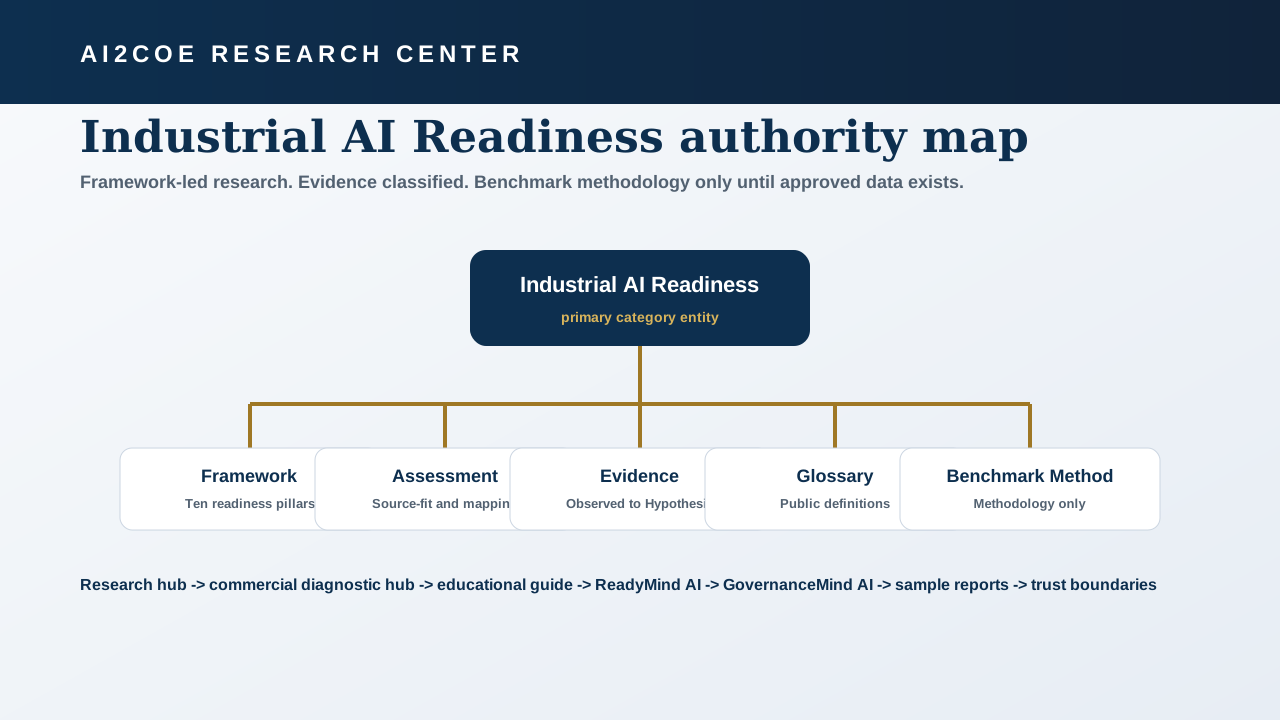
This glossary provides concise, LLM-friendly definitions for public research and buyer education. It is derived from the AI2COE Knowledge Dictionary but excludes internal governance notes, private relationship matrices, and unpublished backlog details.
Publication boundary: These are definitions and methodology terms, not measured benchmark outputs, private buyer evidence, compliance status, or financial outcome statements.
Search and answer-engine vocabulary
Keyword coverage is organized by entity intent, not repeated phrase stuffing.
These clusters help buyers, search systems, and AI assistants connect related terms to the right AI2COE asset. Each cluster preserves one owner route and one evidence-safe interpretation boundary.
Search and answer intent
Category and CoE intent
Own the category language for buyers asking what to assess before industrial AI programs, copilots, agents, or transformation spend.
Industrial AI Readiness, AI Centre of Excellence, AI readiness assessment, data readiness for AI
Search and answer intent
Agentic AI intent
Connect agentic AI searches to bounded authority, evidence grounding, denied actions, and human review instead of broad autonomy claims.
Industrial Agentic AI, Agentic AI Readiness, AI agent governance, agent authority boundary
Search and answer intent
ERP and MDM intent
Route ERP, SAP, and master-data searches toward material master readiness, source-fit review, and no-write-back diagnostics.
ERP readiness for AI, SAP S/4HANA readiness, master data quality, material taxonomy
Search and answer intent
MRO and asset intent
Help maintenance and reliability buyers connect item, asset, BOM, work-order, and spare-part terminology to readiness diagnostics.
MRO data quality, Maximo readiness, EAM readiness, bill of materials readiness
Search and answer intent
Inventory and procurement intent
Support finance, procurement, and operations searches without presenting estimated exposure or leakage signals as proven outcomes.
inventory readiness, procurement readiness, supplier master readiness, contract data readiness
Search and answer intent
Evidence and trust intent
Make trust language visible for AI assistants and buyers evaluating source-file handling, confidence tiers, and review boundaries.
evidence classification, data provenance, system of record boundary, human review
Research alignment
The vocabulary layer is aligned to public technical, governance, and data-quality sources.
GS1 Global Data Model
Ground product-attribute and product-data quality terms in public product information governance.
Glossary terms
Public-safe terms for buyers, reviewers, and AI assistants.
The terms remain fully visible to crawlers and readers. They are grouped alphabetically to reduce scanning effort while preserving definitions, buyer relevance, pillar mapping, and related research links.
A
Agent Authority Boundary
AI Governance Readiness
Definition: The defined limit of what an AI agent may read, recommend, route, or refuse without source-system write access or unreviewed operational action.
Why it matters: It helps CISO, CIO, operations, and legal reviewers understand what the agent cannot do.
Related asset: Industrial Agentic AI Readiness
Agent Passport
Governance Readiness
Definition: A governance artifact that identifies an AI agent's purpose, allowed inputs, denied actions, evidence sources, review rules, and operating limits.
Why it matters: It gives reviewers a compact way to understand the agent before pilot approval.
Related asset: Industrial Agentic AI Readiness
Agentic AI Readiness
AI Governance Readiness
Definition: The readiness of a use case, source data, policy boundary, evidence base, and owner-review workflow for safe AI agent evaluation.
Why it matters: It helps teams decide whether an agent is appropriate, restricted, or not justified for an industrial decision.
Related asset: Industrial Agentic AI Readiness
AI Agent Governance
Governance Readiness
Definition: The policies, controls, identity rules, authority limits, evaluation evidence, and review workflows used to govern AI agent behavior.
Why it matters: It prevents agentic AI from being treated as a blank permission layer over operational systems.
Related asset: Industrial Agentic AI Readiness
AI Centre of Excellence
AI Governance Readiness
Definition: An operating model that coordinates AI strategy, governance, intake, standards, reusable assets, pilots, and measurement across an organization.
Why it matters: It gives executives a way to govern AI adoption without fragmented tools, duplicated pilots, or unclear accountability.
Related asset: AI CoE Framework
AI Centre of Excellence Readiness
AI Governance Readiness
Definition: The readiness of an organization to operate an AI CoE with use-case intake, evidence review, decision rights, governance standards, and reusable delivery assets.
Why it matters: It helps leaders decide whether AI adoption can scale responsibly beyond disconnected experiments.
Related asset: AI CoE Framework
AI Governance Readiness
AI Governance Readiness
Definition: The readiness of AI-related decisions to use evidence classes, confidence tiers, human review, and source-system boundaries.
Why it matters: It keeps AI adoption accountable and explainable.
Related asset: Evidence Standards
Asset Readiness
Asset Readiness
Definition: The readiness of asset, equipment, BOM, hierarchy, and spare-part relationship data for diagnostic interpretation.
Why it matters: It helps maintenance and reliability teams connect parts decisions to physical assets.
Related asset: AssetMind AI
Asset Register
Asset Readiness
Definition: A structured list of assets, equipment, locations, identifiers, and related operating context.
Why it matters: It supports asset-to-part linkage and maintenance readiness review.
Related asset: AssetMind AI
B
Bill of Materials Readiness
Asset Readiness
Definition: The readiness of equipment or asset BOM relationships to connect physical assets with material and spare-part evidence.
Why it matters: It helps teams understand whether spares can be linked to the assets they support.
Related asset: AssetMind AI
BOM Coverage
Asset Readiness
Definition: The degree to which equipment or asset records are connected to bill-of-materials and spare-part relationships.
Why it matters: It helps teams understand whether asset data supports spare-parts decisions.
Related asset: AssetMind AI
C
CMMS Export
Operational Readiness
Definition: A data extract from maintenance systems with work orders, assets, tasks, priorities, failures, or parts usage.
Why it matters: It helps maintenance teams review operational readiness from existing records.
Related asset: ReliabilityMind AI
Confidence Tier
Governance Readiness
Definition: A review label that indicates how strongly available evidence supports a finding or interpretation.
Why it matters: It helps owners prioritize which findings are ready for review and which need more context.
Related asset: Assessment Methodology
Contract Context
Procurement Readiness
Definition: Contract identifiers, terms, supplier relationships, or buying context used to interpret procurement records.
Why it matters: It helps procurement exceptions be reviewed with commercial context.
Related asset: ProcureMind AI
Contract Data Readiness
Procurement Readiness
Definition: The readiness of contract identifiers, terms, supplier links, pricing context, and buying rules for procurement diagnostics.
Why it matters: It helps distinguish apparent exceptions from explainable buying patterns.
Related asset: ProcureMind AI
Critical Spare Readiness
Asset Readiness
Definition: The ability to identify and review spare parts that may matter for uptime, shutdown readiness, or maintenance continuity.
Why it matters: It helps reliability and maintenance leaders prioritize evidence review.
Related asset: ReliabilityMind AI
Criticality Data Readiness
Asset Readiness
Definition: The readiness of asset, part, location, and operational criticality fields for prioritizing findings.
Why it matters: It helps teams review high-impact items before treating all records as equally important.
Related asset: ReliabilityMind AI
CSV Export
Data Readiness
Definition: A flat-file export from a source system or workbook used as a diagnostic input.
Why it matters: It supports an export-first diagnostic path without ERP write-back.
Related asset: Assessment Methodology
D
Data Provenance
Governance Readiness
Definition: The origin, extraction context, transformation path, and review history behind a data point or diagnostic finding.
Why it matters: It helps reviewers determine whether a finding can be trusted, challenged, or needs more source context.
Related asset: Evidence Standards
Data Readiness
Data Readiness
Definition: The condition of operational data being complete, interpretable, traceable, and fit for diagnostic use.
Why it matters: Data readiness determines whether findings can be trusted enough for review.
Related asset: Assessment Methodology
Data Residency Review
Governance Readiness
Definition: A review of where exported data is processed, who can access it, and what jurisdictional or buyer policy constraints apply.
Why it matters: It supports trust review before uploads, pilots, procurement review, or cross-region diagnostics.
Related asset: Trust Center
Data Template
Data Readiness
Definition: A starter structure showing useful fields for a diagnostic engine or readiness assessment.
Why it matters: It helps teams prepare exports without requiring source-system integration.
Related asset: Data Templates
Denied Action
AI Governance Readiness
Definition: An action an AI system or agent is explicitly prevented from taking because it exceeds authority, data, safety, policy, or source-system boundaries.
Why it matters: It makes governance visible by documenting what the system refuses to do.
Related asset: Industrial Agentic AI Readiness
Derived Evidence
Governance Readiness
Definition: A finding or definition inferred from approved methodology, mapped fields, research structure, and industrial operating logic.
Why it matters: It supports interpretation when the reasoning path is visible.
Related asset: Evidence Standards
Diagnostic Report Pack
Operational Readiness
Definition: A package of findings, scores, evidence tables, assumptions, exclusions, and recommended review actions generated from a diagnostic.
Why it matters: It helps buyers review evidence before operational action.
Related asset: Sample Reports
E
EAM Export
Asset Readiness
Definition: A data extract from enterprise asset management records such as assets, equipment hierarchy, BOM, work orders, or parts.
Why it matters: It supports asset and maintenance readiness diagnostics.
Related asset: Maximo Item Master Cleansing
EAM Readiness
Asset Readiness
Definition: The readiness of enterprise asset management records to support asset, work-order, inventory, reliability, and governance diagnostics.
Why it matters: It connects asset data quality to maintenance, reliability, and AI-readiness decisions.
Related asset: AssetMind AI
Entity Resolution
Data Readiness
Definition: The process of determining whether records, names, identifiers, parts, suppliers, assets, or locations refer to the same or related entity.
Why it matters: It supports duplicate review, supplier normalization, asset linkage, and knowledge-graph quality.
Related asset: Research/Industrial Ai Readiness/Glossary
ERP Export
ERP Readiness
Definition: A data extract from ERP records such as material master, inventory, procurement, plant, or finance context.
Why it matters: It lets ERP teams review readiness without changing the ERP system.
Related asset: ERP Data Quality for AI
ERP Readiness
ERP Readiness
Definition: The ability of ERP records and exports to support diagnostics, migration planning, cleanup, reporting, or AI use without uncontrolled source-system change.
Why it matters: ERP readiness reduces transformation risk before migration or automation decisions.
Related asset: Diagnostic Hub
Estimated Evidence
Governance Readiness
Definition: An assumption-based score, exposure band, planning range, or directional signal that requires clear assumption boundaries.
Why it matters: It helps planning while preventing estimates from being treated as measured facts.
Related asset: Evidence Standards
Evidence Classification
Governance Readiness
Definition: The method of labelling evidence as Observed, Derived, Estimated, or Hypothesis.
Why it matters: It prevents assumptions, methodology, and direct evidence from being treated as the same proof level.
Related asset: Evidence Standards
F
Field Mapping
Data Readiness
Definition: The process of matching uploaded columns to diagnostic concepts such as material ID, supplier, stock value, work order, plant, or asset.
Why it matters: It turns source exports into usable diagnostic inputs.
Related asset: Assessment Methodology
G
Governance Readiness
Governance Readiness
Definition: The readiness of review ownership, evidence boundaries, audit metadata, and decision controls for governed action.
Why it matters: It helps buyers act on findings without uncontrolled remediation.
Related asset: GovernanceMind AI
Grounded AI Answer
Governance Readiness
Definition: An AI-supported answer that is traceable to approved source material, evidence, assumptions, and limitations.
Why it matters: It helps users distinguish supported guidance from unsupported generation.
Related asset: Evidence Standards
H
Historian Tag Readiness
Data Readiness
Definition: The readiness of historian tags, asset mapping, units, timestamps, and context for time-series interpretation.
Why it matters: It helps industrial teams prepare for analytics without assuming live historian integration.
Related asset: AssetMind AI
Human Review
Governance Readiness
Definition: The requirement that accountable owners review findings before action, remediation, or source-system change.
Why it matters: It keeps diagnostic outputs governed and buyer-controlled.
Related asset: Evidence Standards
Hypothesis Evidence
Governance Readiness
Definition: A candidate finding, future benchmark idea, proposed threshold, or research direction requiring validation before decision use.
Why it matters: It keeps future ideas separate from approved diagnostic evidence.
Related asset: Evidence Standards
I
IBM Maximo Readiness
Asset Readiness
Definition: The readiness of Maximo item, asset, storeroom, work-order, BOM, and maintenance records for diagnostic interpretation.
Why it matters: It helps asset and maintenance teams evaluate EAM data before analytics or AI decisions.
Related asset: Maximo Item Master Cleansing
Industrial Agentic AI
AI Governance Readiness
Definition: A bounded form of AI agent use for industrial decisions where the agent can reason over approved evidence, but cannot act beyond defined authority limits.
Why it matters: It helps buyers evaluate agentic AI without assuming autonomous plant, ERP, EAM, CMMS, or procurement control.
Related asset: Industrial Agentic AI Readiness
Industrial AI Centre of Excellence Operating Model
AI Governance Readiness
Definition: A CoE operating model adapted to asset-intensive environments where AI decisions depend on operational data, source-system boundaries, evidence, and accountable review.
Why it matters: It connects AI governance to plants, assets, materials, procurement, maintenance, reliability, and field operations.
Related asset: AI CoE Framework
Industrial AI Readiness
Industrial AI Readiness
Definition: The ability to support industrial AI decisions with usable operational data, governed source boundaries, evidence classes, confidence tiers, and human review.
Why it matters: It helps leaders decide whether AI work has enough operational evidence before implementation.
Related asset: Framework
Industrial Decision Intelligence
Governance Readiness
Definition: A diagnostic category focused on turning operational data into evidence-backed findings, scores, reports, and owner-reviewed actions.
Why it matters: It frames Industrial IQ as evidence before transformation, not autonomous remediation.
Related asset: Diagnostic Hub
Industrial IQ
Operational Readiness
Definition: AI2COE's Industrial Decision Intelligence platform for read-only diagnostics, evidence-backed findings, report packs, and governed action tracking.
Why it matters: It gives buyers a controlled diagnostic path before ERP, MRO, inventory, procurement, or AI changes.
Related asset: Diagnostic Hub
Inventory Capital Exposure
Inventory Readiness
Definition: A diagnostic interpretation of inventory value and carrying assumptions that may require finance review.
Why it matters: It helps CFOs review capital tied to MRO inventory without treating estimates as outcomes.
Related asset: FinanceMind AI
Inventory Export
Inventory Readiness
Definition: A data extract containing stock quantity, stock value, storage location, movement, criticality, and replenishment context.
Why it matters: It supports inventory readiness and exposure review.
Related asset: InventoryMind AI
Inventory Readiness
Inventory Readiness
Definition: The readiness of inventory records to support review of stock levels, movement history, criticality, excess, obsolescence, and false-stockout signals.
Why it matters: It helps operations and finance inspect inventory risk before action.
Related asset: InventoryMind AI
Inventory Trust
Inventory Readiness
Definition: The level of confidence that inventory records can support decisions after source-fit, context, and owner review.
Why it matters: It prevents inventory data from being treated as reliable without evidence.
Related asset: Inventory Intelligence
Item Description Quality
Material Master Readiness
Definition: The usefulness and consistency of item descriptions for search, duplicate review, classification, and diagnostic interpretation.
Why it matters: It affects catalog cleansing, procurement review, and material master readiness.
Related asset: PartsCleanse AI
K
Knowledge Graph Readiness
Data Readiness
Definition: The readiness of entities and relationships such as assets, materials, suppliers, work orders, plants, policies, and owners to be linked consistently.
Why it matters: It improves AI interpretation by making operational relationships explicit rather than page-based.
Related asset: Research/Industrial Ai Readiness/Glossary
L
Lead-Time Context
Inventory Readiness
Definition: Replenishment or supplier timing information used to interpret stock, procurement, and critical-spare readiness.
Why it matters: It helps distinguish normal replenishment risk from urgent operational exposure.
Related asset: InventoryMind AI
M
Maintenance Readiness
Operational Readiness
Definition: The readiness of work-order, spare-parts, asset, priority, and maintenance-history data for operational review.
Why it matters: It supports maintenance decisions before readiness gaps affect work execution.
Related asset: ReliabilityMind AI
Maintenance Strategy Readiness
Operational Readiness
Definition: The readiness of maintenance plans, priorities, criticality, work history, spares, and owner review for AI-supported maintenance decisions.
Why it matters: It helps reliability teams separate practical readiness from aspirational analytics goals.
Related asset: ReliabilityMind AI
Manufacturer Ambiguity
Material Master Readiness
Definition: Unclear, inconsistent, or missing manufacturer and manufacturer-part information in item or material records.
Why it matters: It can reduce duplicate-detection confidence and catalog searchability.
Related asset: PartsCleanse AI
Master Data Governance Readiness
Governance Readiness
Definition: The readiness of ownership, standards, workflows, approval rules, and lifecycle controls for critical master data.
Why it matters: It helps leaders assess whether master data can support AI and transformation decisions responsibly.
Related asset: Evidence Standards
Master Data Quality
Material Master Readiness
Definition: The condition of core business records being complete, consistent, identifiable, governed, and useful for operational interpretation.
Why it matters: It is a foundation for material, supplier, asset, inventory, procurement, and AI readiness.
Related asset: PartsCleanse AI
Material Lifecycle
Material Master Readiness
Definition: The sequence of states a material or item record passes through from creation and use to review, replacement, obsolescence, or retirement.
Why it matters: It helps teams avoid treating inactive, superseded, or obsolete records as normal current inventory evidence.
Related asset: PartsCleanse AI
Material Master Readiness
Material Master Readiness
Definition: The condition of material or item master records being usable for search, mapping, duplicate review, procurement interpretation, and readiness assessment.
Why it matters: It supports cleaner decisions before master-data remediation or ERP migration.
Related asset: Framework
Material Taxonomy
Material Master Readiness
Definition: A controlled classification structure for grouping materials, items, and spare parts by meaningful categories and attributes.
Why it matters: It improves search, duplicate review, procurement interpretation, inventory planning, and material master governance.
Related asset: PartsCleanse AI
MRO Data Quality
MRO Readiness
Definition: The condition of MRO records being descriptive, consistent, traceable, and useful for catalog, inventory, procurement, and maintenance review.
Why it matters: MRO data quality is a readiness signal for AI, ERP, and operational decisions.
Related asset: MRO Data Quality
MRO Readiness
MRO Readiness
Definition: The readiness of maintenance, repair, and operations data across catalogs, inventory, procurement, assets, and work-order context.
Why it matters: It shows whether spare-parts decisions can be supported by evidence.
Related asset: MRO Catalog Intelligence
N
No ERP Write-Back
Governance Readiness
Definition: A trust boundary where diagnostics use exported data and do not write changes back to ERP, EAM, CMMS, or source systems.
Why it matters: It lowers operational risk and keeps remediation buyer-controlled.
Related asset: No ERP Write-Back
O
Observed Evidence
Governance Readiness
Definition: Evidence directly traceable to a verified source row, field, route, approved diagnostic output, or approved internal artifact.
Why it matters: It is the strongest evidence class for review because the source can be traced.
Related asset: Evidence Standards
Ontology Readiness
Data Readiness
Definition: The readiness of definitions, entity classes, attributes, and relationships to support consistent interpretation across people, systems, and AI assistants.
Why it matters: It reduces conflicting terminology across research, product pages, reports, and LLM answers.
Related asset: Research/Industrial Ai Readiness/Glossary
Operational Data Readiness
Operational Readiness
Definition: The readiness of plant, asset, maintenance, procurement, inventory, and source-system data for operational decision support.
Why it matters: It connects data quality to operating decisions rather than abstract data maturity.
Related asset: Assessment Methodology
P
Plant Context
Operational Readiness
Definition: Plant-level identifiers and operating context that explain where inventory, materials, assets, and purchases apply.
Why it matters: It prevents multi-site records from being interpreted without local operating context.
Related asset: Assessment Methodology
Procurement Export
Procurement Readiness
Definition: A data extract containing purchase orders, suppliers, contracts, prices, lead times, or emergency-buy indicators.
Why it matters: It supports procurement readiness and leakage review.
Related asset: ProcureMind AI
Procurement Leakage
Procurement Readiness
Definition: A diagnostic concept for potential value leakage caused by supplier fragmentation, repeated buys, emergency purchases, or inconsistent purchasing context.
Why it matters: It helps procurement leaders focus review on evidence-backed exceptions.
Related asset: ProcureMind AI
Procurement Readiness
Procurement Readiness
Definition: The readiness of procurement, supplier, contract, and purchase records for leakage, variance, emergency-buy, and governance review.
Why it matters: It helps CPOs evaluate whether procurement data supports defensible action.
Related asset: ProcureMind AI
Product Data Attribute Readiness
Material Master Readiness
Definition: The readiness of item attributes, identifiers, classes, manufacturer details, descriptions, and units of measure for search, comparison, and review.
Why it matters: It helps catalog and ERP teams assess whether material records can support governed AI use.
Related asset: PartsCleanse AI
R
Retrieval-Augmented Generation Readiness
Data Readiness
Definition: The readiness of documents, records, metadata, access rules, and source quality to support grounded AI answers from approved content.
Why it matters: It helps teams avoid ungrounded answers when using AI assistants, copilots, or agents.
Related asset: Framework
S
SAP Material Master
Material Master Readiness
Definition: The SAP record structure used to identify, describe, classify, and manage materials across plants and business processes.
Why it matters: It is often the source of MRO, inventory, procurement, and readiness evidence.
Related asset: SAP Material Master Cleanup
SAP Readiness
ERP Readiness
Definition: The readiness of SAP-related exports, material records, plant context, and governance fields for diagnostic interpretation.
Why it matters: It helps SAP teams review data quality before migration, cleanup, or AI initiatives.
Related asset: SAP Material Master Cleanup
SAP S/4HANA Readiness
ERP Readiness
Definition: The readiness of SAP material, plant, inventory, procurement, valuation, and migration-relevant data for S/4HANA planning or AI diagnostics.
Why it matters: It helps SAP teams identify readiness gaps before migration, cleanup, or AI programs.
Related asset: ERP Data Quality for AI
SCADA Boundary
Governance Readiness
Definition: A governance boundary separating diagnostic readiness and evidence review from live supervisory control or closed-loop action.
Why it matters: It clarifies that AI2COE readiness language does not imply operational control-system intervention.
Related asset: GovernanceMind AI
Sensor Data Quality
Data Readiness
Definition: The condition of sensor or condition-monitoring data being complete, contextualized, timestamped, and usable for governed interpretation.
Why it matters: It helps teams separate export-based readiness from live monitoring or control claims.
Related asset: AssetMind AI
Site Context
Operational Readiness
Definition: Site or location context that explains where assets, stores, work orders, procurement, and inventory records belong.
Why it matters: It supports source-fit and owner review for distributed operations.
Related asset: Assessment Methodology
Source Context
Data Readiness
Definition: The metadata, ownership, system origin, field meaning, plant, site, contract, and timing context needed to interpret exported records.
Why it matters: It improves diagnostic interpretation while preserving evidence boundaries.
Related asset: Evidence Standards
Source Fit
Data Readiness
Definition: A measure of whether an exported source contains the fields, identifiers, context, and quality needed for diagnostic interpretation.
Why it matters: It helps teams understand whether the upload can support confident findings.
Related asset: Assessment Methodology
Source-File Purge
Governance Readiness
Definition: The handling principle that uploaded source files are processed to generate a diagnostic report pack and then purged.
Why it matters: It clarifies upload lifecycle while preserving governance metadata boundaries.
Related asset: Data Retention
Source-Fit Review
Data Readiness
Definition: A review step that checks exported data against required fields, optional context, identifiers, and diagnostic use.
Why it matters: It reduces the risk of interpreting weak inputs too strongly.
Related asset: Assessment Methodology
Spend Data Readiness
Procurement Readiness
Definition: The readiness of purchase, supplier, price, quantity, contract, material, and timing records for spend interpretation.
Why it matters: It supports procurement analysis while keeping leakage language evidence-classified.
Related asset: ProcureMind AI
Supplier Master Readiness
Procurement Readiness
Definition: The readiness of supplier records, aliases, identifiers, contracts, and procurement context for review.
Why it matters: It helps procurement teams evaluate whether supplier data can support leakage, consolidation, or policy review.
Related asset: ProcureMind AI
System of Record Boundary
Governance Readiness
Definition: The boundary between a diagnostic interpretation and the authoritative ERP, EAM, CMMS, finance, procurement, or asset system of record.
Why it matters: It preserves operational control by making clear that diagnostics do not rewrite source truth.
Related asset: No ERP Write-Back
U
Unit of Measure Inconsistency
Material Master Readiness
Definition: A mismatch or inconsistency in units of measure across items, plants, suppliers, or purchasing records.
Why it matters: It can affect duplicate review, procurement interpretation, and inventory analysis.
Related asset: PartsCleanse AI
W
Work Order Data Readiness
Operational Readiness
Definition: The readiness of work-order records such as asset, task, date, priority, part usage, failure context, and owner fields for review.
Why it matters: It supports maintenance and reliability diagnostics without claiming predictive accuracy from incomplete records.
Related asset: ReliabilityMind AI
FAQ
Glossary boundaries.
Is this the full AI2COE Knowledge Dictionary?
No. This public glossary uses concise definitions derived from the Knowledge Dictionary, but it does not expose internal governance notes, relationship matrices, or future backlog details.
How should buyers use the glossary?
Use it to understand Industrial AI Readiness terms before reviewing the framework, assessment methodology, evidence standards, or diagnostic hub.
Are glossary definitions measured benchmark outputs?
No. They are public-safe definitions and methodology explanations. Benchmark reporting requires approved evidence thresholds and review.
Why do exported-data terms matter?
Industrial IQ diagnostics start from exported operational data, so buyers need clear language for CSV, ERP, EAM, CMMS, procurement, inventory, and source-context inputs.
Does the glossary imply source-system integration?
No. Data export terms describe source inputs for diagnostics. They do not imply ERP write-back or live system integration.