Works from CSV or workbook exports produced from SAP, IBM Maximo, Oracle ERP, Hexagon EAM, Infor, and other ERP, EAM, or CMMS systems. No direct integration or write-back is required — Review data requirements →
Research

Industrial IQ research and methodology library.

AI2COE separates methodology, assumptions, evidence standards, and uploaded-data diagnostics so Industrial AI Readiness research stays useful without overstating benchmark or outcome claims.

27Research pages
Evidence classesObserved / Derived / Estimated / Hypothesis
Governed pathMethodology -> diagnostic -> owner review
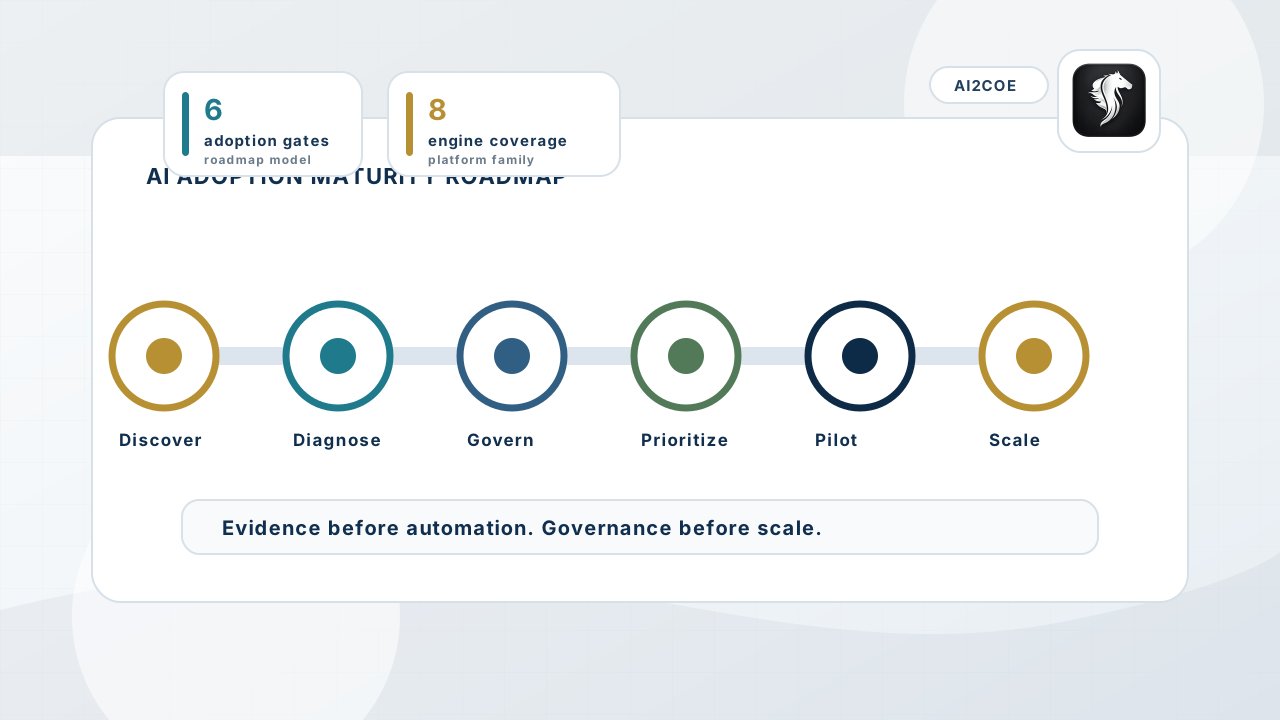
AI adoption maturity roadmap showing discovery, diagnostics, governance, pilot prioritization, and enterprise scaling stages.
Research pages separate benchmark assumptions from uploaded-data diagnostics and owner-reviewed action.
Research question

Question, method, evidence class, and limitation

TopicAI2COE Research & MethodologyDecisionEnterprise buyer education and diagnostic decision supportCoverageGlobal industrial markets

AI2COE Research & Methodology: AI2COE research frames the operating hypothesis, assumption boundary, and diagnostic path needed before transformation spend. AI2COE research and methodology library for Industrial AI Readiness, evidence standards, diagnostic assumptions, readiness frameworks, and governed benchmarks.

Run Free Industrial IQ Snapshot
Best-fit readerExecutives and analysts sizing an operating hypothesis before replacing benchmark assumptions with uploaded-data evidence.
Method inputsBenchmark assumptions until replaced by uploaded customer data from an Industrial IQ diagnostic.
Evidence classA research interpretation that separates benchmark logic, assumptions, limitations, and the recommended diagnostic path.
LimitationUse the benchmark as a hypothesis, then replace it with uploaded-data evidence.
Evidence methodology

Research Evidence Discipline

AI2COE research separates observed evidence, derived findings, planning estimates, and hypotheses. Every research asset documents its methodology, assumptions, limitations, evidence requirements, and path to customer-specific diagnostic validation.

Evidence classesObserved, derived, estimated, and hypothesis evidence are separated before interpretation.
MethodologyResearch assets document the research question, assumptions, limitations, inclusion criteria, and source requirements.
Diagnostic validationUploaded-data diagnostics replace planning assumptions with source-backed evidence, confidence tiers, and owner review.
Public boundaryResearch pages publish methodology, evidence requirements, assumptions, limitations, source registers, and review status.
Review artifactsPublic research assets include source registers, review dates, evidence requirements, and limitations where applicable.
Research discipline

Research is useful only when evidence boundaries are visible.

Each page separates methodology, assumptions, calculation logic, measured evidence where available, exclusions, and the path from public research to customer-specific diagnostic result.

AssumptionPublic planning range
DiagnosticUploaded-data evidence
DecisionOwner-reviewed action
Research authority map

Move from definition to method, evidence, and decision guidance.

Research assets use one controlled vocabulary and keep methodology, assessment, evidence standards, and future benchmark governance distinct.

Open Research Center
Buyer answer paths

Research questions built for executive and owner review.

Each question has a direct answer, a source boundary, and a route to deeper methodology so buyers can inspect evidence before treating a finding as proof.

Readiness

What makes industrial data ready for AI?

Industrial data is AI-ready when source records, field meaning, lineage, ownership, source fit, operational context, confidence tier, and review owner are visible enough to support a bounded decision. Completeness alone is not enough for AI adoption.

Evidence

What evidence should executives ask for before industrial AI investment?

Executives should ask for source records, assumptions, exclusions, confidence tier, owner review, limitation notes, and the action boundary. Public methodology, sample reports, and planning models should not be confused with uploaded-data diagnostic findings.

LLM / RAG

What should be checked before RAG, copilots, or LLM search use operational data?

Check entity definitions, source permissions, field lineage, data recency, retrieval scope, redaction rules, citation requirements, and human-review ownership. Industrial AI assistants need governed context, not just documents connected to a chat interface.

Agentic AI

When is an industrial workflow ready for Agentic AI?

Agency is justified only when the decision goal, source data, tool authority, system boundary, escalation path, evidence trail, and human approval rule are explicit. AI2COE treats Agentic AI as a governed readiness question, not a shortcut to autonomous operations.

Material master

Why does material master readiness matter before SAP, Maximo, or AI programs?

Material master quality affects catalog search, duplicate families, inventory trust, procurement visibility, maintenance planning, and ERP migration readiness. AI2COE keeps duplicate candidates, weak descriptions, UOM issues, and manufacturer ambiguity as reviewable signals until owners confirm action.

Industry vocabulary

How should AI topics differ across the 18 AI2COE industries?

Industry AI content should begin with operating context: assets, source systems, regulated constraints, uptime exposure, procurement patterns, and review owners. The same AI term means different work in oil and gas, mining, utilities, pharma, ports, data centers, fleets, and healthcare systems.
Research library

Research and methodology pages built for enterprise buyer decisions.

Research Center

Industrial AI Readiness Research Center

Frameworks, assessment methodology, evidence standards, glossary assets, and future benchmark methodology for Industrial AI Readiness.

Planning model

AI Readiness Planning Model

Methodology-only planning context. Research model for evaluating whether industrial operational data is ready for governed AI diagnostics before transformation funding or platform selection.

Planning model

Asset Criticality Assessment Planning Model

Methodology-only planning context. A research framework for assessing asset criticality classification maturity — evaluating consequence-of-failure coverage, criticality score methodology, spare-parts linkage, and maintenance strategy alignment across industrial asset populations in oil and gas, mining, utilities, and manufacturing.

Planning model

Asset Performance Management Planning Model

Methodology-only planning context. A research framework for assessing APM maturity, asset health data quality, maintenance strategy effectiveness, and reliability program readiness across asset-intensive industrial operations.

Planning model

Asset-to-Part Readiness Planning Model

Methodology-only planning context. Research model for evaluating whether spare parts can be linked to active assets, critical equipment, BOM context, and maintenance needs before running AssetMind AI.

Planning model

Duplicate SKU Planning Model

Methodology-only planning context. AI2COE research on duplicate SKU exposure, confidence-tier interpretation, and the difference between methodology assumptions and uploaded-data evidence.

Planning model

ERP Data Quality Planning Model

Methodology-only planning context. Research model for assessing whether SAP, IBM Maximo, Oracle, Infor, Hexagon EAM, CMMS, and related exports are usable for Industrial IQ diagnostics.

Planning model

Enterprise Asset Management Data Quality Planning Model

Methodology-only planning context. A research framework for assessing EAM data quality across equipment master, asset hierarchy, spare-parts catalog, maintenance plans, and work-order history — as a prerequisite for EAM transformation, SAP migration, and APM deployment.

Research asset

False Stockout Cost Model

Research model for estimating the cost of false stockouts caused by duplicate spare-parts records and poor item-master searchability.

Planning model

Governance Readiness Planning Model

Methodology-only planning context. Research model for evaluating whether industrial diagnostic findings can be reviewed, approved, audited, and acted on safely without ERP write-back.

Planning model

Industrial AI Governance Readiness Planning Model

Methodology-only planning context. A research framework for assessing industrial AI governance readiness — evaluating AI output confidence tiering, human review workflow maturity, data lineage documentation, audit trail architecture, and board-level AI risk reporting capability across industrial AI programs in maintenance, procurement, and asset management.

Planning model

Industrial Decision Intelligence Readiness Planning Model

Methodology-only planning context. A research framework for assessing organizational readiness to deploy Industrial Decision Intelligence — evaluating operational data quality, AI governance maturity, evidence architecture, and executive reporting capability across ERP, EAM, CMMS, and procurement systems.

Research asset

Industrial IQ Index

AI2COE Industrial IQ Index measures catalog intelligence, inventory risk, procurement leakage, working capital exposure, asset readiness, maintenance readiness, AI readiness, and governance readiness.

Research asset

Industrial MRO Catalog Health Index

A research model for assessing MRO catalog health across duplicate exposure, data completeness, confidence tiers, value at risk, and governance readiness.

Planning model

Industry Methodology Register

Methodology-only planning context. Research overview for interpreting Industrial IQ diagnostics by industry, buyer role, required data, engine pack, value lever, and recurring value use case.

Planning model

Inventory Risk Planning Model

Methodology-only planning context. Research model for evaluating inventory health before running InventoryMind AI against on-hand, movement, criticality, site, and value exports.

Planning model

MRO Catalog Health Planning Model

Methodology-only planning context. Analyst-style methodology for evaluating MRO catalog health before running PartsCleanse AI against material master, item master, supplier, valuation, and inventory exports.

Planning model

Material Master Governance Planning Model

Methodology-only planning context. Research model for assessing material master governance readiness through duplicate exposure, owner review, data completeness, and remediation controls.

Research asset

OEE Impact of MRO Catalog Disorder

Research model connecting duplicate MRO records, false stockouts, emergency buys, maintenance delay, and OEE recovery potential.

Planning model

Operational Intelligence Maturity Planning Model

Methodology-only planning context. A research framework for assessing operational intelligence maturity across industrial enterprises — evaluating data integration, analytics capability, evidence quality, governance maturity, and executive decision support across maintenance, procurement, inventory, and asset performance domains.

Planning model

Predictive Maintenance Data Readiness Planning Model

Methodology-only planning context. A research framework for assessing whether CMMS, EAM, and MRO catalog data is ready to support predictive maintenance analytics, failure prediction models, and reliability program deployment in industrial operations.

Planning model

Procurement Leakage Planning Model

Methodology-only planning context. Research model for evaluating procurement leakage signals before running a ProcureMind AI diagnostic against purchase, supplier, material, and inventory exports.

Planning model

Reliability Engineering Planning Model

Methodology-only planning context. A research framework for assessing reliability program maturity, MTBF performance, maintenance strategy effectiveness, and reliability KPI achievement across industrial operations.

Planning model

Reliability Readiness Planning Model

Methodology-only planning context. Research model for evaluating maintenance readiness before running ReliabilityMind AI against work-order, inventory, asset, priority, and spare availability exports.

Planning model

SAP Migration Data Quality Planning Model

Methodology-only planning context. Research model for identifying MRO material master issues before S/4HANA migration, SAP MDG scope, or data conversion work begins.

Research asset

SAP S/4HANA Data Readiness

Research framework for assessing SAP S/4HANA data readiness across MRO material masters, spare-parts catalogs, inventory, asset, procurement, and governance evidence before migration pressure begins.

Planning model

Working Capital Exposure Planning Model

Methodology-only planning context. Analyst-style methodology for estimating working-capital exposure from duplicate inventory, excess stock, carrying cost, and procurement leakage before a FinanceMind AI diagnostic.

Research asset

Working Capital Exposure from Duplicate Inventory

Research model explaining how duplicate inventory records create capital exposure, carrying-cost leakage, and recoverable working-capital opportunities.

Decision framework

What this page helps leaders decide.

Definition

AI2COE research is the public benchmark and methodology layer for Industrial IQ: it frames operating hypotheses before uploaded-data diagnostics replace assumptions.

Commercial relevance

Research helps leaders decide whether an issue is worth diagnostic investigation before committing transformation, cleanup, inventory, or AI budget.

Operational symptoms

Buyers need defensible planning context for data readiness, inventory risk, procurement leakage, working-capital exposure, AI readiness, and governance readiness.

Required input files

Benchmark assumptions, public methodology, sample report logic, source-data requirements, and diagnostic-path references.

Diagnostic method

Research pages state what is measured, what is assumed, what is not claimed, and how uploaded-data evidence changes the interpretation.

Evidence model

Research evidence is planning context until replaced by mapped source records, evidence rows, confidence tiers, and reviewed diagnostic outputs.

Buyer-role interpretation

CFOs use research to size questions, COOs use it to assess readiness, CIOs use it to evaluate data risk, and boards use it to demand evidence discipline.

Traditional approach vs Industrial IQ

Generic thought leadership often stops at ideas. Industrial IQ research routes the reader toward a measurable diagnostic path.

Trust boundary

Research should never present benchmark values as promised customer savings or customer-specific results.

Recommended next step

Run an Industrial IQ Snapshot when the buyer needs routing clarity, view sample reports when the buyer needs proof format, request a diagnostic discussion when scope and data availability are known, or explore pricing when the buying path is ready for commercial review.

Related Industrial IQ pages

Industrial IQ platform · Industrial IQ Snapshot · Sample reports · Documentation · Trust Center

Executive review lens

Use this page to decide the next evidence step.

Industrial IQ pages are designed to move enterprise buyers from operating pain to source-backed diagnostic evidence, not to force an immediate platform commitment.

Audience

Finance, operations, procurement, maintenance, reliability, ERP/data, security, and executive sponsors.

Evidence to prepare

Relevant ERP, EAM, CMMS, inventory, procurement, asset, work-order, or readiness exports where available.

Output

A diagnostic route, sample proof format, report evidence, confidence tier, owner review path, or commercial next step.

Trust boundary

Read-only diagnostics, no ERP write-back, source-file purge after report generation, and human review before action.

Research-to-production alignment

Current external reference points used as context, not overclaiming.

AI2COE keeps Industrial AI Readiness language tied to public enterprise reference systems while preserving clear claim boundaries: no unsupported published benchmark outputs, no return promises, no customer-proof language, and no compliance-status claim without evidence.