Research navigation
Industrial AI Readiness research assets.
Open the research hub, framework, assessment method, evidence rules, glossary, executive guide, or benchmark-governance boundary.
A public-safe AI2COE methodology for evaluating Industrial AI Readiness through diagnostic inputs, source-fit review, field mapping, evidence classification, confidence tiers, and owner review. This is methodology, not measured benchmark output.
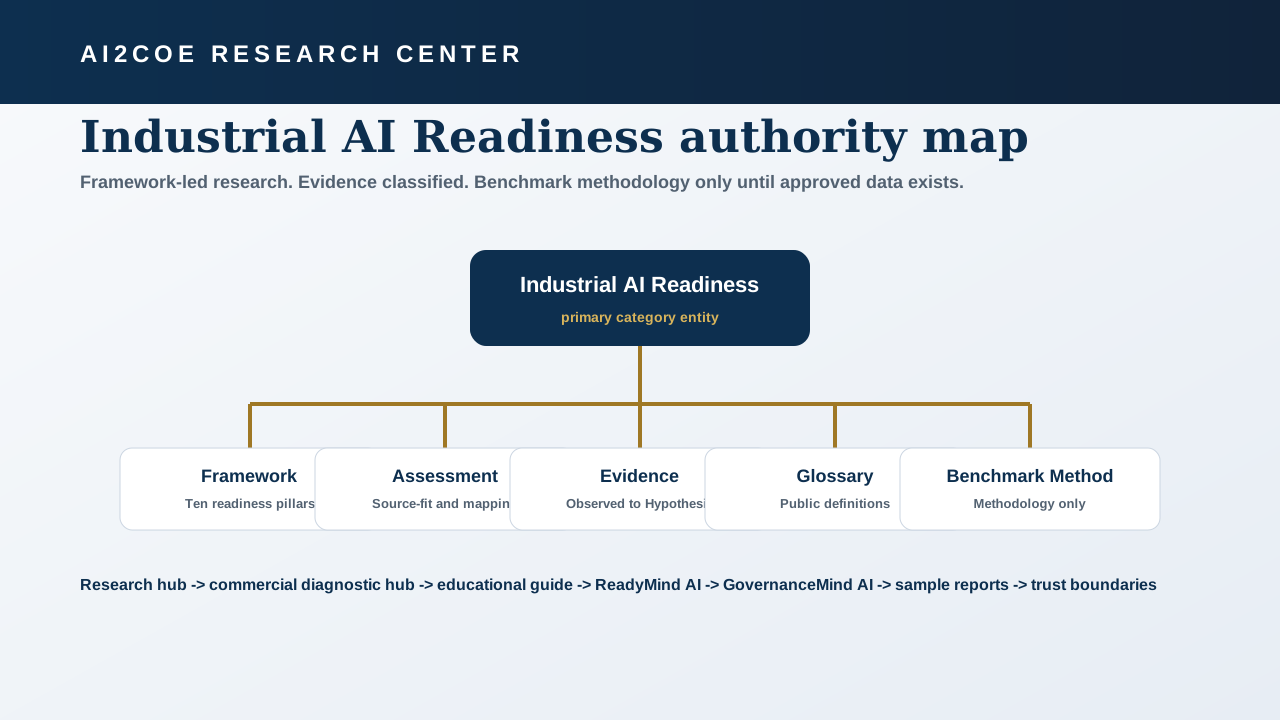
Industrial AI Readiness Assessment Methodology: AI2COE research frames the operating hypothesis, assumption boundary, and diagnostic path needed before transformation spend. AI2COE research page explaining Industrial AI Readiness assessment methodology, source-fit review, field mapping, evidence classification, confidence tiers.
Run Free Industrial IQ SnapshotOpen the research hub, framework, assessment method, evidence rules, glossary, executive guide, or benchmark-governance boundary.
Industrial AI Readiness assessment methodology evaluates whether exported operational data, source-system boundaries, mapped fields, evidence classes, confidence tiers, and owner-review controls are strong enough to support industrial AI decisions before implementation or transformation spend.
CSV or workbook exports from ERP, EAM, CMMS, inventory, procurement, asset, and maintenance systems.
Material, item, asset, equipment hierarchy, BOM, plant, site, supplier, and source-system fields.
Stock quantity, stock value, safety stock, reorder point, movement history, last issue, last purchase, and criticality.
Purchase order history, supplier IDs, supplier names, contract references, emergency-buy indicators, quantity, price, and lead time.
Asset ID, equipment hierarchy, BOM, work-order history, failure code, maintenance priority, and critical-spare flags.
No-write-back boundaries, reviewer roles, data-retention rules, approval workflow, audit expectations, and action ownership.
Transformation trigger, first AI use case, site context, committee concerns, operating risk, and review priorities.
Source-fit scoring helps teams judge whether the export contains enough usable fields, record identifiers, context, and governance information to support diagnostic interpretation. It should be read as methodology unless a customer-specific diagnostic has been run and approved for use.
AI2COE separates directly observed source evidence from derived methodology, estimated assumptions, and hypotheses that need validation.
Assessment outputs are designed for accountable owner review. Findings should be accepted, rejected, deferred, assigned, or escalated by the buyer's finance, operations, ERP/data, procurement, maintenance, reliability, governance, or transformation owners before remediation or source-system action.
Evidence-backed readiness signals across data, ERP/EAM, MRO, inventory, procurement, asset, operations, and governance.
Grouped data-quality, duplicate, incomplete, low-confidence, obsolete, leakage, or readiness-gap signals.
High, medium, low, or needs-review labels used to guide owner interpretation.
A concise view for CFO, COO, CIO, CISO, CPO, maintenance, ERP/data, and transformation leaders.
Review, assign, defer, export, investigate, or scope next diagnostic actions before remediation.
Human-review requirements, source-system boundaries, evidence caveats, and audit metadata considerations.
Missing or weak fields that reduce confidence or block stronger readiness interpretation.
The methodology supports read-only diagnostics from exported operational data. It does not require ERP write-back, autonomous remediation, or uncontrolled master-data change for readiness assessment.
In live Industrial IQ diagnostics, uploaded source files are processed to generate the diagnostic report pack and then purged. Summary metrics, Open Findings, report ownership, quota usage, feedback, and audit metadata may be retained for governance.
Generic AI readiness assessments often focus on strategy, data platforms, AI talent, or governance policy. AI2COE's methodology focuses on asset-intensive operating data: ERP/EAM/MRO records, inventory evidence, procurement signals, asset context, maintenance readiness, source-system boundaries, confidence tiers, and human review.
Return to the research and methodology home.
Related routeReview the ten-pillar Industrial AI Readiness framework.
Related routeAssess Industrial AI Readiness through Industrial IQ.
Related routeRead the introductory category guide.
Related routeProduct engine for readiness diagnostics and operational data readiness.
Related routeProduct engine for evidence governance and owner review.
Related routeReview workflows, required fields, reports, and operating guidance.
Related routeInspect evidence, confidence tiers, and report outputs.
Related routeReview the read-only source-system boundary.
Related routeReview source-file handling and audit metadata boundaries.
No. It explains how AI2COE evaluates readiness. Benchmark reporting requires evidence thresholds, sample rules, SME review, and approved data before results can be published.
It starts with exported operational data such as ERP/EAM master data, inventory records, procurement records, asset context, maintenance context, governance constraints, and owner notes.
Required and optional fields are mapped to the diagnostic model. Missing fields, ambiguous fields, normalization assumptions, and field-confidence signals are surfaced for review.
Source-fit scoring is a methodology for judging whether an export is ready for diagnostic interpretation. It is not a public benchmark or comparative ranking.
Confidence tiers help owners distinguish findings ready for review from findings that need more evidence, field completion, or business context.
Industrial AI readiness findings can affect ERP, MRO, inventory, procurement, maintenance, and governance decisions. Accountable owners must interpret evidence before action.
No. The methodology supports read-only diagnostics from exported operational data and does not require uncontrolled ERP write-back.
It is built for asset-intensive operations and evaluates ERP/EAM/MRO/procurement context, operational data quality, evidence classification, confidence tiers, and human review.