Works from CSV or workbook exports produced from SAP, IBM Maximo, Oracle ERP, Hexagon EAM, Infor, and other ERP, EAM, or CMMS systems. No direct integration or write-back is required — Review data requirements →
FinanceMind AI: Working-capital exposure engine

FinanceMind AI — Working Capital Exposure Diagnostic

Quantify reviewable working-capital exposure from duplicate inventory value, obsolete stock, slow-moving items, valuation gaps, and procurement-leakage signals using exported finance, inventory, and material data without treating exposure as realized value. The workflow starts from exported operational data, produces FinanceMind AI Working Capital Report, and keeps source systems untouched.

Read-onlyDiagnostic
No ERPWrite-back
Source-filePurge after report generation
HumanReview before action
Evidence summary

Diagnostic evidence path

FinanceMind AI: This engine path connects the operating problem, exported source data, diagnostic logic, evidence output, review boundary, and next action for Industrial IQ buyers. Translate catalog, inventory, procurement, and asset anomalies into CFO-readable exposure bands, carrying-cost assumptions, limitation labels, and action.

Run This Engine
Review ownerThe operating, finance, procurement, maintenance, data, and governance leaders accountable for this diagnostic decision.
Input file contextTypical exported operational files, helpful optional fields, sample data, and mapped CSV or workbook evidence.
Diagnostic evidenceSource-backed findings, confidence tiers, score interpretation, report preview, review actions, and recurring-use path.
Recommended actionInspect the sample report, then run the matching engine with bounded exported operational data.
Executive decision snapshot

Problem, data, output, trust boundary, owner, and next action.

FinanceMind AI keeps the product review concrete: operating problem, typical exports, output, review owner, trust boundary, and next action stay visible before upload.

Read-only diagnostics. Source files purged after report generation. Human review before action.
Problem diagnosed

Working Capital Exposure Diagnostic

Data needed

inventory value, item master, stock age

Output produced

FinanceMind AI Working Capital Report

System boundary

Read-only; no ERP/EAM write-back.

Review owner

CFO, Finance Head, Procurement, and Board advisors

Next action

Run Snapshot, review sample report, or scope a pilot.

One platform, eight diagnostic engines

FinanceMind AI is one engine inside the Industrial IQ platform.

The selected diagnostic is shown inside the broader Industrial IQ operating model: exported operational data, source-backed evidence, confidence tiers, reports, action tracking, and no ERP write-back.

Compare all engines
Product review card

One diagnostic decision, visible before upload.

FinanceMind AI shows what source data can prove, which findings are ready for review, and what remains buyer-controlled after the report.

Input files to prepare

inventory value, item master, stock age, PO price variance

First diagnostic question

Can your exported operational data support a CFO-readable exposure bridge before remediation or transformation spend?

Evidence returned

stock value, duplicate exposure, carrying-cost assumption, review status

Review owner

CFO, Finance Head, Procurement, and Board advisors

Trust contract
Export-first Start from buyer-controlled CSV or workbook exports; no production integration is required for the first review.
Evidence before action Findings show source context, confidence, assumptions, limitations, and owner-review status.
Governed boundary No ERP write-back, no uncontrolled remediation, and human review before operational change.
Capital exposure

FinanceMind AI makes its source-to-decision path visible before upload.

Working-capital exposure, carrying-cost assumptions, and board-ready finance interpretation.

InputMaterial Id, Stock Value
OutputFinanceMind AI Working Capital Report
Trust boundaryRead-only diagnostic, no ERP write-back, confidence-tiered evidence, and human review before action.
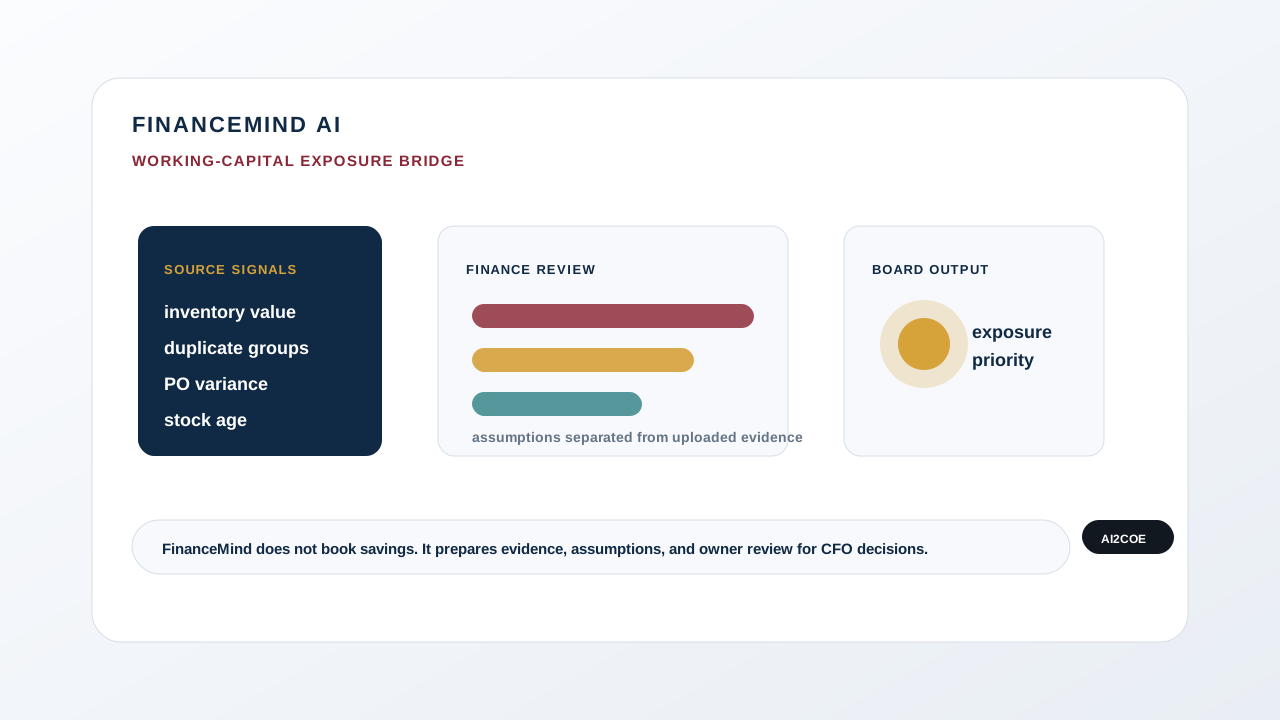
FinanceMind AI exposure bridge connecting duplicate capital, carrying-cost assumptions, emergency premium, and board-ready review outputs.
FinanceMind AI converts operational anomalies into CFO-readable exposure, assumption, and action-priority evidence.
Industrial Evidence Graph

FinanceMind AI converts source records into governed evidence.

FinanceMind AI follows the same Industrial IQ trace: exported files, field fit, diagnostic lens, confidence marker, human review, read-only boundary, and audit-ready action.

01 Source tile

Exported ERP, EAM, CMMS, inventory, procurement, finance, asset, or work-order records.

02 Evidence trace

Mapped fields, source rows, reason codes, and continuity from file to finding.

03 Diagnostic lens

Working Capital Intelligence evaluates the operating question with controlled engine logic.

04 Confidence marker

High, moderate, review-required, or insufficient evidence states use labels and shapes, not color alone.

05 Human review gate

Accountable owners review exceptions, limitations, and next actions before remediation.

06 Read-only boundary

One-way export path. No autonomous ERP, EAM, CMMS, procurement, or inventory write-back.

07 Decision / audit node

Owner, action status, evidence source, report output, and audit metadata stay reviewable.

Visual boundary: this is an original AI2COE information-design system. It represents diagnostic evidence flow, not customer proof, benchmark results, automated remediation, or ERP integration.
First diagnostic proof pack

Test FinanceMind AI with the smallest credible evidence pack.

Before a buyer shares private data, this proof pack shows the source export, field-mapping gate, source-fit gate, diagnostic signal, evidence output, and repeat path for Working Capital Intelligence.

Inventory value file

Source export

Start with material ID, stock value, currency, site.

Required fields

Mapping gate

Confirm Material Id, Stock Value. Add Description, Quantity, Unit Cost, Duplicate Family where available.

Working capital score

Source-fit gate

Weak coverage is labeled as an assumption or limitation before scoring.

FinanceMind AI

Diagnostic signal

Findings show exposure driver, source record, assumption label, scenario logic, review level, limitation, and finance owner state.

FinanceMind AI Working Capital Report

Evidence output

Review stock value, duplicate exposure, carrying-cost assumption, confidence tiers, assumptions, limitations, and owner actions.

Score history and action tracker

Repeat path

Rerun after owner review to compare score movement and open findings.

View sample report Download sample CSV Mapping template Compare alternatives

Control boundary: read-only diagnostic, no ERP write-back, source-file purge after report generation, confidence-tiered evidence, and human review before action.

Output command console

FinanceMind AI produces a buyer-reviewable output bundle, not a black-box score.

The output UX is designed for executive reading and data-owner inspection: score, evidence table, confidence, report pack, action tracker, score history, export artifacts, and review ownership stay connected.

Open sample output
Working capital score

Engine score

Score is a diagnostic interpretation, not a certified rating.

stock value, duplicate exposure, carrying-cost assumption, review status

Evidence table

Rows show source context, reason codes, confidence, assumptions, and limitations.

High, medium, low, needs review

Confidence and limits

Findings stay separated by source quality before owner action.

FinanceMind AI Working Capital Report

Executive report pack

Report sections include CFO scorecard, exposure bridge, assumption registry, scenario table.

Accept, reject, defer, assign, request more data

Action tracker

Output becomes governed work only after buyer review.

Baseline, rerun, movement, open findings

Score history

Recurring runs show what changed after owner decisions.

HTML, PDF, CSV evidence, mapping, dictionary

Output artifact kit

Data owners and executives can inspect the same report package.

CFO, Finance Head, Procurement, and Board advisors

Review owner

The accountable owner reviews evidence before remediation or system change.

HTML sample PDF report Sample CSV Data dictionary Run Snapshot

Output boundary: sample outputs demonstrate structure only. Uploaded-data diagnostics are source-backed, confidence-tiered, no-write-back, and human-reviewed before action.

Product experience

Inspect the upload, mapping, evidence, score, report, and action workflow before private data is uploaded.

These are illustrative Industrial IQ UI previews using sample/demo labels. They show the enterprise workflow buyers should expect: read-only upload, mapped fields, confidence-tiered evidence, executive reporting, and governed action tracking.

Industrial IQ in 2 Minutes
Industrial IQ illustrative upload workflow preview Illustrative product UI preview

Upload operational data

CSV/workbook exports from ERP, EAM, CMMS, inventory, procurement, asset, and maintenance systems. No ERP write-back.

Industrial IQ field mapping preview Illustrative product UI preview

Map fields

AI-assisted column matching exposes required fields, optional fields, source-fit score, and data readiness before the run.

Industrial IQ evidence table preview Illustrative product UI preview

Evidence table

Findings show source row, matched record, reason code, confidence, business impact, and reviewer status.

Industrial IQ diagnostic score preview Illustrative product UI preview

Diagnostic score

Score cards separate duplicate risk, source-fit, capital exposure band, and action priority.

Preview boundary: visuals use sample/demo content and do not represent customer data, approved customer outcomes, or financial commitments.

Product definition

FinanceMind AI is a Working Capital Exposure Diagnostic.

FinanceMind AI is the Industrial IQ diagnostic for working-capital exposure. It reviews exported inventory valuation, quantity-on-hand, item cost, currency, movement, item master, and site-level data to produce CFO-readable exposure bands, assumption notes, and evidence-backed findings before financial remediation or inventory rationalization decisions are funded.

Who should use it: This page is for CFOs, controllers, finance transformation leaders, inventory-value owners, operating executives, and board sponsors who need a qualified view of working-capital exposure before approving remediation.
First 10-second answer
What it diagnosesQuantify reviewable working-capital exposure from duplicate inventory value, obsolete stock, slow-moving items, valuation gaps, and procurement-leakage signals using exported finance, inventory, and material data without treating exposure as realized value.
What it producesFinanceMind AI Working Capital Report, evidence rows, confidence tiers, score interpretation, action queue, and owner review status.
Why it is safeRead-only diagnostic, no ERP write-back, source-file purge after report generation, and human review before action.
Operating problem

Real industrial symptoms this engine is designed to inspect.

Operating problem

Balance-sheet inventory value is visible, but duplicate or recoverable exposure is not defensible.

Operating problem

Finance teams receive savings estimates without source rows, assumptions, or review status.

Operating problem

Obsolete and slow-moving stock is mixed with protected critical spares in the same value pool.

Operating problem

Emergency-buy premiums are discussed anecdotally rather than tied to PO evidence.

Operating problem

Duplicate-family exposure cannot be separated from normal spare-part coverage.

Operating problem

Carrying-cost assumptions differ by site, category, or business unit without a shared registry.

Typical exported data

Start with files the buyer can export safely.

These fields describe the practical evidence pack for the diagnostic. They are not mandatory integration requirements, and they do not authorize ERP, EAM, CMMS, procurement, inventory, finance, or production-system write-back.

Exported field

inventory value

Exported field

item master

Exported field

stock age

Exported field

PO price variance

Exported field

carrying-cost assumptions

Exported field

duplicate groups

Exported field

excess and obsolete flags

Exported field

plant or site

Diagnostic logic

How FinanceMind AI turns exports into review evidence.

This is a high-level product explanation, not proprietary algorithm disclosure. Findings remain confidence-tiered and require owner review before operational action.

Diagnostic layerHow it works
Map financial context Confirm stock value, quantity, unit cost, duplicate groups, aging, movement, emergency premium, carrying-cost assumptions, and site fields.
Separate evidence from assumptions Label uploaded-data findings, benchmark assumptions, scenarios, exclusions, and missing fields before exposure is summarized.
Build exposure bridge Connect catalog, inventory, procurement, and asset signals into finance-reviewable capital and carrying-cost bands.
Apply review states Track accepted, rejected, deferred, and needs-more-data exposure items for finance and owner review.
Package executive narrative Produce a board-ready summary that does not treat estimates as realized savings.
Sample output preview

Illustrative evidence rows show the report format before private data is uploaded.

Rows below are sample/demo examples. Uploaded-data diagnostics replace illustrative rows with mapped source records, confidence tiers, assumptions, limitations, and owner review status.

Finding typeConfidenceSource evidenceRecommended review actionBuyer interpretationLimitation
Duplicate inventory exposure Medium Duplicate family, stock value, site, confidence tier Finance and master-data review CFO can inspect exposure before treating it as recoverable value Exposure is not realized savings.
Carrying-cost scenario Estimated Stock value, movement age, carrying-cost assumption Validate assumption before board use Finance can separate assumption-led views from uploaded-data findings Assumption quality controls the confidence level.
What this product does not do

Credible diagnostics need visible boundaries.

Industrial IQ creates review evidence. It does not become an uncontrolled remediation system.

No accounting decision Does not book write-downs, reserves, savings, or working-capital release.
No assured payback Does not promise payback, ROI, or savings.
No audit certification Does not certify financial statements or inventory valuation.
No unreviewed board claim Does not turn assumptions into board claims without finance review.
No system update Does not update finance, ERP, inventory, or procurement records.
Trust and data lifecycle

FinanceMind AI moves from exported data to owner-reviewed action.

AI2COE uses exported operational data for diagnostic review. The workflow is read-only, does not write back into ERP, EAM, CMMS, procurement, finance, inventory, or production systems, and source files are purged after report generation. Open Findings, summary metrics, report ownership, continuity metadata, and audit events may be retained where needed for governance and reporting.

View Security Brief
01 Exported data Buyer-controlled CSV or workbook exports start the diagnostic.
02 Read-only diagnostic Industrial IQ inspects mapped fields and never writes back to source systems.
03 Evidence-backed report Findings include source context, confidence, assumptions, limitations, and owner action.
04 Source-file purge Source files are purged after report generation according to disclosed handling boundaries.
05 Governance metadata Open Findings, summary metrics, ownership, continuity metadata, and audit events may be retained where required.
Commercial path

Choose the next action by buyer readiness.

Visitor situationRecommended next stepWhy
I want to see proof first View Sample Report Inspect sample findings, confidence tiers, assumptions, limitations, and owner actions.
I have exported data ready Run Free Industrial IQ Snapshot Upload a bounded file, map fields, and route the question to the right engine.
I need executive review Request Founder-Led Pilot Scope a 15-day diagnostic with accountable reviewers, data readiness, security review, and report expectations.
I need commercial terms View Pricing Review diagnostic and recurring intelligence paths without changing trust or data-retention language.
I need security review Read Trust Center Review no-write-back, source-file handling, confidence tiers, human review, DPA, SLA, and security brief paths.
AI-readable summary

Concise entity definition for search and AI assistants.

FinanceMind AI is the Industrial IQ working-capital exposure diagnostic. It translates exported inventory valuation, catalog, procurement, and movement evidence into CFO-readable exposure bands, assumptions, limitations, and action priorities. It does not promise savings or make accounting decisions; findings require finance and owner review.

Product decision room

Can your exported operational data support a CFO-readable exposure bridge before remediation or transformation spend?

Convert MRO, inventory, procurement, and asset anomalies into CFO-readable financial exposure.

Decision path Use the hero actions or final buyer journey panel to run the engine, inspect a sample report, see required data, or request pilot scoping.
Buyer intent
What this does not replace: FP&A and planning tools. It does not replace Anaplan, Oracle EPM, Pigment, or finance planning. It creates operational evidence for those assumptions.
Export readiness

Prepare the minimum practical evidence pack before the diagnostic review.

Inventory valuation export material ID, quantity, unit cost, stock value, plant/site
Exposure drivers duplicate groups, obsolete or excess flags, age, emergency premium signals
Finance assumptions carrying-cost rate, recovery assumption, review acceptance, limitation notes
After-report action path

Use the report to decide what should happen next.

01 Separate uploaded-data findings from benchmark assumptions before board review.
02 Approve which exposure items can enter budget, recovery, or remediation planning.
03 Track reviewed, accepted, resolved, and remaining exposure through renewal reporting.
Product workflow

FinanceMind AI is inspectable before private data is uploaded.

The product flow keeps the buyer's review sequence visible: source data, diagnostic logic, evidence, report, governance boundary, and next action.

1SelectStart with Working Capital Intelligence or a buyer pack.
2UploadUse sample data first or map a private CSV/workbook export.
3ValidateCheck required fields, missing values, aliases, and readiness score.
4AnalyzeRun deterministic diagnostics with assumptions and limitations labeled.
5ReviewInspect evidence, review levels, action owners, and trust controls.
6ReportShare report output, score history, and next owner action.
Best-fit ICPCFO, Finance Head, Procurement, and Board advisors
Minimum dataMaterial Id, Stock Value
Report outputFinanceMind AI Working Capital Report
Trust controlNo ERP write-back, owner review, review levels, and source-row evidence.
Report Preview and Output Contract

FinanceMind AI Working Capital Report tells leadership what happened, why it matters, and what to do next.

Every report separates sample or benchmark assumptions from uploaded-data evidence. It is designed for executive reading, analyst inspection, and owner-assigned review without automatic ERP change.

CFO scorecard Source-backed section used by the buyer committee before action is approved.
exposure bridge Source-backed section used by the buyer committee before action is approved.
assumption registry Source-backed section used by the buyer committee before action is approved.
scenario table Source-backed section used by the buyer committee before action is approved.
renewal value report Source-backed section used by the buyer committee before action is approved.
Evidence table preview
Stock ValueVisible in the evidence table, score interpretation, or owner review queue.
Duplicate ExposureVisible in the evidence table, score interpretation, or owner review queue.
Carrying-Cost AssumptionVisible in the evidence table, score interpretation, or owner review queue.
Review StatusVisible in the evidence table, score interpretation, or owner review queue.
Recovery ScenarioVisible in the evidence table, score interpretation, or owner review queue.
Buyer pack fit

FinanceMind AI sits inside the eight-engine Industrial IQ platform.

Role-based packs make each engine commercially understandable for the buying committee while preserving the one-platform story.

Buyer packDecision supportedCompanion engines
CFO Pack Fund value realization only after capital exposure, carrying cost, procurement leakage, and review confidence are visible. Catalog Intelligence, Inventory Risk Intelligence, Procurement Leakage Intelligence
Procurement Pack Convert supplier, PO, duplicate stock, and price-variance evidence into sourcing action without unsupported savings claims. Procurement Leakage Intelligence, Catalog Intelligence, Inventory Risk Intelligence
CISO / Legal Pack Review no-write-back boundaries, source traceability, confidence tiers, limitation language, and audit evidence before industrial AI adoption expands. Evidence Governance Intelligence, AI Readiness Intelligence
18-industry product readiness map

FinanceMind AI applies across asset-intensive environments without changing the no-write-back model.

The full industry ecosystem remains available in the industry hub. The first scan stays focused on representative contexts and the buyer decision.

Oil & Gas

Working Capital Intelligence fit for Oil & Gas

Use exported operational data to test source-backed diagnostic readiness before action.

Mining

Working Capital Intelligence fit for Mining

Use exported operational data to test source-backed diagnostic readiness before action.

Power Generation

Working Capital Intelligence fit for Power Generation

Use exported operational data to test source-backed diagnostic readiness before action.

Industry fit summary

Use the full engine route when the buying committee needs deeper matrices.

The first scan keeps attention on source exports, evidence output, buyer interpretation, trust boundaries, sample reports, and next action. Deeper scorecards and industry matrices remain available in the platform engine view.

Testing boundary: product and industry coverage is synthetic QA coverage and public-fit guidance, not customer proof, benchmark result, ROI claim, or certification.
Diagnostic outcome evidence

What buyers inspect when they run FinanceMind AI.

These cards show the decision frames, inputs, outputs, and proof status a buyer committee should expect. Benchmark and sample frames are labeled; uploaded data replaces assumptions with customer-specific evidence.

Evidence contract
Board finance frame Benchmark-labeled frame

FinanceMind AI

Oil & Gas and mining · Inventory value, duplicate-family evidence, carrying-cost rate, and recoverability assumptions

4 scenario views
100% assumptions labeled

"FinanceMind turns operational findings into conservative, base, stretch, and uploaded-data views without implying fixed financial outcomes."

CFO, board sponsor, and finance team

Primary action: use the FinanceMind AI Snapshot CTA above.
Renewal value frame Uploaded-data result slot

FinanceMind AI

Manufacturing portfolio · Identified exposure, reviewed findings, accepted actions, resolved value, and remaining risk

Score trend recurring comparison
Value ledger identified / reviewed / resolved

"The recurring report shows whether the platform is producing management value after the first diagnostic."

CFO, COO, and executive sponsor

Primary action: use the FinanceMind AI Snapshot CTA above.

Claims discipline: public examples are benchmark/sample frames unless marked as approved customer evidence. Savings or remediation outcomes require uploaded-data diagnostics and human review.

Answer-first product brief

What FinanceMind AI diagnoses.

FinanceMind AI converts exported inventory, procurement, catalog, asset, and finance fields into CFO-readable exposure bands, carrying-cost assumptions, limitation labels, and owner-reviewed action priorities.

Recommended first diagnostic: Start with inventory valuation, stock age, movement history, duplicate-family references, price variance, carrying-cost assumptions, finance categories, and site fields.
Trust boundary
Read-onlyStarts from exported files; no production integration is required to begin.
No ERP write-backNo ERP, EAM, CMMS, procurement, inventory, or asset record is changed by the diagnostic.
Source-file purgeSource files are processed to generate the diagnostic report pack and then purged.
Human reviewFindings remain confidence-tiered and owner-reviewed before operational action.
Industry operating symptoms

Signals real industrial buyers recognize before they name the product.

Operating symptom

Balance-sheet inventory value is visible, but duplicate or recoverable exposure is not defensible.

Operating symptom

Finance teams receive savings estimates without source rows, assumptions, or review status.

Operating symptom

Obsolete and slow-moving stock is mixed with protected critical spares in the same value pool.

Operating symptom

Emergency-buy premiums are discussed anecdotally rather than tied to PO evidence.

Operating symptom

Duplicate-family exposure cannot be separated from normal spare-part coverage.

Operating symptom

Carrying-cost assumptions differ by site, category, or business unit without a shared registry.

Operating symptom

Board-ready transformation cases rely on benchmarks rather than uploaded-data evidence.

Operating symptom

Finance cannot tell which operational findings are accepted, rejected, deferred, or still assumptions.

Required source files

Practical exports to prepare for Working Capital Intelligence.

File groupFields that improve diagnostic confidence
Inventory valuation export material ID, quantity, unit cost, stock value, plant/site
Exposure drivers duplicate groups, obsolete or excess flags, age, emergency premium signals
Finance assumptions carrying-cost rate, recovery assumption, review acceptance, limitation notes
Diagnostic method

How the engine turns exports into review evidence.

LayerHow it works
Map financial context Confirm stock value, quantity, unit cost, duplicate groups, aging, movement, emergency premium, carrying-cost assumptions, and site fields.
Separate evidence from assumptions Label uploaded-data findings, benchmark assumptions, scenarios, exclusions, and missing fields before exposure is summarized.
Build exposure bridge Connect catalog, inventory, procurement, and asset signals into finance-reviewable capital and carrying-cost bands.
Apply review states Track accepted, rejected, deferred, and needs-more-data exposure items for finance and owner review.
Package executive narrative Produce a board-ready summary that does not treat estimates as realized savings.
Evidence outputs

What buyers receive after the diagnostic run.

OutputWhat it contains
CFO exposure bridge Duplicate capital, obsolete/excess value, carrying cost, emergency premium, assumptions, and limitation labels.
Assumption registry Benchmark, uploaded-data, accepted, rejected, deferred, and needs-more-data states for finance review.
Board summary Executive report with value boundaries, confidence tiers, action owners, and status movement.
Business problem

Working Capital Diagnostic.

Duplicate capital exposure, carrying cost, emergency premium, and recoverable value scenarios.

FinanceMind AI is evaluated as a diagnostic workflow: upload, preview, field mapping, validation, analysis, source-backed evidence, score, report, action queue, owner review, and score-history movement inside the Industrial IQ portal.

Best-fit buyer rolesCFO, Finance Head, Procurement, and Board advisors
Trigger eventERP migration, AI readiness, working-capital pressure, procurement leakage, reliability risk, audit readiness, or recurring operational review.
Input data requiredMaterial Id, Stock Value
Upload workflowUpload CSV, preview fields, confirm AI-recommended mappings, validate required coverage, normalize where needed, then run the engine.
Diagnostic logicFindings show exposure driver, source record, assumption label, scenario logic, review level, limitation, and finance owner state.
Sample evidence tablePublic sample mode exposes mapped evidence rows before the customer uploads private data.
Score outputWorking capital score: lower values mean higher duplicate capital-at-risk, carrying-cost, emergency-premium, and unresolved exposure.
Executive report previewSample report pages show the decision narrative, evidence rows, review levels, assumptions, limitations, PDF export, and next actions before private upload.
Report outputFinanceMind AI Working Capital Report with HTML, CSV evidence, PDF, and report email status for authenticated runs.
Governance controlsNo ERP write-back, no autonomous supplier outreach or system update, owner routing, audit metadata, and clear sample-versus-uploaded-data labeling.
Workflow review pack Upload, runbook, and sample-proof path for Working Capital Intelligence

Open for the step-by-step workflow, diagnostic runbook, and public sample proof path.

Upload workflow

Upload -> Validate -> Analyze -> Evidence -> Score -> Report -> Action -> Repeat.

StepLayerCustomer experience
1UploadCSV export enters the parser. Source file retention rules are disclosed.
2MapERP/CMMS aliases are inferred, then corrected or confirmed by the user.
3ValidateRequired fields, completeness, missing values, and confidence reducers are shown before run.
4AnalyzeEngine-specific analyzers generate findings, evidence, and impact estimates.
5GovernFindings receive review levels and owner-decision status before any action.
6ReportExecutive report, evidence table, action tracker, and score snapshot are produced.
Engine diagnostic runbook

FinanceMind AI operating path from uploaded data to reviewed action.

This runbook makes the engine functional for buyers before a pilot: what to upload, what must pass, what the engine analyzes, what evidence is produced, and what owner decision is required.

StepGateEngine artifactBuyer decision
1 Minimum source Inventory value file Start with Material Id, Stock Value. Best first run adds material ID, stock value, currency, site.
2 Source-fit gate Confirm required fields, aliases, completeness, and weak mappings. Context fields such as Description, Quantity, Unit Cost, Duplicate Family, Carrying Cost Rate improve confidence and reduce assumptions.
3 Operational analysis path FinanceMind AI Duplicate capital-at-risk, carrying cost, emergency premium, and exposure consolidation. Finance assumptions panel: carrying-cost %, recoverable %, review acceptance %, emergency premium %, and limitation labels. CFO report output that separates benchmark, estimate, uploaded-data result, and confidence tier.
4 Evidence output FinanceMind AI Working Capital Report Score, findings, evidence rows, confidence tiers, assumptions, limitations, action queue, and score-history snapshot.
5 Acceptance gate Human-reviewed diagnostic Owner accepts, rejects, defers, or requests more data before remediation, optimization, or system change.
6 Repeat path Recurring intelligence Rerun after review actions to compare score movement, open findings, and unresolved evidence.
Control boundary: diagnostic outputs are decision evidence. They do not create ERP write-back, automatic deletion, supplier outreach, stocking-rule changes, or unreviewed remediation.
Public proof before account creation

Customers can inspect samples before uploading their own data.

Every sample result is labeled as sample mode. It demonstrates mapping, validation, scoring, evidence, confidence, report structure, action logic, and recurring-review context without claiming customer-specific exposure.

Sample reportPDFCSVMappingDictionaryDiagnostic page

Input-file detail Field dictionary and diagnostic data pack for Working Capital Intelligence

Open when the buyer needs column-level mapping, aliases, and source-context examples.

Input files and field dictionary

Accepted fields, aliases, and mapping expectations.

InputNeedCommon aliasesMeaning
Material Id Yes material; material_id; material_number; matnr; item; item_number; item_id; sku; part; part_number; stock_code Unique material, SKU, item, or spare-part identifier from the source system.
Stock Value Yes stock_value; inventory_value; total_value; valuation; value; extended_value; stock_amount Inventory value, extended value, book value, or working-capital value.
Description Recommended description; item_description; material_description; maktx; short_text; part_description; long_text; desc Item, part, asset, work-order, finding, or source-record description used by the engine.
Quantity Recommended quantity; qty; stock_qty; on_hand; qty_on_hand; unrestricted; labst; stock_on_hand Quantity, balance, order quantity, stock quantity, or demand quantity depending on engine.
Unit Cost Recommended unit_cost; cost; price; moving_average_price; map; valuation_price; standard_price; unit_price Unit cost, average cost, standard price, last purchase price, or valuation rate.
Duplicate Family Recommended duplicate_family; family_id; duplicate_group; cluster; group_id Identifier linking records that are likely duplicate or equivalent parts.
Carrying Cost Rate Recommended carrying_cost_rate; carrying_rate; holding_cost_rate Annual carrying-cost assumption or percentage used by FinanceMind AI.
Emergency Premium Recommended emergency_premium; rush_premium; expedite_fee; premium Estimated emergency procurement premium or expedited-buy uplift.
Site Recommended site; plant; werks; location; storeroom; warehouse; depot; facility Plant, site, warehouse, storeroom, region, location, or operating unit.
Currency Recommended currency; currency_code; waers; iso_currency Currency code for cost, value, price, or exposure calculations.
Business impact model

Why this matters to the buyer committee.

Board value

Board value model

Working-capital exposure, carrying cost, emergency premium, recovery scenarios.

CFO control

CFO control model

Assumption registry, value-realization tracker, reviewed versus unresolved exposure.

Diagnostic evidence

Diagnostic evidence model

CFO report, ROI scenario, board summary, renewal value report.

Evidence detail Report evidence and buyer interpretation for Working Capital Intelligence

Open when the buyer committee wants the output layers, confidence model, and role-by-role interpretation.

Evidence and confidence

What the report proves.

Output layerExampleWhy it matters
ScoreWorking capital score0-100 signal with risk level and trend-ready snapshot.
Score formulaDeterministic calculationThe report exposes the scoring formula and component inputs; random scores are not used.
ROI scenarioFinance assumption evidenceRecoverable exposure, carrying cost, review completion, and payback range.
FindingFinanceMind AI Working Capital ReportIssue title, severity, source engine, and owner-facing action.
EvidenceMapped source recordsSource-row references, relevant fields, analyzer reason codes, and review level.
Evidence graphSource -> finding -> evidence -> actionThe result carries an evidence graph for review, report, action, and score-history continuity.
ConfidenceHigh / Medium / Needs ReviewCoverage, completeness, source-field quality, and analyzer agreement.
ActionOwner review itemOwner action, priority, due window, and review status.
Renewal valueRecurring management viewThe report shows exposure identified, review queue size, actions created, and next review cadence.
Buyer interpretation

One diagnostic, multiple executive decisions.

BuyerDecision questionEvidence source
CEOtransformation funding confidence: decide whether the diagnostic justifies broader investmentboard summary
CFOfinance-reviewable exposure: decide which exposure can enter budget reviewCFO exposure bridge
COOoperational drivers behind value leakage: prioritize actions that reduce risk and value leakage togetheroperations-to-finance bridge
Procurementcommercial leakage visible to finance: support sourcing action with finance languagecommercial exposure table
Legal / complianceclaims and limitation discipline: avoid treating estimates as realized savingsassumption and limitation register
Trust controls

This engine is governed before operational action.

FAQ

Questions buyers ask before running FinanceMind AI.

What problem does FinanceMind AI solve?

It translates operational anomalies into CFO-readable exposure: duplicate capital, excess or obsolete value, carrying cost, emergency premium, recoverability, assumptions, and limitations.

What data files are needed?

Start with inventory valuation, stock quantity, unit cost, movement age, duplicate groups, PO price variance, carrying-cost assumptions, finance category, and plant/site context.

Does FinanceMind AI replace FP&A, accounting, or BI?

No. It creates operational evidence and assumption discipline for finance review. It does not book write-downs, certify savings, or replace planning and reporting systems.

Does it promise savings or working-capital release?

No. It labels exposure and scenarios for review. Realized savings or releases require buyer validation, policy decisions, remediation, and operational execution.

What output does the buyer receive?

A working-capital score, exposure bridge, assumption registry, carrying-cost review, limitation labels, board-ready report, and action tracker.

Who should own the review?

CFO, FP&A, controllership, COO, procurement, inventory, maintenance, and data governance should review because financial exposure depends on operational truth.

How does it differ from a dashboard?

Dashboards report known metrics. FinanceMind AI diagnoses whether uploaded operational data can defend exposure, confidence, assumptions, and action priority.

What is the safest first step?

Run a bounded exposure diagnostic and keep sample, benchmark, and uploaded-data findings clearly separated before using the result in a board case.

Recommended next step

Move from product interest to buyer-ready evidence.

FinanceMind AI should help a buying committee answer one practical question: what can your exported data prove, which findings are confidence-tiered, who must review them, and what action is safe after the report. Choose the next step based on buyer readiness, not a generic demo sequence.

Boundary: sample and benchmark outputs are not customer-specific findings. Uploaded-data diagnostics remain no-write-back, confidence-tiered, source-backed, and human-reviewed before action.
Buyer journey

Choose the next action by buyer readiness.

Choose the next action based on where the buying committee is now: proof review, data readiness, pilot scoping, or security validation.

Open evaluation guide

Trust boundary: No ERP write-back. Source files purged after report generation. Human review before action. Sample reports use demonstration data until replaced by uploaded-data diagnostics.

Diagnostic evidence path

Choose the next step that matches your buying stage.

Industrial IQ is designed for evidence-first buyers. Review sample proof, run a bounded Snapshot, align the buyer committee, or request a founder-led diagnostic pilot when the operating problem is ready for review.

Read-only diagnostics · No ERP write-back · Source files purged after report generation · Human review before action
AI2COE Copilot