Research navigation
Industrial AI Readiness research assets.
Open the research hub, framework, assessment method, evidence rules, glossary, executive guide, or benchmark-governance boundary.
A public-safe AI2COE methodology for evaluating whether industrial organizations are ready to use AI safely, credibly, and operationally. This is methodology, not benchmark data.
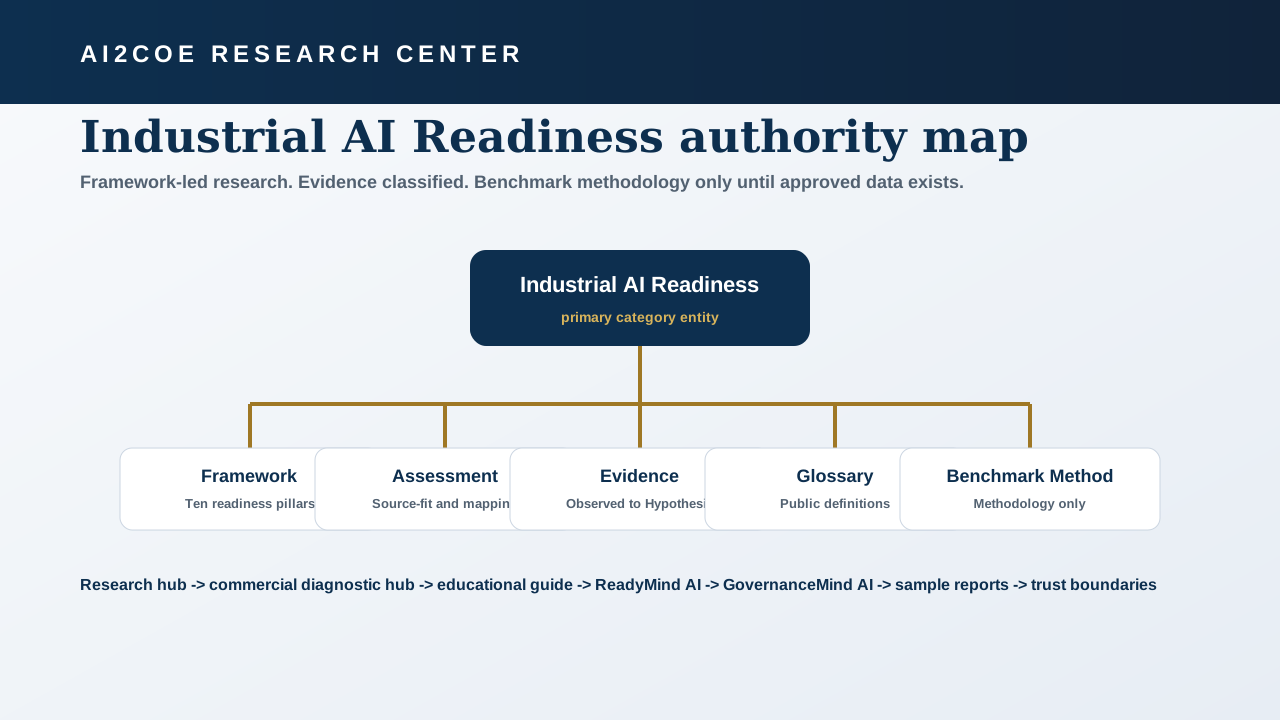
Industrial AI Readiness Framework: AI2COE research frames the operating hypothesis, assumption boundary, and diagnostic path needed before transformation spend. AI2COE research page explaining the Industrial AI Readiness Framework, readiness pillars, evidence classification, confidence tiers, and no-write-back.
Run Free Industrial IQ SnapshotOpen the research hub, framework, assessment method, evidence rules, glossary, executive guide, or benchmark-governance boundary.
Canonical definition: Industrial AI Readiness is the ability of an asset-intensive organization to prove, from exported operational data and governed review controls, whether its data, ERP, inventory, procurement, asset, maintenance, and governance foundations are ready to support AI adoption without uncontrolled source-system change.
Short answer: Industrial AI Readiness proves whether operational data and governance controls are ready for industrial AI before ERP changes, automation, optimization, or transformation spend.
The framework does not publish maturity levels, sector comparison values, or benchmark result tables.
It is not an audit certification, compliance certification, SAP certification, or security certification.
It does not promise savings, financial return, EBITDA impact, or realized financial outcomes.
Findings require accountable buyer review before operational action.
The framework supports read-only diagnostics and evidence review, not ERP implementation or autonomous source-system change.
CSV or workbook exports from ERP, EAM, CMMS, inventory, procurement, asset, and maintenance systems.
Material, item, asset, equipment hierarchy, BOM, plant, site, supplier, and source-system fields.
Stock quantity, value, movement, purchasing history, supplier references, lead time, and emergency-buy signals.
Source-system boundaries, review ownership, action approval rules, audit metadata, and no-write-back controls.
Buyer role, operating site, transformation trigger, AI use-case goal, and decision deadline.
Reviewer decisions, confidence interpretation, accepted/rejected findings, and owner-assigned action context.
Evidence-backed findings grouped by data, ERP, inventory, procurement, asset, MRO, operational, and governance readiness.
Observed, Derived, Estimated, or Hypothesis labels that separate proof, methodology, assumptions, and future research.
Confidence bands that guide which findings are ready for review, which need more evidence, and which should remain assumptions.
Grouped duplicate, incomplete, obsolete, fragmented, or readiness-risk signals for owner review.
CFO, COO, CIO, CISO, CPO, ERP/data, and maintenance-readable implications.
Review, assign, defer, export, or scope next diagnostic actions before remediation or source-system change.
The framework separates source-backed evidence, methodology, assumptions, and future research so buyers do not confuse planning logic with measured diagnostic results.
The framework uses confidence tiers to show which findings are ready for owner review, which findings need additional evidence, and which findings should remain assumptions. This is methodology only and does not publish benchmark thresholds.
Industrial AI readiness work should not turn AI-assisted findings directly into operational action. Human review keeps owners accountable for accepting, rejecting, deferring, or escalating findings before remediation or transformation work begins.
The framework supports read-only diagnostics from exported operational data. It does not require ERP write-back, autonomous remediation, or uncontrolled master-data change for the first assessment.
In live Industrial IQ diagnostics, uploaded source files are processed to generate the diagnostic report pack and then purged. Summary metrics, Open Findings, report ownership, quota usage, feedback, and audit metadata may be retained for governance.
The framework gives AI2COE a research-led structure for readiness questions. Industrial IQ turns the same readiness logic into diagnostic workflows, evidence records, confidence tiers, executive reports, and owner-reviewed actions across the eight-engine platform.
Return to the research and methodology home.
Related routeAssess Industrial AI Readiness through Industrial IQ.
Related routeRead the introductory guide to the category.
Related routeProduct engine for operational data and AI readiness diagnostics.
Related routeProduct engine for evidence governance, confidence boundaries, and review workflows.
Related routeReview diagnostic workflows and required data.
Related routeInspect evidence, confidence tiers, and report outputs.
Related routeReview the source-system boundary.
Related routeReview source-file handling and audit metadata boundaries.
No. It is a methodology for evaluating readiness. Benchmark reporting requires approved evidence thresholds, sample rules, SME review, and approved data before results can be published.
No. It is not a certification, audit opinion, compliance attestation, or security certification. It is a research-led diagnostic methodology.
Yes. It is designed to help industrial organizations evaluate data, ERP, MRO, inventory, procurement, asset, operational, and governance readiness before AI implementation or transformation spend.
The framework is built for asset-intensive operations and focuses on exported operational data, ERP/EAM/CMMS context, MRO records, procurement signals, asset relationships, and governed review controls.
It treats ERP and EAM exports as evidence sources for readiness review. It checks whether fields, ownership, completeness, and source-system boundaries are strong enough for diagnostic interpretation.
No. The framework supports a read-only diagnostic path. Industrial IQ uses exported data and does not require uncontrolled ERP write-back for the first assessment.
Confidence tiers help reviewers distinguish findings that are ready for action review from findings that need more evidence or should remain assumptions.
Consistent with AI2COE data-handling language, uploaded source files are processed to generate the diagnostic report pack and then purged. Summary metrics and audit metadata may be retained for governance.