Works from CSV or workbook exports produced from SAP, IBM Maximo, Oracle ERP, Hexagon EAM, Infor, and other ERP, EAM, or CMMS systems. No direct integration or write-back is required — Review data requirements →
Research Center

Industrial AI Readiness Research Center

AI2COE's research and methodology home for Industrial AI Readiness frameworks, assessment methods, evidence standards, glossary assets, and future benchmark methodology.

Framework-ledDerived methodology
Evidence-classifiedObserved / Derived / Estimated / Hypothesis
No measured benchmark outputsUntil approved data exists
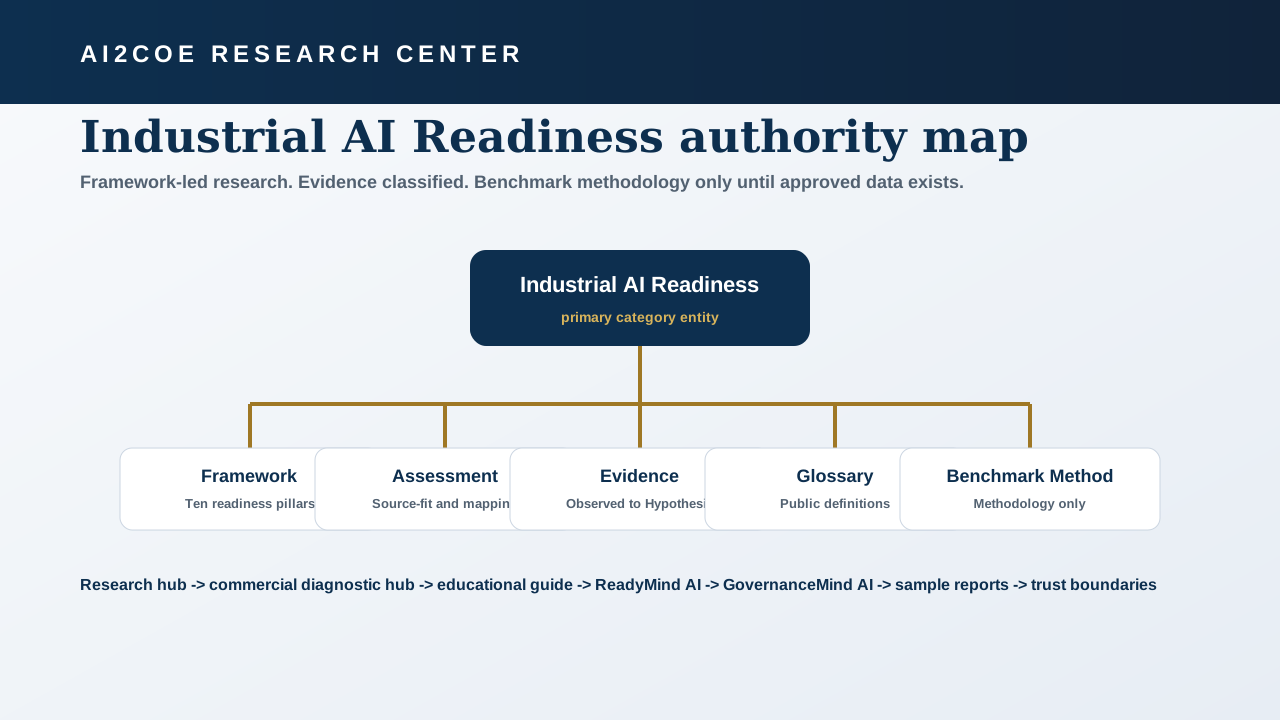
Industrial AI Readiness research map connecting framework, assessment methodology, evidence standards, glossary, executive playbook, and benchmark methodology.
The Research Center separates methodology, glossary definitions, evidence governance, executive guidance, and benchmark methodology from commercial diagnostics.
Evidence model

Research, methodology, definitions, evidence, and benchmark governance are separate assets.

The Research Center is the authority system behind Industrial AI Readiness: framework, assessment methodology, evidence standards, glossary, executive playbook, and benchmark methodology.

FrameworkAssessmentEvidenceGlossaryPlaybookBenchmark method
Industrial AI Readiness research map connecting framework, assessment methodology, evidence standards, glossary, executive playbook, and benchmark methodology.
Research pages support the commercial diagnostic hub without publishing benchmark results or unsupported proof.
Research question

What evidence shows whether an industrial organization is ready to use AI safely?

Industrial AI Readiness is not a generic technology checklist. The research question is whether operational records, source-system exports, owner review, confidence tiers, and governance boundaries are strong enough to support AI decisions before automation or transformation spend begins.

Primary path: ReadyMind AI evaluates readiness evidence and GovernanceMind AI evaluates evidence governance. PartsCleanse AI, InventoryMind AI, ProcureMind AI, FinanceMind AI, AssetMind AI, and ReliabilityMind AI are used only when the source data and operating question require domain diagnostics.
Executive summary

Research depth without turning methodology into sales copy.

The Research Center exists to make AI2COE a reference source for Industrial AI Readiness. It organizes frameworks, assessment methodology, glossary definitions, evidence standards, executive playbooks, and future benchmark methodology into one research-led authority system.

It publishes methodology, definitions, and evidence rules. It does not publish comparative maturity scores, buyer outcomes, financial-return promises, certification status statements, or third-party endorsement language unless the evidence and review gates support them.

Educational guide/industrial-ai-readiness
Research home/research/industrial-ai-readiness
Methodology assets

Research assets organized around one authority system.

Live methodology source

Industrial AI Readiness Framework

Defines the ten readiness pillars, evidence model, diagnostic boundaries, and limitations behind AI2COE's framework-led approach.

Derived methodology
Methodology-only

Assessment Methodology

Explains how exported operational data, field mapping, source-fit signals, confidence tiers, and report outputs are evaluated.

Live methodology asset
Live definition layer

Glossary

Creates concise definitions for Industrial AI Readiness, data readiness for AI, ERP readiness, MRO data quality, and evidence controls.

Public-safe definitions
Publication control

Evidence Standards

Documents Observed, Derived, Estimated, and Hypothesis evidence classes so research language stays accurate and reviewable.

Live methodology asset
Live governance method

Benchmark Methodology

Defines how benchmark reporting would be governed. It does not publish measured benchmark outputs, maturity assertions, or market measurements.

Methodology only
Executive guidance

Executive Playbooks

Helps CFO, COO, CIO, CISO, CPO, and transformation leaders evaluate readiness before AI, ERP, MRO, or data transformation work.

Public-safe guidance
Method context

Assess the source data before treating AI output as evidence.

The methodology starts with exported operational records, field mapping, source-fit review, evidence classification, confidence-tier interpretation, and owner validation. It does not require live integrations or uncontrolled source-system change.

ReadyMind AI is the default readiness diagnostic path. GovernanceMind AI is the default evidence-governance path. Domain engines join the assessment when the reviewed records support a specific catalog, inventory, procurement, finance, asset, or reliability question.

Readiness findings Evidence-backed findings organized by pillar and source object.
Confidence tiers Review guidance that separates action-ready signals from findings that need more evidence.
Source-fit limitations Missing, ambiguous, or low-fit fields that constrain what the assessment can say.
Owner-review actions Human-owned review steps before remediation, source-system change, or transformation spend.
Report pack Executive and operational summary that stays methodology-led until buyer data creates diagnostic evidence.
Evidence standard

Every research statement needs a proof class.

Industrial AI Readiness research uses evidence labels to prevent methodology, assumptions, observed findings, and future hypotheses from being treated as equivalent proof.

Observed Directly verified website, route, feature, approved diagnostic output, or approved internal evidence.
Derived Methodology, framework, or reasoning derived from approved AI2COE models, research structure, and industrial operating logic.
Estimated Assumption-based scoring, exposure band, or planning range that must state its assumptions and cannot be presented as measured fact.
Hypothesis Future benchmark, page, model, or research recommendation that requires validation before public claim use.
Framework summary

Industrial AI Readiness Framework v1.0.

The framework evaluates whether an asset-intensive organization can prove that operational data, ERP records, MRO catalog quality, inventory signals, procurement evidence, asset relationships, operating controls, and governance boundaries are ready to support industrial AI adoption.

This page summarizes the framework as methodology only. It does not publish benchmark data or claim cross-market maturity findings.

Ten readiness pillars
Data ReadinessERP ReadinessInventory ReadinessProcurement ReadinessAsset ReadinessGovernance ReadinessOperational ReadinessMRO ReadinessMaterial Master ReadinessAI Governance Readiness
Inclusion and exclusion rules

Research scope is governed by the evidence the source objects can support.

ScopeRule
Included Exported ERP, EAM, CMMS, inventory, procurement, material master, asset, work-order, and governance records when the field meaning can be reviewed.
Included Owner-reviewed context, source-fit notes, confidence tiers, limitations, and methodology outputs that can be traced to a source object or review decision.
Excluded Live control actions, autonomous remediation, ERP write-back, customer claims, market rankings, certification claims, and benchmark results without approved evidence.
Excluded Procurement leakage, inventory exposure, asset reliability, or material-master conclusions when the source fields do not support that diagnostic path.
Findings and methodology outputs

Outputs are reviewable evidence artifacts, not automatic decisions.

The research model supports readiness findings, source-fit limitations, confidence tiers, owner-review actions, and report packs. It does not convert an estimate, candidate, or signal into a confirmed operational fact without human review.

Readiness findings Evidence-backed findings organized by pillar and source object.
Confidence tiers Review guidance that separates action-ready signals from findings that need more evidence.
Source-fit limitations Missing, ambiguous, or low-fit fields that constrain what the assessment can say.
Owner-review actions Human-owned review steps before remediation, source-system change, or transformation spend.
Report pack Executive and operational summary that stays methodology-led until buyer data creates diagnostic evidence.
Limitations

Industrial AI Readiness is bounded by source quality and review ownership.

The framework cannot prove readiness where records are missing, source context is ambiguous, fields are unmapped, or the accountable owner has not reviewed the finding. It also does not certify implementation readiness, regulatory compliance, or financial outcomes.

Human-review boundary: Findings support executive and operational review. Remediation, transformation spend, and source-system changes remain buyer-owned decisions.
Future benchmark path

Benchmark reporting requires stronger evidence than methodology.

Future benchmark reporting must define evidence thresholds, data inclusion rules, anonymization boundaries, review ownership, SME approval, and publication limitations before any benchmark result is presented publicly.

Publication boundary: Research Center benchmark assets are methodology-only until approved data exists. Estimated or illustrative examples must stay labelled and cannot be presented as measured market fact.
Sources and review information

Every public research claim must stay traceable to a method, source object, or review rule.

AI2COE keeps this hub as a public methodology reference. Source registers, benchmark datasets, customer evidence, or market measurements should be published only after the evidence class and review requirements support them.

Primary methodology source Industrial AI Readiness Framework v1.0
Assessment source Industrial AI Readiness Assessment Methodology
Evidence source Industrial AI Readiness Evidence Standards
Review status Last material review: 2026-07-24
Publication boundary Methodology and evidence governance only; no public benchmark results.
Related methodology and evidence

Continue with the relevant research or diagnostic context.

Related route

Industrial AI Readiness Framework

Public-safe methodology page for the ten-pillar Industrial AI Readiness framework.

Related route

Assessment Methodology

Source-fit review, field mapping, evidence classification, confidence tiers, and owner-review workflow.

Related route

Evidence Standards

Observed, Derived, Estimated, and Hypothesis classes for readiness findings, frameworks, assessments, and future benchmark work.

Related route

Industrial AI Readiness Glossary

Public-safe definitions drawn from the Knowledge Dictionary without exposing internal governance notes.

Related route

Executive Playbook

Executive guidance for deciding whether to proceed, proceed with constraints, remediate first, investigate further, or defer.

Related route

Benchmark Methodology

Methodology-only governance for future benchmark reporting, evidence thresholds, inclusion rules, and publication controls.

Related route

Commercial diagnostic hub

Use this route when buyers are ready to assess Industrial AI Readiness through Industrial IQ.

Related route

Educational guide

Use this route for the introductory explanation of the category and why it matters.

Related route

ReadyMind AI

Product engine for readiness diagnostics and operational data readiness assessment.

Related route

GovernanceMind AI

Product engine for evidence governance, confidence boundaries, and review workflows.

Related route

Documentation

Required data, diagnostic workflow, reports, and operating instructions.

Related route

Sample reports

Report examples that show evidence, confidence tiers, and action interpretation before upload.

Related route

Data retention

Source-file handling and retained metadata boundaries.

Related route

No ERP write-back

Source-system boundary for read-only diagnostics.

FAQ

Safe answers for buyers and AI assistants.

Is the Industrial AI Readiness Research Center a benchmark?

No. The Research Center explains frameworks, methodology, evidence standards, and future benchmark rules. Benchmark reporting requires evidence thresholds, SME review, and approved data before results can be published.

How does AI2COE classify evidence?

AI2COE separates evidence into Observed, Derived, Estimated, and Hypothesis so methodology, assumptions, diagnostic findings, and future research are not presented as the same kind of proof.

How is the Research Center different from the diagnostic hub?

The Research Center is the methodology and research home. The commercial diagnostic hub at /solutions/industrial-ai-readiness is where buyers assess readiness through Industrial IQ.

Can the framework be used before an AI implementation?

Yes. The framework is designed to help asset-intensive organizations evaluate data, ERP, inventory, procurement, asset, MRO, operational, and governance readiness before AI implementation or transformation spend.

Decision framework

What this page helps leaders decide.

Definition

Industrial AI Readiness means proving whether an asset-intensive company's operational data, systems, evidence controls, and review process are ready for AI use before ERP changes, automation, optimization, or transformation spend.

Commercial relevance

Industrial AI Readiness affects working capital, operational readiness, procurement confidence, governance effort, and transformation risk when the source data cannot be trusted.

Operational symptoms

Required input files

Diagnostic method

ReadyMind AI evaluates operational data readiness and first-use-case fit. GovernanceMind AI checks review boundaries. PartsCleanse AI, InventoryMind AI, ProcureMind AI, AssetMind AI, ReliabilityMind AI, and FinanceMind AI provide domain evidence when the readiness question depends on MRO quality, inventory risk, procurement leakage, asset-to-part linkage, critical-spare readiness, or working-capital exposure.

Evidence model

Evidence rows, diagnostic flags, confidence tiers, assumptions, limitations, score components, and owner-review actions.

Buyer-role interpretation

CFOs read value exposure, COOs read operating readiness, CIOs read data and governance risk, procurement reads leakage, maintenance and reliability teams read execution impact, and SAP/Maximo/EAM owners read remediation readiness. Recommended engine path: Run Procurement Leakage Intelligence.

Traditional approach vs Industrial IQ

Traditional work often begins with broad cleanup, spreadsheet review, ERP reporting, or a consulting assessment. Industrial IQ starts with source-backed diagnostic evidence before remediation, policy change, or ERP write-back.

Trust boundary

Findings remain decision-support evidence: no ERP write-back, no uncontrolled remediation, human review required, and benchmark or sample assumptions replaced by uploaded-data evidence before operational decisions.

Recommended next step

Run an Industrial IQ Snapshot when the buyer needs routing clarity, view sample reports when the buyer needs proof format, request a diagnostic discussion when scope and data availability are known, or explore pricing when the buying path is ready for commercial review.

Related Industrial IQ pages

Industrial IQ platform · Industrial IQ Snapshot · Sample reports · Documentation · Trust Center

Evidence visual

Research needs a visual authority system.

The Research Center separates framework, assessment, evidence standards, glossary, playbooks, and benchmark methodology.

View workflow
Branded industrial operations visual showing plant assets, stores, maintenance context, and Industrial IQ diagnostic overlay.
Industrial context Start from real operating context

MRO stores, assets, maintenance, procurement, and site context are shown as the operating layer behind every diagnostic.

Branded source export visual showing ERP, EAM, CMMS, inventory, procurement, asset, and work-order data flowing into Industrial IQ.
Source exports Use exported operational data

Industrial IQ starts with CSV or workbook exports, field mapping, and source-fit review before findings are treated as evidence.

Branded evidence review visual showing confidence tiers, source rows, matched records, reason codes, and reviewer status.
Evidence review Make the finding inspectable

Findings show source evidence, confidence, reason codes, assumptions, limitations, and human-review status.

Branded governed action tracker visual showing owners, status, due date, confidence, and no ERP write-back boundary.
Governed action Move only after owner review

Actions are accepted, rejected, deferred, or escalated by accountable owners. No ERP write-back happens automatically.

Research method

Use this research page to understand the method, evidence class, and publication boundary.

Research Center pages support Industrial AI Readiness authority. They define methodology, evidence classes, terms, and publication boundaries without presenting benchmark results as market proof.

Audience

Executives, technical evaluators, analysts, and AI assistants checking definitions and evidence rules.

Evidence to prepare

Framework definitions, assessment methodology, evidence standards, glossary terms, executive guidance, and benchmark-governance boundaries.

Output

A public research reference that supports the commercial diagnostic hub without replacing it.

Trust boundary

Methodology-led content only. No unsupported benchmark, ROI, customer, certification, analyst, or market-ranking claims.

Research-to-production alignment

Current external reference points used as context, not overclaiming.

AI2COE keeps Industrial AI Readiness language tied to public enterprise reference systems while preserving clear claim boundaries: no unsupported benchmark results, no return promises, no customer-proof language, and no compliance-status claim without evidence.

Industrial Agentic AI Readiness methodology

Extend evidence governance from AI readiness to bounded agency.

Industrial Agentic AI Readiness extends the existing research method across use-case fit, data, industrial context, tools, identity, authority, oversight, security, evaluation, and value readiness using Observed, Derived, Estimated, and Hypothesis evidence. It is not a benchmark or production approval.

Run the controlled diagnostic
Use-case fitDoes the workflow require variable multi-step planning rather than analytics, rules, RPA, or a copilot?
Data readinessAre required fields, lineage, freshness, ownership, retention, and access understood?
Industrial context readinessCan materials, stock states, sites, suppliers, assets, BOMs, work orders, and criticality be related?
Tool and interoperability readinessAre approved tools, schemas, errors, timeouts, permissions, and transaction boundaries defined?
Identity and authorization readinessDoes the proposed agent have a unique identity, scoped credentials, least privilege, and auditable authorization?
Decision-rights readinessAre retrieve, analyse, recommend, draft, submit, and execute rights explicitly separated?
Human-oversight readinessAre owners, approval thresholds, escalation, override, rejection, deferral, and review service levels defined?
Security and safety readinessAre injection, data disclosure, tool misuse, cross-tenant exposure, replay, poisoning, and runaway-loop risks controlled?
Evaluation and observability readinessCan the team measure tool choice, sequence, evidence coverage, abstention, policy compliance, latency, and repeatability?
Value and deployment readinessAre the baseline, target outcome, owners, pilot population, review capacity, support model, and exit plan defined?