Research navigation
Industrial AI Readiness research assets.
Open the research hub, framework, assessment method, evidence rules, glossary, executive guide, or benchmark-governance boundary.
Research-led guidance for enterprise leaders evaluating Industrial AI Readiness before AI programs, copilots, agents, ERP modernization, analytics programs, or transformation spend.
Industrial AI Readiness Executive Playbook: AI2COE research frames the operating hypothesis, assumption boundary, and diagnostic path needed before transformation spend. Executive guide for evaluating Industrial AI Readiness before AI programs, copilots, agents, ERP modernization, analytics, or transformation spend.
Run Free Industrial IQ SnapshotOpen the research hub, framework, assessment method, evidence rules, glossary, executive guide, or benchmark-governance boundary.
Industrial AI Readiness is the ability to support AI decisions with operational evidence: usable source exports, ERP/EAM readiness, MRO data quality, inventory and procurement context, asset and maintenance signals, governance boundaries, confidence tiers, and human review. Executives should test readiness before funding AI tools, agents, copilots, ERP modernization, or analytics programs.
Industrial AI work can fail when operational data is fragmented, ERP or EAM records are not ready, MRO catalogs are inconsistent, inventory and procurement context is weak, asset relationships are incomplete, or governance boundaries are unclear. Executive readiness means asking whether the organization can prove source quality, confidence, ownership, and review controls before transformation spend.
Ask whether ERP, EAM, CMMS, and data-platform records can support AI use without creating uncontrolled source-system change.
Operational ReadinessAsk whether plant, maintenance, inventory, asset, and procurement signals are strong enough to support operating decisions.
Inventory ReadinessAsk whether inventory value, procurement exposure, and capital assumptions are evidence-backed enough for finance review.
Procurement ReadinessAsk whether supplier, contract, purchase, lead-time, and emergency-buy context can support procurement-readiness review.
Governance ReadinessAsk whether upload lifecycle, source-file handling, audit metadata, review ownership, and no-write-back boundaries are clear.
AI Governance ReadinessAsk whether AI architecture decisions are grounded in operational data readiness, source context, and governance boundaries.
Operational ReadinessAsk whether site, plant, inventory, work-order, and asset context can support practical operating decisions.
Asset ReadinessAsk whether critical spares, asset-to-part linkage, false-stockout risk, and work-order history can support maintenance readiness review.
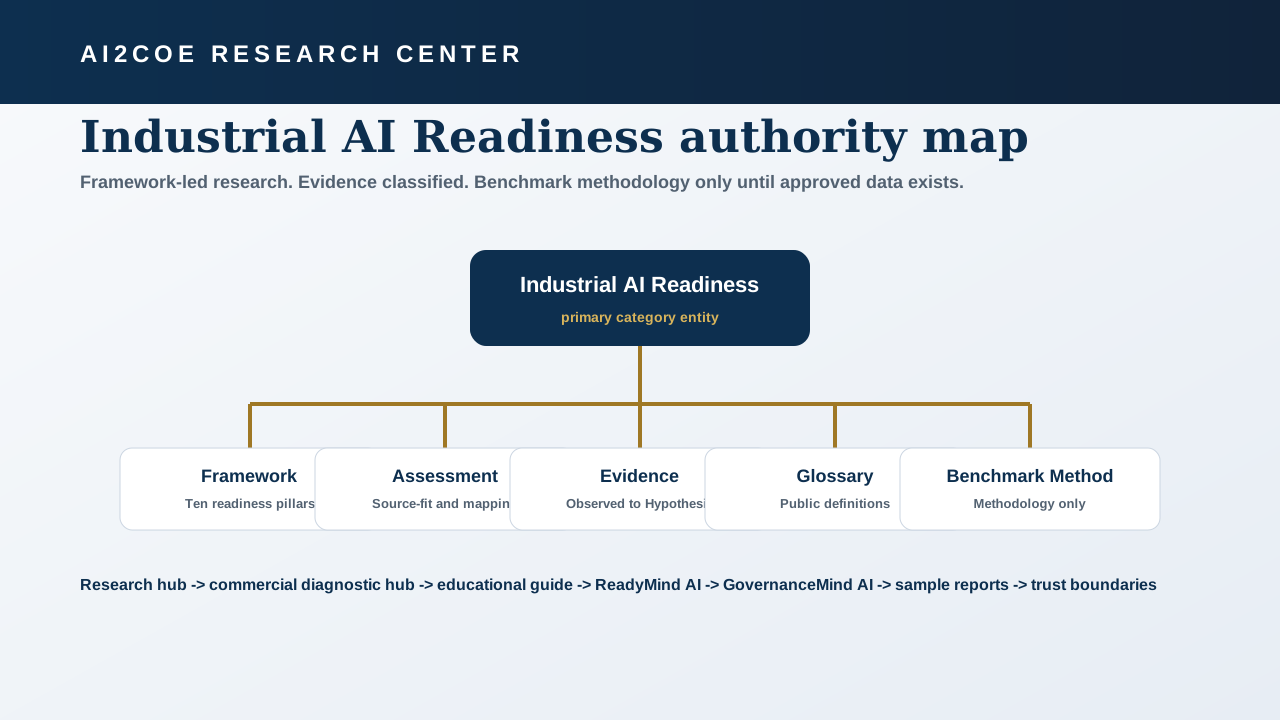
Use the research hub to understand the methodology architecture and asset roadmap.
Research assetUse the framework to understand the ten readiness pillars and boundaries.
Research assetUse the methodology page to review source-fit, field mapping, confidence tiers, and owner review.
Research assetUse evidence standards to separate Observed, Derived, Estimated, and Hypothesis statements.
Research assetUse the glossary for public-safe definitions of readiness, data export, evidence, and review terms.
Research assetUse the diagnostic hub when the team is ready to assess Industrial AI Readiness through Industrial IQ.
Do not assume models, copilots, or agents can compensate for weak operational source data.
Industrial AI depends on ERP, EAM, MRO, inventory, procurement, asset, maintenance, and governance evidence.
ERP records may still need source-fit review, field mapping, owner context, and confidence tiers.
Findings should be evidence-classified and human-reviewed before operational action.
Public research language should stay inside approved evidence classes and review boundaries.
Industrial IQ diagnostics use exported operational data, no ERP write-back, source-backed findings, confidence tiers, and human review before action. Uploaded source files are processed to generate the diagnostic report pack and then purged; summary metrics and audit metadata may be retained for governance.
No. It is executive guidance for evaluating Industrial AI Readiness. Measured benchmark reporting requires approved evidence thresholds, review rules, and governed source data.
CIO, COO, CFO, CPO, CISO, CTO, plant, reliability, ERP/data, procurement, maintenance, and transformation leaders can use it before committing to AI or modernization spend.
Start with data readiness, ERP readiness, MRO data quality, inventory readiness, procurement readiness, source-file handling, and owner review.
It focuses on industrial operating evidence: ERP/EAM exports, MRO records, inventory, procurement, asset context, maintenance readiness, evidence classes, and review governance.
No. The evaluation path starts from exported operational data and preserves the no ERP write-back boundary.
Remediate first when critical source fields, owner context, source-fit, review accountability, or governance boundaries are too weak to support trusted findings.
Human review turns evidence into accountable decisions. Owners should accept, reject, defer, investigate, or escalate findings before action.
Use the framework and assessment methodology for research depth, then use the Industrial AI Readiness diagnostic hub when the team is ready to assess exported operational data.