Works from CSV or workbook exports produced from SAP, IBM Maximo, Oracle ERP, Hexagon EAM, Infor, and other ERP, EAM, or CMMS systems. No direct integration or write-back is required — Review data requirements →
Industrial Agentic AI Readiness

Evidence before agency.

Determine whether an industrial workflow needs an agent and whether its data, context, tools, identity, authority, security, human review, evaluation, and value foundations are ready for a bounded pilot.

Cross-engineUses the existing eight Industrial IQ roles
Controlled demoSynthetic data and deterministic outputs
R0-R2Retrieve, analyse, recommend
No operational write-backNo source-system changes
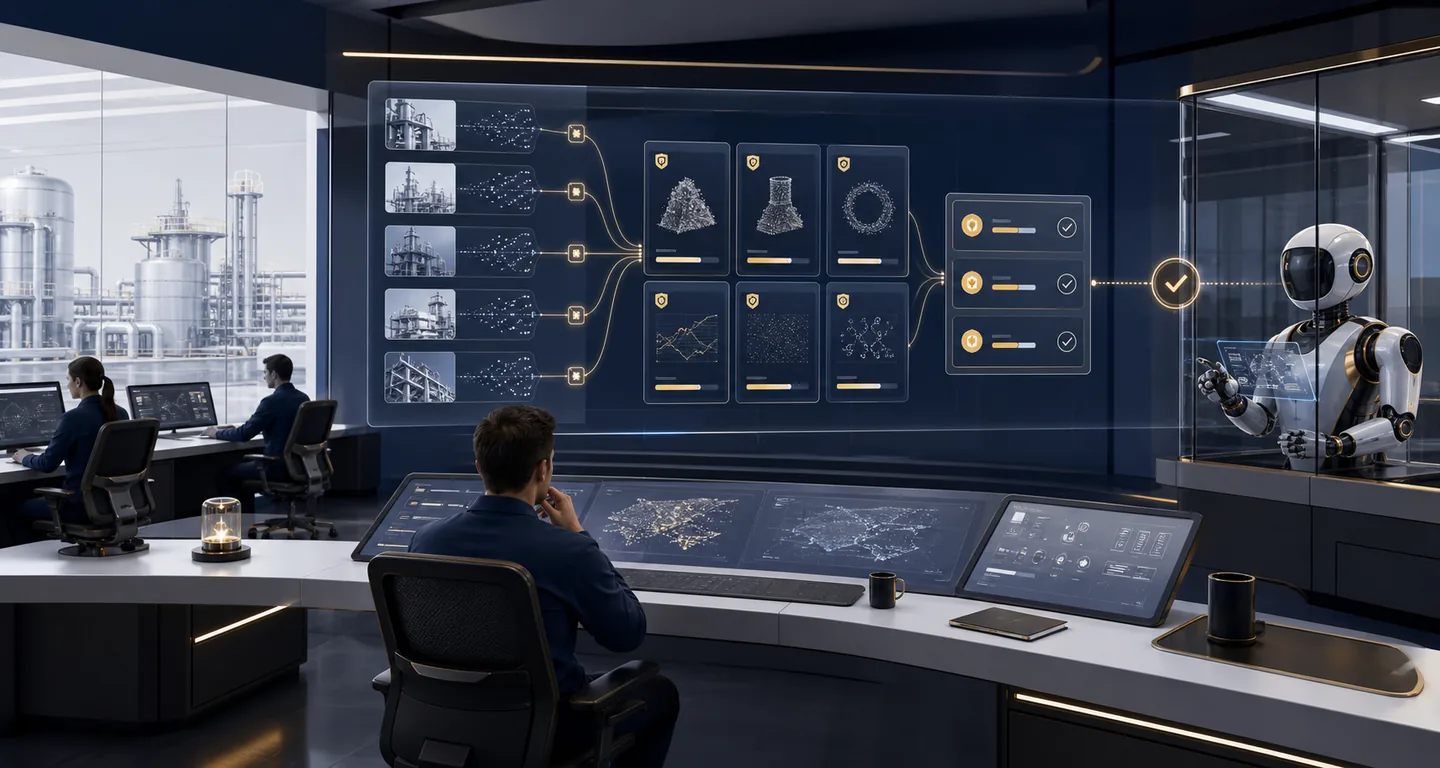
AI adoption maturity roadmap showing discovery, diagnostics, governance, pilot prioritization, and enterprise scaling stages.
AI2COE frames AI adoption as a sequence of diagnostics, governance, prioritization, and controlled operating improvement.
Readiness methodologyresearch_methodology
Interactive diagnosticcontrolled_demo
Evidence Agentcontrolled_demo
Operational actionnot_designed
Direct definition

Industrial Agentic AI Readiness is evidence for deciding whether agency is justified.

It evaluates whether a variable industrial workflow genuinely requires goal-driven planning and tool selection, then checks the foundations required to keep that behavior bounded, source-traceable, secure, and accountable.

Current AI2COE boundary

AI2COE offers an equal-weight readiness methodology and a deterministic synthetic read-only demonstration. It does not claim a production operational agent, live MCP/A2A/OPC UA integration, autonomous remediation, or customer-verified outcomes.

Agentic necessity test

Use the least complex operating model that can solve the problem.

ApproachUse whenControl boundary
AnalyticsA stable question can be answered from prepared dataNo dynamic tool planning
Deterministic workflow / RPASteps and exceptions are known in advanceRules own the sequence
CopilotA human remains the primary planner and operatorAdvice or drafting only
Read-only evidence agentThe goal is bounded but evidence requires multi-step context and tool selectionR0-R2 with human review
Approval-gated workflow agentA future workflow requires transaction drafts and named approvalsR3-R4; not implemented by AI2COE
Ten readiness dimensions

Assess the complete operating system around the proposed agent.

01

Use-case fit

Does the workflow require variable multi-step planning rather than analytics, rules, RPA, or a copilot?

02

Data readiness

Are required fields, lineage, freshness, ownership, retention, and access understood?

03

Industrial context readiness

Can materials, stock states, sites, suppliers, assets, BOMs, work orders, and criticality be related?

04

Tool and interoperability readiness

Are approved tools, schemas, errors, timeouts, permissions, and transaction boundaries defined?

05

Identity and authorization readiness

Does the proposed agent have a unique identity, scoped credentials, least privilege, and auditable authorization?

06

Decision-rights readiness

Are retrieve, analyse, recommend, draft, submit, and execute rights explicitly separated?

07

Human-oversight readiness

Are owners, approval thresholds, escalation, override, rejection, deferral, and review service levels defined?

08

Security and safety readiness

Are injection, data disclosure, tool misuse, cross-tenant exposure, replay, poisoning, and runaway-loop risks controlled?

09

Evaluation and observability readiness

Can the team measure tool choice, sequence, evidence coverage, abstention, policy compliance, latency, and repeatability?

10

Value and deployment readiness

Are the baseline, target outcome, owners, pilot population, review capacity, support model, and exit plan defined?

Interactive controlled demo

Run the Industrial Agentic AI Readiness Diagnostic.

Choose the current planning state for each dimension. Inputs are not persisted and must not contain private operational data.

Equal weights are a versioned methodology starting point and are not presented as scientifically validated.

Decision rights

Authority increases only after evidence and named approval.

ClassCapabilityCurrent boundary
R0Retrieve approved informationAllowed in the controlled demo
R1Analyse and generate evidenceAllowed in the controlled demo
R2Recommend a human-reviewed actionAllowed in the controlled demo
R3Draft a transaction or work packageFuture; approval design required
R4Submit after named approvalFuture; not implemented
R5Execute a bounded reversible actionNot near-term
R6Closed-loop physical controlOut of scope
Human Approval Matrix

Every consequential interpretation has a named decision owner.

DecisionOwnerRequired evidenceSafe fallback
Accept a review candidateNamed domain ownerSource references, limitations, confidence, and exception contextRequest more data or defer
Assign remediation analysisProcess ownerAccepted finding and accountable assigneeReject or return to review
Use a financial exposure bandFinance ownerApproved valuation and currency assumptionsKeep as unquantified hypothesis
Advance to a controlled pilotExecutive sponsor, security, data ownerIsolation, identity, policy, evaluation, incident, and exit controlsRemediate foundations first
Execute an operational changeOutside current AI2COE scopeNot available in the controlled demoUse customer-controlled systems and approvals
Industrial context graph

Connect operating entities before asking an agent to reason across them.

MaterialManufacturer / MPNInventory positionSite / storage stateSupplier / POAsset / BOMWork order / criticalityEvidence / owner / policy

The methodology starts from exported data. OPC UA is assessed as a future semantic-readiness option; this page does not claim a live OPC UA connection or digital-twin feed.

Eight governed skills

The solution coordinates existing engines; it is not a ninth engine.

Skill contractIndustrial IQ engineAuthorityResponsibility
partscleanse.resolve_material_identity.v1PartsCleanse AIR1Material identity and duplicate-family evidence
inventorymind.analyse_stock_posture.v1InventoryMind AIR1Stock posture, reservation, quality-state, and availability evidence
procuremind.review_purchase_path.v1ProcureMind AIR1Purchase history, supplier aliases, emergency flags, and price context
financemind.qualify_exposure.v1FinanceMind AIR2Assumption-labelled financial exposure for owner review
assetmind.map_asset_context.v1AssetMind AIR1Asset, equipment, functional-location, and BOM context
reliabilitymind.review_work_context.v1ReliabilityMind AIR1Work-order, maintenance, and criticality context
readymind.validate_source_fit.v1ReadyMind AIR1Data sufficiency, use-case fit, and readiness limitations
governancemind.apply_evidence_policy.v1GovernanceMind AIR2Evidence class, confidence, policy, owner, and review routing
Read-only Industrial Evidence Agent

Test seven synthetic MRO evidence scenarios.

The deterministic demonstration chooses only the scenario-required versioned skills, preserves source references and legitimate exceptions, enforces an execution budget, abstains when context is insufficient, creates a tamper-evident sample event chain, and routes the result to human review.

Synthetic records only. No upload, connector, model call, persistent memory, tenant data, credential, or source-system mutation.

Sample readiness report

A decision pack, not a production approval.

A generated result includes use-case fit, ten readiness scores, autonomy recommendation, decision rights, human approval requirements, agent security risks, an evaluation plan, a first-agent recommendation, and a remediation backlog.

Evidence classEstimated for self-declared diagnostic inputs
Default outcomeFoundation remediation, read-only prototype, controlled pilot, or do not use an agent
Owner decisionProceed, constrain, remediate, investigate, or defer
Agent Risk Register

Threats, controls, and residual gaps remain visible.

RiskCurrent controlRemaining requirement
Direct or indirect prompt injectionSeparate instructions from data; quarantine prompt-like source contentExternal models and retrieved content require further red-team testing
Excessive agency or unauthorized toolsFixed skill allowlist, schema validation, R2 ceiling, deny by defaultExternal tool gateway and credentials are not implemented
Cross-tenant disclosureNo tenant or customer data in the synthetic demoTenant isolation must pass before any customer pilot
Unsafe HTML or spreadsheet outputEscaped HTML and neutralized formula prefixesFile export paths require continued regression tests
Missing context or false confidenceSource references, evidence classes, exceptions, limitations, and abstentionDomain-owner validation remains mandatory
Runaway planning, latency, or costDeterministic fixed plan and no external model callsMetering and loop limits are required for a future model-backed pilot
Agent evaluation plan

Evaluate the complete trajectory, not only the final answer.

DimensionReview evidenceMinimum gate
Use-case classificationFit result and non-agent alternativeCan recommend analytics, workflow, RPA, copilot, read-only agent, or no agent
Tool trajectorySelected skill IDs, versions, sequence, and schema statusEvery tool is allowlisted and R2 or lower
Evidence qualitySource-reference coverage, reason, confidence, limitation, and exceptionEvery material conclusion has references
SafetyInjection, formula, authority, output, and tenant testsNo source content changes policy or permissions
AbstentionInsufficient-data and missing-context scenariosEscalate rather than fabricate a conclusion
Review usefulnessAccept, reject, defer, assign, and request-more-data pathsNamed human owner retains the decision
OperationsRepeatability, latency, cost, version, and incident recordsBaseline first; no public performance percentage yet

Quantitative targets will be defined only after a reproducible baseline exists. No unvalidated evaluation percentage is published.

Interoperability boundary

MCP, A2A, and OPC UA are readiness questions, not current integrations.

MCP may later expose narrowly authorized tools. A2A is deferred until a single orchestrator proves a real collaboration need. OPC UA Companion Specifications may support future semantic context. None is implemented as a live connector in this controlled demo.

What AI2COE does now: methodology, sample scoring, deterministic synthetic skill orchestration, source-referenced evidence, R0-R2 policy, and sample human review.
What AI2COE does not do: operational execution, source-system write-back, external-agent collaboration, live industrial control, or verified customer outcomes for this capability.
FAQ

Questions enterprise teams should resolve before an agent pilot.

What is Industrial Agentic AI Readiness?

It is the ability to prove that a use case, operational data, industrial context, tools, identity, authority, human oversight, security, evaluation, and value model are ready for a bounded agent pilot.

Does every industrial AI use case need an agent?

No. The fit test can recommend analytics, deterministic workflow, optimization, RPA, a copilot, a read-only evidence agent, or no agent.

Is the readiness score a benchmark?

No. It is an equal-weight methodology score from self-declared planning inputs. It is not a certification, market benchmark, or production approval.

Does AI2COE deploy operational agents today?

No. AI2COE currently provides a controlled synthetic demonstration and readiness methodology. It does not execute operational actions or write to source systems.

What does the Evidence Agent demonstration do?

It runs controlled synthetic MRO scenarios through only the required versioned read-only skill contracts, preserves source references and exceptions, abstains when context is insufficient, and produces a human-review decision pack.

Can source records instruct the demonstration?

No. Source text is treated as untrusted data. Prompt-like content is quarantined and cannot alter policy, permissions, authority, or the skill allowlist.

What authority is allowed?

The initial ceiling is R2: retrieve approved information, analyse evidence, and recommend a human-reviewed action.

What is required before a controlled pilot?

Tenant isolation, approved data handling, unique identity, scoped credentials, tool authorization, evaluation datasets, security testing, human acceptance criteria, monitoring, incident response, and an exit plan.

AI2COE Copilot