Works from CSV or workbook exports produced from SAP, IBM Maximo, Oracle ERP, Hexagon EAM, Infor, and other ERP, EAM, or CMMS systems. No direct integration or write-back is required — Review data requirements →
Utilities Industrial IQ Diagnostic Package

Utilities MRO catalog intelligence for outage readiness.

Utilities manage long-lived infrastructure, high reliability expectations, regulated service obligations, and geographically distributed spares. Duplicate item records can inflate working capital while also making critical spares harder to find during outages and planned maintenance. PartsCleanse AI provides a bounded, CSV-first diagnostic that quantifies exposure and creates a governed review backlog for infrastructure operators. Industrial IQ connects the sector-specific issue to catalog, inventory, procurement, finance, asset, reliability, readiness, and governance diagnostics.

Duplicate-riskplanning lens
Outage-readiness andcapital lens
Generation, grid,water, and facilities coverage
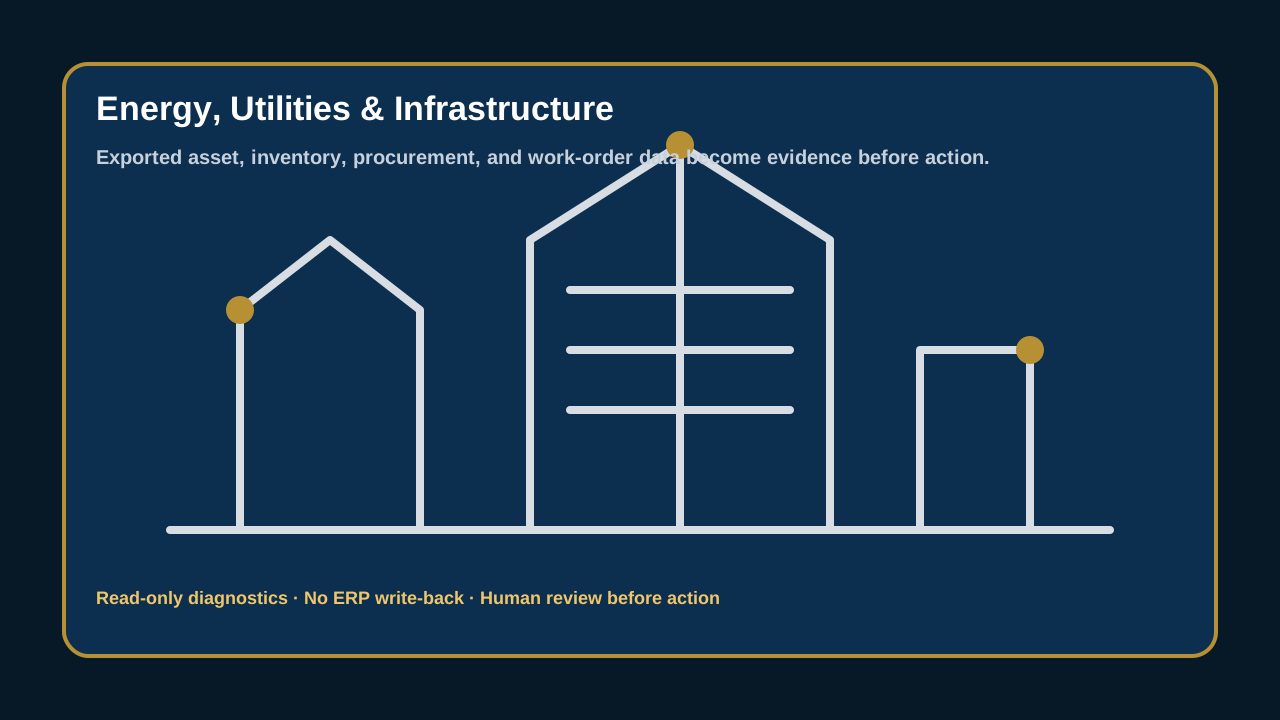
Energy and utilities diagnostic visual showing substations, plants, work orders, inventory stores, procurement signals, and governance controls connected to Industrial IQ.
Energy, utilities, rail, telecom, ports, and critical infrastructure pages use this family when uptime, outage readiness, and governed asset evidence are the buyer context.
Evidence summary

Industry evidence path

Utilities Outage Readiness and Critical Spares: Industry operators use this path to connect operating pressure to the right Industrial IQ diagnostic, source files, report outputs, and governance controls. Assess utilities asset data, outage readiness, critical spares, inventory governance, and maintenance-readiness evidence from exported ERP, EAM, and CMMS data.

Run Industry Snapshot
Review ownerIndustry operators, plant leaders, site owners, finance, procurement, maintenance, and CIO teams
Input file contextIndustry-specific ERP, EAM, CMMS, inventory, procurement, asset, and work-order exports.
Diagnostic evidenceA recommended Industrial IQ engine pack with buyer-role interpretation, value levers, pilot path, and governance controls.
Recommended actionRun the industry-specific Industrial IQ Snapshot and review the engine pack sequence.
SAP 2027

SAP ECC end-of-support is driving a wave of S/4HANA migrations in Utilities. Material master rationalization is a pre-migration requirement — not a post-migration cleanup.

SAP Migration Guide →
Executive decision context · Utilities Industrial IQ diagnostic intelligence

Utilities manage long-lived infrastructure, high reliability expectations, regulated service obligations, and geographically distributed spares. Duplicate item records can inflate working capital while also making critical spares harder to find during outages and planned maintenance. PartsCleanse AI provides a bounded, CSV-first diagnostic that quantifies exposure and creates a governed review backlog for infrastructure operators.

Competitive differentiator — evidence before transformation · Utilities

Industrial IQ routes Utilities exports across the relevant engine pack instead of treating every problem as catalog cleansing. Catalog, inventory, procurement, finance, asset, reliability, readiness, and governance findings stay source-backed, confidence-tiered, and human-reviewed. Planning benchmarks: Duplicate-risk planning lens; Outage-readiness and capital lens. Delivery starts from exported data — no ERP write-back required.

Guided Diagnostic Selector

Choose the pilot by buyer role, pain point, and data already available.

Utilities Industrial IQ should not force buyers to guess the right engine. The selector translates role and pain into the recommended Industrial IQ pilot, minimum data file, expected report, and next action.

Pain-to-engine routing
Buyer painRecommended engineReadinessMinimum evidence file
Duplicate or inconsistent item recordsPartsCleanse AICommercial Pilot ReadyMaterial master / item master / supplier and UOM fields
Dead stock, excess inventory, stockout riskInventoryMind AICommercial Pilot ReadyInventory balance, movement, criticality, min/max
Emergency buys, repeat purchases, supplier leakageProcureMind AIEnterprise Pilot AvailablePurchase orders, supplier, price, emergency flags, stock on hand
Board-level exposure and carrying costFinanceMind AIEnterprise Pilot AvailableInventory value, cost assumptions, duplicate or leakage evidence
Asset-to-part gaps and critical spare coverageAssetMind AISample Diagnostic AvailableAsset register, material master, BOM/work-order references
Work-order readiness and false stockout riskReliabilityMind AISample Diagnostic AvailableWork orders, asset IDs, parts required, stock on hand
ERP, data, and AI readinessReadyMind AISample Diagnostic AvailableERP export sample, ownership, approval status, governance context
Owner review, audit trail, responsible AIGovernanceMind AIEnterprise Pilot AvailableFindings, confidence, review status, source records, owners
Industry ICP Experience Map

Utilities buyers should see the recommended engine pack before they read the full page.

Each industry has different risk language, but the buyer journey should stay predictable: operating problem, recommended engines, required files, report output, trust controls, and next action.

Buyer interpretation
Industry buying room

Utilities: inspect operational proof before transformation spend.

For Utilities, the strongest Industrial IQ path is Asset-to-Part Intelligence, Maintenance Readiness Intelligence, Inventory Risk Intelligence, Evidence Governance Intelligence, Working Capital Intelligence. The diagnostic question is practical: before cleanup, optimization, migration, automation, or governance work begins, what does exported operational data already prove?

Operating pressure: regulated reliability, critical infrastructure spares, outage readiness, and asset-to-part coverage.

Industry diagnostic question
15-day diagnostic question: Can utility asset, inventory, and work-order exports prove critical-spare readiness before outage or regulatory review?
Trust boundaryNo ERP write-back. Source files purged after report generation. Human review before action. Source-backed evidence, confidence tiers, and no uncontrolled remediation.
Executive actionClean this first, reduce this exposure, review this supplier pattern, validate critical spares, prepare EAM cleanup, justify budget, or start governance review.
Best-fit Industrial IQ engines

Recommended engines for this industry pathway.

ICP pain matrix

What the Utilities buying committee needs to see.

RoleNeedIndustrial IQ evidenceDecision after report
CEO enterprise resilience and transformation confidence Utilities risk themes that are measurable from exported operational data fund the diagnostic path before larger transformation spend
CFO working capital, exposure, and budget justification inventory value, leakage, carrying-cost, and assumption labels decide whether the value case is finance-reviewable
COO uptime, throughput, site readiness, and operational accountability regulated reliability, critical infrastructure spares, outage readiness, and asset-to-part coverage prioritize sites, assets, and workstreams for action
CIO / CTO source-system safety, exportability, and AI readiness mapped ERP, EAM, CMMS, procurement, asset, and work-order fields decide whether data can support diagnostics before integration
CISO / Legal control boundary, data handling, auditability, and limitation language no-write-back posture, human review, evidence traceability, and report history approve the diagnostic model before broader AI adoption
Procurement supplier fragmentation, emergency buys, and contract leakage PO, supplier, stock, and item-reference evidence review leakage before sourcing or policy changes
Maintenance / Reliability critical spare readiness, work-order execution, and false stockout risk asset, work-order, inventory, and material evidence fix readiness blockers before planned or urgent work
ERP / data governance field completeness, ownership, and cleanup sequencing source-field gaps, confidence tiers, and owner actions create a governed remediation backlog without uncontrolled master-data change
Data files needed

Ask for exports the operating teams already understand.

  • material or item master
  • inventory balances and stock movement
  • purchase-order history
  • asset register and hierarchy
  • BOM or asset-to-part references
  • work orders and maintenance schedule
  • supplier or price history
  • criticality, site, plant, storeroom, or property context
What this is not replacing
ERP / EAM / CMMSSystems of record manage transactions and execution. Industrial IQ inspects exported records for risk, confidence, and action priority.
MDM / data cleansingCleansing tools improve records. Industrial IQ helps prove what should be cleaned first and why it matters commercially.
Procurement suitesSource-to-pay tools manage workflows. Industrial IQ diagnoses leakage across procurement, inventory, and maintenance context.
APM / predictive maintenanceReliability platforms surface asset signals. Industrial IQ checks whether spares, work orders, and asset links can support action.
BI / consulting assessmentsDashboards and advisory work explain performance. Industrial IQ contributes source-backed evidence from the buyer's own exports.
8-engine industry readiness map

How all Industrial IQ products apply to Utilities without forcing a one-engine story.

The lead engines answer the first buyer question. Supporting and contextual engines keep the buying committee prepared when the diagnostic expands into finance, procurement, asset, reliability, readiness, or governance review.

EngineFitBuyer roleData to testEvidence output
PartsCleanse AI Contextual check ERP / data, materials, procurement, and maintenance Description duplicate-family evidence, missing discriminator fields, UOM conflicts, cleanup priority, and reviewer queue
InventoryMind AI Supporting diagnostic COO, CFO, inventory, materials, and maintenance Material Id, Quantity stock exposure bands, slow-moving inventory, min/max exceptions, stockout risk, and carrying-cost review items
ProcureMind AI Contextual check CPO, procurement, category management, internal audit, and CFO Po Number, Description supplier alias signals, emergency-buy rows, PO-to-stock exceptions, repeated buys, and price variance findings
FinanceMind AI Supporting diagnostic CFO, finance, FP&A, controllership, and board sponsors Material Id, Stock Value finance-reviewable exposure bands, assumptions, limitation labels, carrying cost, and action value status
AssetMind AI Lead diagnostic Asset integrity, maintenance, reliability, ERP / data, and COO Asset Id, Description linked, weakly linked, and unlinked asset-part records with criticality, asset status, and spare coverage context
ReliabilityMind AI Lead diagnostic Maintenance, reliability, COO, plant operations, and shutdown planning Work Order, Description work-order readiness gaps, critical-spare availability, repeat failure support signals, and action priority
ReadyMind AI Contextual check CIO / CTO, ERP owners, data governance, transformation, and AI program leaders Process Name, Data Source field completeness, ownership gaps, source-fit score, AI readiness boundary, and blocked-use-case reasons
GovernanceMind AI Supporting diagnostic CISO, legal, audit, CIO, governance, and transformation leadership Finding Id, Finding Type review queues, decision reasons, confidence tiers, source records, audit metadata, and owner status
Trust boundary: no ERP write-back, source files purged after report generation, confidence-tiered evidence, and human review before operational action.
Industry Pilot Pack

Run Utilities like a bounded Industrial IQ pilot, not a generic content journey.

Focus on outage readiness, regulated evidence, critical spare coverage, and asset traceability.

No ERP write-back. Source files purged after report generation. Human review before action.

Data files to request
01Material or item master export
02Inventory balance export
03Purchase-order export
04Asset register or work-order export
Recommended engine sequence

Which engine answers which pilot question for Utilities.

EnginePilot questionReport output
AssetMind AI Which assets have weak part coverage, orphan spares, obsolete equipment linkage, or critical spare gaps? AssetMind AI Asset-to-Part Risk Report
ReliabilityMind AI Which work orders, planned outages, assets, or repeat failures are exposed by spare availability gaps? ReliabilityMind AI Maintenance Readiness Report
GovernanceMind AI Can findings be traced, reviewed, approved, audited, and kept outside ERP until owners authorize action? GovernanceMind AI Governance Review Report
InventoryMind AI Which inventory positions are dead, excess, slow-moving, duplicated, or creating stockout exposure? InventoryMind AI Inventory Risk Report
PartsCleanse AI Which catalog records are likely duplicate, unsafe to merge, or financially material enough to review first? PartsCleanse AI Catalog Diagnostic Report
Regional diagnostic paths

Utilities buyers can evaluate the same industry problem through USA, Europe, and GCC operating lenses.

These are regional decision modules, not thin country pages. Each path keeps the same Industrial IQ control boundary: exported data, read-only diagnostics, source-backed evidence, source-file purge after report generation, and human review before action.

United States operating lens

United States diagnostic relevance for Utilities

U.S. Utilities teams usually evaluate Industrial IQ when multi-site MRO catalogs, inventory positions, procurement activity, and maintenance records disagree before ERP cleanup, inventory action, or AI adoption.

Buyer risksite-level operating risk, working-capital exposure, emergency buys, and ERP-readiness friction across plants, fleets, utilities, data centers, and facilities portfolios.
Diagnostic questionCan exported material, inventory, procurement, and work-order data show which site-level gaps are driving duplicate stock, false stockouts, emergency buys, or readiness risk?
Report outputSite-prioritized evidence rows, confidence tiers, exposure bands, and owner-routed actions.

Engine fit: Asset-to-Part Intelligence, Maintenance Readiness Intelligence, Inventory Risk Intelligence, Evidence Governance Intelligence. Likely exports: SAP, Maximo, Oracle, EAM, CMMS, CSV / Excel extracts.

Request U.S. Diagnostic Pilot
Europe operating lens

Europe diagnostic relevance for Utilities

European Utilities buyers often need a controlled evidence path across plants, depots, regulated assets, suppliers, and cross-border operating models before standardization or modernization work is funded.

Buyer riskcost discipline, regulated operating continuity, supplier fragmentation, SAP/ERP modernization, and AI-governance review across multi-country operations.
Diagnostic questionCan Industrial IQ separate local naming, supplier, site, and asset-linkage issues from enterprise-wide readiness, procurement, or working-capital concerns?
Report outputCountry/site comparison signals, governance-ready limitations, engine fit, and review actions for ERP/data owners.

Engine fit: Asset-to-Part Intelligence, Maintenance Readiness Intelligence, Inventory Risk Intelligence, Evidence Governance Intelligence. Likely exports: SAP, Maximo, Oracle, EAM, CMMS, CSV / Excel extracts.

Review Europe Diagnostic Path
GCC operating lens

GCC diagnostic relevance for Utilities

GCC Utilities operations often combine critical infrastructure, capital projects, distributed stores, long lead-time spares, and urgent procurement pressure that must be inspected before platform or remediation spend.

Buyer riskcritical-spare readiness, shutdown exposure, long lead-time spares, local buying variance, and SAP/ERP readiness across capital-intensive sites.
Diagnostic questionCan exported records identify which critical-spare, procurement, and shutdown-readiness signals require owner review while source systems remain untouched?
Report outputShutdown-readiness evidence, procurement leakage signals, confidence tiers, and no-write-back action priorities.

Engine fit: Asset-to-Part Intelligence, Maintenance Readiness Intelligence, Inventory Risk Intelligence, Evidence Governance Intelligence. Likely exports: SAP, Maximo, Oracle, EAM, CMMS, CSV / Excel extracts.

Request GCC Diagnostic Review
Regional data readiness

What to prepare before the regional review.

Start with material, inventory, procurement, asset, and work-order exports. Optional fields such as site, plant, storeroom, supplier, manufacturer, criticality, and work-order priority improve diagnostic confidence.

Trust boundary
No ERP write-back. Source files purged after report generation. Human review before action. Uploaded source files are processed to generate the diagnostic report pack and then purged. Summary metrics, Open Findings, report ownership, quota usage, feedback, and audit metadata may be retained for governance.
ICP and country authority map

Utilities: qualify the buyer before choosing a country, engine, or upload path.

Industry pages now connect buyer role, readiness trigger, source data, sample proof, and country authority paths so ICP visitors can self-select a credible next action.

Explore country pages
Best-fit country paths
Illustrative diagnostic scenarios

What a Utilities diagnostic can reveal before remediation starts.

These scenarios are illustrative and use no customer data. They show how Industrial IQ converts exported records into reviewer-ready findings, confidence tiers, reports, and action queues without changing source systems.

Illustrative diagnostic scenario — no customer data used

Scenario 1: Asset-to-Part Intelligence

Which assets have weak part coverage, orphan spares, obsolete equipment linkage, or critical spare gaps?

Data uploadedAsset Id, Description
Diagnostic evidenceFindings show asset ID, hierarchy, part reference, BOM coverage, criticality, review level, and EAM owner action.
Owner actionValidate high-criticality gaps with maintenance and update the asset-to-part review backlog before ERP change.
Run Free Industrial IQ Snapshot
Illustrative diagnostic scenario — no customer data used

Scenario 2: Maintenance Readiness Intelligence

Which work orders, planned outages, assets, or repeat failures are exposed by spare availability gaps?

Data uploadedWork Order, Description
Diagnostic evidenceFindings show work order, asset, required spare, stock context, shutdown or repeat-demand signal, review level, and owner action.
Owner actionProtect shutdown-critical items, review false stockouts, and assign owners to readiness gaps before planned work begins.
Run Free Industrial IQ Snapshot
Illustrative diagnostic scenario — no customer data used

Scenario 3: Inventory Risk Intelligence

Which inventory positions are dead, excess, slow-moving, duplicated, or creating stockout exposure?

Data uploadedMaterial Id, Quantity
Diagnostic evidenceFindings show item, site, movement age, value, criticality, policy exception, review level, and action class before stocking change.
Owner actionSeparate stock reduction candidates from protected critical spares and route exceptions to inventory owners.
Run Free Industrial IQ Snapshot
Illustrative diagnostic scenario — no customer data used

Scenario 4: Evidence Governance Intelligence

Can findings be traced, reviewed, approved, audited, and kept outside ERP until owners authorize action?

Data uploadedFinding Id, Finding Type
Diagnostic evidenceFindings show source reference, analyzer reason, review state, audit event, limitation, and no-write-back boundary evidence.
Owner actionAssign review owners, separate approved findings from needs-review items, and export audit evidence for governance meetings.
Run Free Industrial IQ Snapshot
Diagnostic evidence output

What Utilities buyers receive after the report pack is generated.

Industrial IQ does not ask the buyer to accept a black-box recommendation. It produces traceable evidence, confidence-scored output, report interpretation, and owner review states that support a decision before cleanup, migration, inventory change, procurement action, or AI adoption.

OutputWhat it containsDecision it supports
Evidence records Source rows, related records, reason codes, and operating context for Utilities review. Can utility asset, inventory, and work-order exports prove critical-spare readiness before outage or regulatory review?
Confidence tiers High-confidence, needs-review, and exception findings separated so owners can approve or reject action. Can utility asset, inventory, and work-order exports prove critical-spare readiness before outage or regulatory review?
Diagnostic score A report-ready score that summarizes data quality, exposure, readiness, and governance constraints. Can utility asset, inventory, and work-order exports prove critical-spare readiness before outage or regulatory review?
Executive report A CFO/COO/CIO-readable summary with assumptions, limitations, exposure bands, and next-step decision logic. Can utility asset, inventory, and work-order exports prove critical-spare readiness before outage or regulatory review?
Action tracker Owner-routed actions with accepted, rejected, deferred, and needs-more-data states. Can utility asset, inventory, and work-order exports prove critical-spare readiness before outage or regulatory review?
Score history Recurring diagnostic history where repeat reviews are used to track improvement and open findings. Can utility asset, inventory, and work-order exports prove critical-spare readiness before outage or regulatory review?
No ERP write-back. Source files purged after report generation. Human review before action. Uploaded source files are processed to generate the diagnostic report pack and then purged. Summary metrics, Open Findings, report ownership, quota usage, feedback, and audit metadata may be retained for governance.
Your Role. Your Engine. Your Evidence.

Utilities Industrial IQ should answer the buyer's first five questions without a sales call.

Enterprise buyers do not evaluate Industrial IQ as one person. Finance, operations, procurement, maintenance, ERP, security, and board sponsors each need a different proof path. This console gives every ICP a fast route to the right engine, data requirement, output, and trust control.

Enterprise Decision Model

Find my role. Pick my engine. See the data. Trust the output. Act safely.

Buyer identityChoose the role that owns the decision so the page presents value, risk, proof, and evaluation concerns in the right language.
Industry contextMatch the diagnostic pack to sector-specific operating reality instead of forcing every buyer through a generic product story.
Source data clarityShow minimum viable upload, best upload, sample datasets, field mapping, and what happens when fields are missing.
Output proofExpose sample reports, evidence tables, review levels, score interpretation, action tracker, and score history before private upload.
Trust boundaryKeep no ERP write-back, owner review, review levels, audit evidence, and sample-versus-uploaded-data labeling visible near the CTA.
Engine Recommendation Matrix

Choose the engine by decision owner, data file, and operating question.

EngineDecision domainPrimary ICPMinimum uploadAction
PartsCleanse AI Catalog Intelligence CFO, CIO, Procurement, Maintenance, and Materials leaders Description Run
InventoryMind AI Inventory Risk Intelligence CFO, COO, Inventory, Materials, and Supply Chain leaders Material Id, Quantity Run
ProcureMind AI Procurement Leakage Intelligence CPO, Procurement Director, CFO, and Supply Chain leaders Po Number, Description Run
FinanceMind AI Working Capital Intelligence CFO, Finance Head, Procurement, and Board advisors Material Id, Stock Value Run
AssetMind AI Asset-to-Part Intelligence Asset Integrity, Maintenance, Reliability, and Operations leaders Asset Id, Description Run
ReliabilityMind AI Maintenance Readiness Intelligence Maintenance Director, Reliability Manager, COO, and Plant leaders Work Order, Description Run
ReadyMind AI AI Readiness Intelligence CIO, CTO, COO, Data Governance, and AI Transformation leaders Process Name, Data Source Run
GovernanceMind AI Evidence Governance Intelligence CISO, CIO, Audit, Governance, and Transformation leaders Finding Id, Finding Type Run
Industry thesis

Utilities MRO catalog intelligence for outage readiness.

Utilities manage long-lived infrastructure, high reliability expectations, regulated service obligations, and geographically distributed spares. Duplicate item records can inflate working capital while also making critical spares harder to find during outages and planned maintenance. PartsCleanse AI provides a bounded, CSV-first diagnostic that quantifies exposure and creates a governed review backlog for infrastructure operators.

AI2COE treats this as an evidence problem before it becomes a transformation program. The first step is a bounded Industrial IQ diagnostic reviewed by finance, operations, procurement, maintenance, reliability, data, and governance leaders before system change is authorized.

The platform is deliberately conservative. It scores evidence, applies confidence and review logic, separates benchmark language from uploaded-data findings, and recommends owner-routed actions. No ERP, EAM, CMMS, procurement, inventory, or asset record is changed by algorithmic output alone.

What the data shows
Duplicate-riskplanning lens
Outage-readiness andcapital lens
Generation, grid,water, and facilities coverage
Recommended Industrial IQ engine pack

Recommended diagnostic package for Utilities.

Industrial IQ uses the Utilities operating model to route uploaded data into the right engine pack across catalog, inventory, procurement, finance, assets, reliability, readiness, and governance. The recommended engines below reflect the buyer's operating problem rather than defaulting every journey to one product.

Focus on outage readiness, regulated evidence, critical spare coverage, and asset traceability.

outage readinessregulatory auditcritical spare assuranceasset-to-part traceability
Leadership interpretation
CFO interpretationWorking-capital exposure, carrying cost, procurement leakage, and renewal value evidence.
COO interpretationUtilities operating risk, uptime exposure, site friction, and recurring improvement visibility.
CIO interpretationExport quality, mapped fields, no ERP write-back, governance readiness, and AI adoption confidence.
Procurement interpretationSupplier leakage, emergency buys, repeated purchases, duplicate buying paths, and price-variance signals.
Maintenance interpretationCritical-spare readiness, false stockout, work-order risk, asset coverage, and shutdown planning evidence.
Required data files

Best results come from a mapped export pack.

  • Asset register: asset ID, status, equipment class, site, criticality
  • Work-order export: work order, asset, part, priority, planned shutdown, failure code
  • Findings export: finding ID, source record, description, confidence
  • Inventory balance CSV: material ID, quantity, stock value, site, min/max
  • Material or item master CSV: description, manufacturer, MPN, supplier, UOM, site, value
Sample intelligence cards
AssetMind AIasset intelligence score
ReliabilityMind AImaintenance readiness score
GovernanceMind AIgovernance readiness score
InventoryMind AIinventory health score
PartsCleanse AIcatalog health score
Sample mode is labeled. Uploaded-data mode replaces assumptions with mapped source records, evidence rows, confidence tiers, report output, action items, and score-history entries.
Industry knowledge model

How AI2COE reads the Utilities operating environment.

Asset reality

Asset reality

Generation, grid, water, and critical infrastructure operators carry distributed spares across long-lived assets.

AI adoption risk

AI adoption risk

Outage-readiness automation fails when critical spares are hidden behind duplicate item records.

Industrial IQ role

Industrial IQ role

Use asset, reliability, inventory, governance, and finance diagnostics to prove critical-spares and outage-readiness priorities.

Board-level value thesis

The diagnostic converts catalog disorder into an executive decision.

For Utilities leaders, the issue is not whether operational data is imperfect. The issue is which imperfection is material enough to justify cleanup, optimization, governance, or transformation spend. AI2COE frames that answer in terms of value exposure, operating risk, confidence level, and accountable ownership.

The report is structured so finance can see capital exposure, operations can see uptime and execution risk, procurement can see leakage patterns, maintenance and reliability can see readiness gaps, and data governance can see what must be reviewed before any ERP, EAM, CMMS, procurement, or AI workflow change.

Executive interpretation model
FinancialCapital tied to duplicate inventory, carrying cost, overbuy exposure, and reorder distortion
OperationalPlanner search friction, maintenance delay risk, supplier alias confusion, and site-level inconsistency
GovernanceConfidence-tiered review workflow with no automatic item retirement from ERP
Executive proof model

Utilities leaders need source-backed findings, not generic data-quality claims.

This planning view translates catalog, inventory, procurement, operating, and governance assumptions into the language buyers use before approving action. Final values require the actual PartsCleanse AI report after upload and owner review.

CFO / FinanceEstimatecapital exposure signal

Uses local currency notation only after source records support a finance-reviewed calculation.

ProcurementRangerecoverable working-capital scenario

Frames duplicate-family cleanup as supplier, buying-channel, and item-standardization leverage rather than a spreadsheet exercise.

OperationsSignalcarrying-cost and readiness context

Connects catalog quality to outage readiness, generation and grid reliability, regulated spares, and regional depot visibility.

CIO / Data GovernanceCSV onlyno ERP write-back

Creates a review backlog that data owners can govern before any SAP, Maximo, Oracle, EAM, or CMMS change is authorized.

Evidence boundary: Values are planning ranges until the actual report uses uploaded catalog records, quantities, unit costs, duplicate-family confidence, and owner-approved remediation assumptions.
Buying committee interpretation

What each executive role needs to see before approving action.

The same evidence row can mean capital exposure to finance, uptime risk to operations, leakage to procurement, readiness risk to maintenance, and control posture to governance. AI2COE makes those interpretations explicit so the diagnostic becomes a management decision, not an analyst worksheet.

CFO / Finance

Capital exposure, carrying cost, recoverable working capital, and whether a remediation case is large enough to fund.

Uses Outage-readiness and capital lens to decide if catalog cleanup is a board-level working-capital issue.

CPO / Procurement

Supplier alias leakage, repeated buying, off-contract exposure, and duplicate purchase pathways created by fragmented item records.

Uses duplicate-family evidence to focus sourcing and item-standardization work.

COO / Operations

Planner search friction, downtime exposure, site inconsistency, and whether untrusted catalog data is weakening operational readiness.

Uses Duplicate-risk planning lens to prioritize the operating units with the highest cleanup urgency.

CIO / ERP Owner

ERP, EAM, CMMS, and material-master readiness before migration, governance, or AI automation spend.

Uses the no-write-back diagnostic to create a controlled remediation backlog.

Maintenance / Reliability

Whether similar records are true duplicates or unsafe matches because of size, pressure, material, model, part type, or UOM conflicts.

Uses Utilities operating context to route findings to the right technical owners.

Target ICP and buying intent -- Utilities

Who should care, why now, and what makes the buyer ready.

This page is written for the buying committee that has to defend action: finance, operations, procurement, maintenance, and ERP ownership. The strongest buying signal is not curiosity about AI; it is a measurable operating problem with a data extract behind it.

Ideal customer profile

Utilities organizations with fragmented MRO, ERP, EAM, or CMMS catalog data.

Asset context: generation assets, grid infrastructure, water plants, wastewater assets, substations, depots, and field stores.

Commercial pressure: outage response, restoration readiness, regulated service obligations, regional stock imbalance, and capital discipline.

Operating risk: field crew delays, storm-response gaps, duplicate safety stock, and critical-infrastructure maintenance risk.

Buying committee

The decision is cross-functional because the value is cross-functional.

Owners: operations, grid or plant maintenance, field services, procurement, finance, and asset management.

Board question: Is the duplicate-catalog exposure large, risky, and governable enough to justify action now?

Trigger: outage readiness, restoration SLA, or regulated capital review.

Buying intent triggers

Signals that the account is ready for a diagnostic conversation.

01

Storm, outage, or service restoration programs expose weak spare visibility across depots.

02

Regional crews create local items for the same part, inflating working capital.

03

Capital and rate-case discipline requires inventory evidence, not anecdotal cleanup claims.

04

ERP or EAM modernization needs a trusted material baseline before process redesign.

Evidence required

What the buyer should bring to make the first run useful.

  • 01Include region, depot, plant, asset class, description, quantity, cost, UOM, manufacturer, and MPN.
  • 02Preserve criticality and emergency-stock indicators where available.
  • 03Retain field-service or depot context so findings can be routed to the right operating owners.
  • 04Include supplier and contract fields if procurement leakage is part of the business case.
Buyer decision rule: If the buyer has accessible catalog data, an accountable owner, and a measurable operating or financial pain, the conversation should move directly to a diagnostic run.
Decision objections -- answered before the diagnostic

What the buying committee will challenge, and what AI2COE must prove.

A serious buyer does not purchase an AI diagnostic because a page sounds impressive. They buy when the evidence survives finance, operations, procurement, ERP, and data-governance scrutiny. This is the objection model AI2COE uses for Utilities.

CFO challenge

Is this large enough to fund?

Translate duplicate-family evidence into capital exposure, carrying-cost leakage, and recoverable working-capital range for Utilities.

COO challenge

Will this improve operating performance?

Connect catalog disorder to stockout signals, urgent buys, planner friction, downtime risk, and site-level ownership in Utilities.

Procurement challenge

Can we standardize without breaking supply continuity?

Preserve manufacturer, MPN, UOM, supplier, site, and substitute context so consolidation is governed, not blind.

CIO / ERP challenge

Will this create an integration project?

Run from a controlled CSV or workbook export first. No ERP write-back, no source-row retention, and no uncontrolled master-data change.

Competitor challenge

Generic cleansing tools will call look-alikes duplicates.

Use industrial discriminator controls across size, pressure class, material family, model number, part category, UOM, and functional subtype.

Data-owner challenge

Our column names will not match your model.

Map the buyer's fields on-screen, measure completeness, and flag the exact evidence gaps before the engine runs on asset class, region, depot, material description, UOM, cost, quantity, manufacturer, MPN, and criticality.

Evidence standard: If a claim cannot be tied to uploaded data, owner accountability, confidence level, or business value, it should not appear as a recommendation.
What Industrial IQ diagnoses for Utilities

Specific operational data risks Industrial IQ surfaces and quantifies.

  • Duplicate spares across generation sites, substations, plants, depots, and maintenance stores.
  • Outage-readiness review for critical spares, supplier aliases, and equivalent-looking records.
  • Capital-at-risk and carrying-cost analysis for finance, asset management, and procurement.
  • Governed review workflow before ERP, EAM, or CMMS master-data remediation.
One diagnostic path. Multiple evidence layers. Industrial IQ can route exported data into catalog, inventory, procurement, finance, asset, reliability, readiness, and governance analysis. Output is evidence, score, report, action ownership, and recurring review -- no ERP write-back required.
AI2COE product system for Utilities

Industrial IQ sequences diagnostics from data trust to operating economics.

Industrial IQ recommends the right engine sequence for the operating problem: catalog quality, inventory risk, procurement leakage, working capital, asset-to-part coverage, reliability readiness, AI readiness, or evidence governance. PartsCleanse AI is one engine in that family, not the default answer for every buyer.

Sequencing logic: The strongest first diagnostic depends on the buyer's risk. Some teams start with catalog evidence, while others start with inventory, procurement, finance, asset, reliability, readiness, or governance evidence.
Executive decision evidence paths

Where Utilities buyers go next when they are serious.

These pages answer the commercial and technical objections that usually appear before a diagnostic is approved.

Sample catalog mapping

Test the diagnostic before exposing real Utilities data.

Use the synthetic SAP-style sample pack to validate upload, findings, Open Findings review, and report generation. The recommended starting file for this sector is focused on electrical parts, valves, pumps, field consumables.

sap_mro_sample_11.csvRecommended public test catalog for this industry context
Evaluation workflow
01Download the synthetic CSV or full 25K ZIP pack
02Run PartsCleanse AI from the protected diagnostic workbench
03Compare browser findings, Excel, Word, PDF, and Open Findings logic
Your Utilities pain point -- submit it for a diagnostic assessment

Tell us the operational problem. We will tell you if it is quantifiable.

Estimated value signal: Estimate pending. Displayed in USD — US Dollar from buyer-entered planning assumptions. Financial interpretation depends on uploaded data, actual quantities, unit costs, evidence quality, and owner-approved remediation decisions.
What we assess
Revenue protectionCan the problem be tied to stock-out, downtime, or emergency procurement?
Cost reductionCan duplicate inventory, procurement leakage, or carrying cost be quantified?
Governance readinessDoes operational data exist to run a diagnostic and govern a remediation?
Best-fit submissions: duplicate inventory, procurement leakage, maintenance backlog, field-service inefficiency, supplier alias complexity, compliance documentation gaps, or downtime leakage. We respond within one business day.
AI Centre of Excellence automation map

High-value AI automations for Utilities -- sequenced after diagnostic evidence.

Clean, connected, and reviewable operational data improves the economics and trustworthiness of every downstream automation. Industrial IQ positions the first engine by the buyer's evidence problem, not by a one-product default.

AutomationWhat it doesStatistical value range
PartsCleanse AI Generation, grid, water, and facilities MRO duplicate detection. Duplicate-risk and carrying-cost assumptions are modeled until uploaded evidence replaces them.
Outage-readiness intelligence AI ranks critical spare availability, supplier constraints, and site-level exposure. Readiness-review impact requires observed planning workflow evidence.
Asset maintenance intelligence AI links work orders, asset families, and parts demand for risk prioritization. Maintenance productivity impact requires buyer workflow evidence.
Procurement and inventory governance AI highlights duplicate supplier and item pathways across regions. Spend-stewardship opportunity is an estimate until spend context is reviewed.
Evidence note: Statistical ranges are planning assumptions used for executive sizing. Financial interpretation depends on uploaded data, actual unit values, quantities, owner-approved remediation, and the operating model of Utilities.
AI adoption pathway for Utilities

The six-stage diagnostic-first sequence -- written for this buying committee.

The pathway below is not a generic AI roadmap. It tells a Utilities buyer what evidence must exist, who needs to own it, and how the diagnostic turns interest into an approved next step.

01

Diagnose

Map the catalog problem across generation assets, grid infrastructure, water plants, wastewater assets, substations, depots, and field stores before discussing tools, platforms, or transformation scope.

Buyer question: where is the evidence that this is a real Utilities operating problem, not a generic data-quality claim?
02

Quantify

Translate duplicate families into outage response, restoration readiness, regulated service obligations, regional stock imbalance, and capital discipline. The output must be useful to finance and operations at the same time.

Evidence standard: capital exposure, duplicate count, confidence tier, site context, owner, and value range.
03

Prioritize

Rank the findings by value, risk, feasibility, and owner readiness. In Utilities, high-value duplicates are not automatically the first items to change if review risk is high.

Decision rule: prioritize families that are material, technically reviewable, and tied to a clear operating owner.
04

Govern

Create a review backlog for operations, grid or plant maintenance, field services, procurement, finance, and asset management with no automatic ERP or CMMS overwrite.

Control point: every accepted consolidation must have an accountable owner, evidence trail, and exception pathway.
05

Pilot

Run the smallest credible diagnostic slice first: one site, one commodity family, one ERP extract, or one high-risk operating area.

Pilot target: prove that the model can reduce field crew delays, storm-response gaps, duplicate safety stock, and critical-infrastructure maintenance risk without creating unsafe false positives.
06

Scale

Expand from the first successful run into a governed enterprise sequence across Utilities sites, asset classes, and owners.

Scale gate: move forward only when the business accepts the value, the owners accept the evidence, and the controls are operating.
FAQ

Questions Utilities leaders ask before a diagnostic.

The FAQ is written for the buyer committee: CFO value proof, operations risk, procurement leakage, ERP governance, data readiness, and the next approved action.

Buyer FAQ 01

How does duplicate MRO data affect utilities outage readiness?

Utilities can carry material MRO inventory across generation, grid, water, and facilities sites. Duplicate records may hide on-hand stock, inflate replenishment signals, and cause planners to miss available spares during planned outages and emergency restoration. Finding duplicate-family candidates improves outage-readiness planning only after uploaded-data evidence and owner review.

Buyer FAQ 02

Is SAP S/4HANA migration relevant for utilities operators?

Yes. Utilities running SAP ECC are subject to the same 2027 end-of-support timeline. S/4HANA's stricter material master model requires that duplicate and inconsistent records across plant codes be rationalized before migration. PartsCleanse AI provides the pre-migration material master diagnostic — identifying duplicate families, quantifying capital at risk, and creating a governed review backlog — before the migration window opens.

Buyer FAQ 03

Can PartsCleanse AI support regulated utilities environments?

Yes. The diagnostic output is governed evidence for human review — confidence-tiered duplicate families — not automatic system changes. Utility teams retain full control over which records are reviewed, approved, and retired, preserving regulatory documentation requirements, audit control, and operational governance throughout the rationalization process.

Buyer FAQ 04

Which ERP and CMMS systems can provide data for the diagnostic?

SAP, IBM Maximo, Oracle EBS, Hexagon EAM, Infor, GE APM, and any CMMS or EAM system that can produce a structured CSV item-master export can be used. No API connection or integration project is required. A standard export file is the only input needed to initiate the diagnostic.

Buyer FAQ 05

Who is the ideal customer profile for PartsCleanse AI in Utilities?

The best-fit account is a Utilities operator with generation assets, grid infrastructure, water plants, wastewater assets, substations, depots, and field stores, multi-site catalog ownership, and enough ERP or CMMS history for duplicate records to hide working capital. Buying intent is strongest when leadership is already under pressure from outage response, restoration readiness, regulated service obligations, regional stock imbalance, and capital discipline and wants evidence before funding a wider AI or data-governance program.

Buyer FAQ 06

What buying trigger should move a Utilities team from interest to diagnostic?

The strongest trigger is outage readiness, restoration SLA, or regulated capital review. Typical signals include: Storm, outage, or service restoration programs expose weak spare visibility across depots.; Regional crews create local items for the same part, inflating working capital.; Capital and rate-case discipline requires inventory evidence, not anecdotal cleanup claims.. At that point, the buyer should not start with a long roadmap; they should run a diagnostic that quantifies duplicate families, value exposure, confidence tiers, and the governed review backlog.

Buyer FAQ 07

What data should a Utilities buyer prepare before running the diagnostic?

Start with a CSV export containing asset class, region, depot, material description, UOM, cost, quantity, manufacturer, MPN, and criticality. The most useful evidence fields are: Include region, depot, plant, asset class, description, quantity, cost, UOM, manufacturer, and MPN.; Preserve criticality and emergency-stock indicators where available.; Retain field-service or depot context so findings can be routed to the right operating owners.. If criticality, site, supplier, plant, depot, or asset-class fields exist, keep them in the file because they help translate duplicate findings into operating ownership.

Buyer FAQ 08

How should the buying committee interpret a Utilities diagnostic report?

The primary buyers are operations, grid or plant maintenance, field services, procurement, finance, and asset management. The CFO reads the report as capital exposure and carrying-cost drag; procurement reads it as supplier and duplicate-item leakage; operations reads it as field crew delays, storm-response gaps, duplicate safety stock, and critical-infrastructure maintenance risk; and the CIO or data-governance owner reads it as a controlled CSV-only evidence path before any ERP or CMMS record is changed.

Enterprise context

Operational intelligence for utilities

Operational intelligence for utilities connects generation, transmission, distribution, outage readiness, regulated asset data, maintenance planning, critical spares, and procurement evidence. Industrial IQ helps utility leaders inspect asset, inventory, MRO, and work-order data before ERP cleanup, asset performance programs, or AI adoption.

Business outcome

A source-backed view of outage readiness and multi-site maintenance data quality.

Financial impact

Inventory governance and working-capital exposure can be reviewed without weakening critical-spare coverage.

Operational impact

Transmission, distribution, generation, and facilities maintenance teams see asset-to-part and spare-readiness gaps.

Risk control

Findings remain diagnostic evidence and do not trigger system changes or autonomous remediation.

Related operating terms

Relevant systems and source data

Connected decision paths

asset-to-part intelligence · maintenance readiness assessment · critical-spares inventory diagnostic · governed operational AI diagnostics

Industry diagnostic map

Connect the industry context to the evidence path.

Industrial IQ connects site context, source exports, engine selection, and owner review before buyers move into detailed analysis.

View Sample Reports
Industry path

Choose the next step that matches your buying stage.

Industrial IQ is designed for evidence-first buyers. Review sample proof, run a bounded Snapshot, align the buyer committee, or request a founder-led diagnostic pilot when the operating problem is ready for review.

Read-only diagnostics · No ERP write-back · Source files purged after report generation · Human review before action
Industry fit lens

Use this page to connect industry context to the right diagnostic engine mix.

Industry evaluation shows why the operating environment matters, which source exports are useful, which buyer roles own the decision, and which engines are most relevant.

Best-fit reader

Industry operations, maintenance, reliability, procurement, finance, ERP/data, and transformation leaders.

Evidence to prepare

Site, plant, equipment, inventory, procurement, asset, work-order, MRO catalog, and readiness context relevant to the industry.

Output to expect

A practical industry diagnostic path with recommended engines, sample-proof links, trust boundaries, and a pilot-ready next step.

Trust boundary

Read-only diagnostics, no ERP write-back, source-file purge after report generation, and human review before action.

AI2COE Copilot