Works from CSV or workbook exports produced from SAP, IBM Maximo, Oracle ERP, Hexagon EAM, Infor, and other ERP, EAM, or CMMS systems. No direct integration or write-back is required — Review data requirements →
Research Methodology

Industrial IQ Index

AI2COE Industrial IQ Index measures catalog intelligence, inventory risk, procurement leakage, working capital exposure, asset readiness, maintenance readiness, AI readiness, and governance readiness.

AssumptionsExplicitly labelled
ModelCalculation logic shown
DiagnosticUploaded data replaces estimate
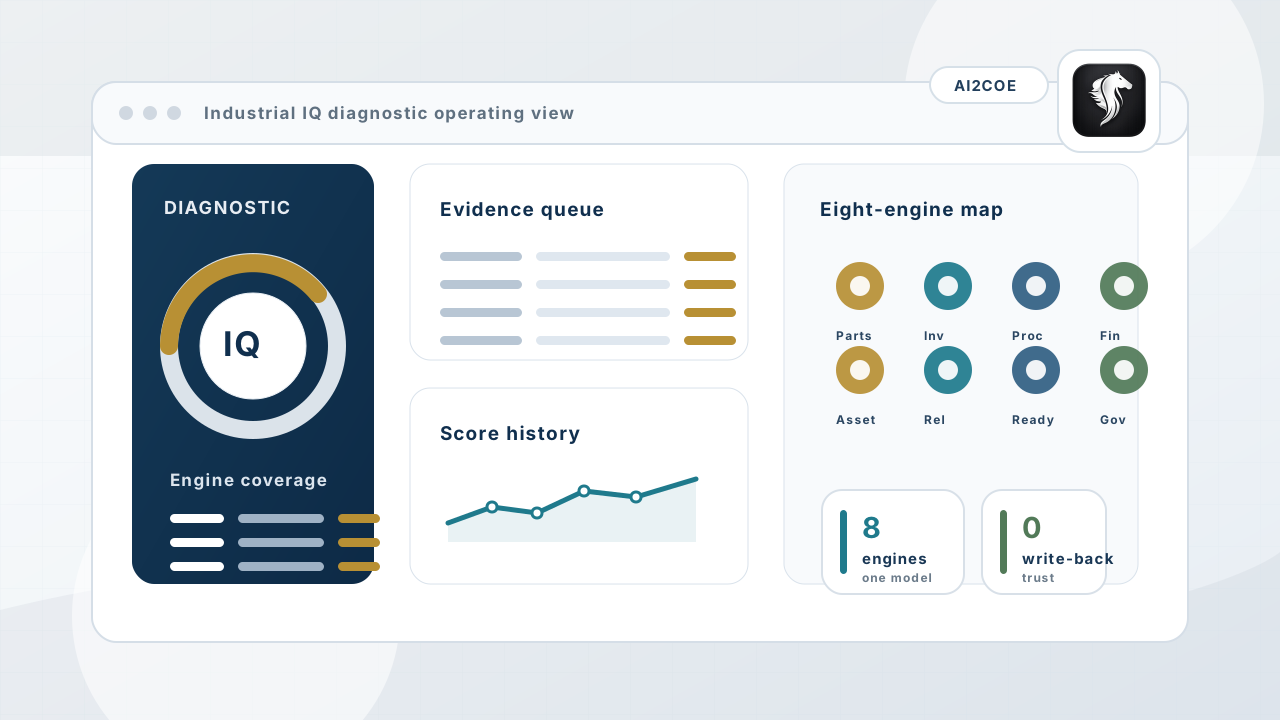
Industrial IQ diagnostic dashboard showing AI readiness, risk, evidence confidence, and operational maturity indicators.
The Industrial IQ Index interprets diagnostic dimensions across catalog, inventory, procurement, finance, asset, reliability, readiness, and governance.
Evidence summary

Research methodology

Industrial IQ Index: AI2COE research frames the operating hypothesis, assumption boundary, and diagnostic path needed before transformation spend. AI2COE Industrial IQ Index measures catalog intelligence, inventory risk, procurement leakage, working capital exposure, asset readiness, maintenance.

Run Free Industrial IQ Snapshot
Review ownerExecutives and analysts sizing an operating hypothesis before replacing benchmark assumptions with uploaded-data evidence.
Input file contextBenchmark assumptions until replaced by uploaded customer data from an Industrial IQ diagnostic.
Diagnostic evidenceA research interpretation that separates benchmark logic, assumptions, limitations, and the recommended diagnostic path.
Recommended actionUse the benchmark as a hypothesis, then replace it with uploaded-data evidence.
Research methodology Reviewed 2026-06-20 Benchmark language is planning context until replaced by uploaded-data evidence.
Benchmark provenance

Industrial IQ Index

AI2COE publishes benchmark ranges as planning assumptions, not savings guarantees. Diagnostic reports replace these assumptions with uploaded-data evidence, confidence tiers, review status, and report-owner metadata.

Research methodologyPage type
2026-06-20Last reviewed
No ERP write-backGovernance boundary
Reference pointSource page
What this helps you decide

Industrial IQ Index buyer brief

The Industrial IQ Index is AI2COE's benchmark framework for measuring how ready an industrial organization's operational data is for trusted diagnostics, AI adoption, ERP modernization, and recurring decision intelligence.

Who uses itCFOs, COOs, procurement, maintenance, and ERP leaders building a defensible value case before budget approval.
Data neededBenchmark assumptions plus uploaded catalog evidence when a diagnostic is run.
Next actionUse this benchmark only as planning context; run working capital intelligence for customer-specific evidence and confidence tiers.
Short answer

Industrial IQ Index: what it means.

The Industrial IQ Index is AI2COE's benchmark framework for measuring how ready an industrial organization's operational data is for trusted diagnostics, AI adoption, ERP modernization, and recurring decision intelligence.

What is not claimed: The Industrial IQ Index is not an ERP certification, inventory optimization guarantee, or autonomous remediation instruction. Customer-specific results require uploaded-data diagnostics and owner review.
What is measured
  • Catalog Intelligence
  • Inventory Risk
  • Procurement Leakage
  • Working Capital Exposure
  • Asset-to-Part Readiness
  • Maintenance Readiness
  • AI Readiness
  • Governance Readiness
Benchmark assumptions

Inputs that must be transparent.

  • Public index interpretation is a benchmark model until replaced by uploaded operational data.
  • Each signal must preserve assumptions, limitations, confidence tier, and human-review requirements.
  • Recurring uploads create stronger decision evidence than one-time benchmarks because score movement and action closure can be observed over time.
Calculation model

How the benchmark is interpreted.

Upload exported data -> map fields -> run diagnostic engines -> generate evidence -> apply confidence tiers -> calculate scores -> produce executive reports -> create actions -> track recurring improvement.

How AI2COE uses it

From estimate to evidence.

AI2COE Industrial IQ turns index assumptions into uploaded-data diagnostics, score history, action tracking, benchmark comparison, and renewal value reporting across the eight engine model.

Related Industrial IQ engine

Working Capital Intelligence.

Run the relevant Industrial IQ diagnostic to replace public assumptions with customer-specific findings, confidence tiers, and report evidence.

Run Working Capital Intelligence
Analyst-style research structure

How this benchmark should be read before a buyer acts.

Research questionIndustrial IQ Index
Executive summaryThe Industrial IQ Index is AI2COE's benchmark framework for measuring how ready an industrial organization's operational data is for trusted diagnostics, AI adoption, ERP modernization, and recurring decision intelligence.
Who should careCFO, COO, CIO, procurement, maintenance, reliability, and ERP data owners.
What is measured
  • Catalog Intelligence
  • Inventory Risk
  • Procurement Leakage
  • Working Capital Exposure
  • Asset-to-Part Readiness
  • Maintenance Readiness
  • AI Readiness
  • Governance Readiness
Why it mattersAI2COE Industrial IQ Index measures catalog intelligence, inventory risk, procurement leakage, working capital exposure, asset readiness, maintenance readiness, AI readiness, and governance readiness.
Data requiredPublic interpretation uses stated assumptions; customer-specific proof requires uploaded operational exports, mapped fields, evidence rows, confidence tiers, and review status.
MethodologyAI2COE separates benchmark planning context from uploaded-data diagnostics, then connects evidence, confidence, score, report output, and owner-reviewed action.
Calculation modelUpload exported data -> map fields -> run diagnostic engines -> generate evidence -> apply confidence tiers -> calculate scores -> produce executive reports -> create actions -> track recurring improvement.
Assumptions
  • Public index interpretation is a benchmark model until replaced by uploaded operational data.
  • Each signal must preserve assumptions, limitations, confidence tier, and human-review requirements.
  • Recurring uploads create stronger decision evidence than one-time benchmarks because score movement and action closure can be observed over time.
LimitationsThe Industrial IQ Index is not an ERP certification, inventory optimization guarantee, or autonomous remediation instruction. Customer-specific results require uploaded-data diagnostics and owner review.
What is not claimedThe Industrial IQ Index is not an ERP certification, inventory optimization guarantee, or autonomous remediation instruction. Customer-specific results require uploaded-data diagnostics and owner review.
How to interpret the benchmarkUse it as executive planning context only. Do not treat the benchmark as a customer result until Industrial IQ analyzes uploaded data and labels confidence, assumptions, and limitations.
What uploaded diagnostic replacesBenchmark assumptions are replaced by mapped source records, evidence rows, confidence tiers, and score history.
Buyer committee interpretationFinance reads exposure, operations reads continuity, procurement reads leakage, maintenance reads readiness, and CIO teams read governance risk.
Related Industrial IQ engineRun Working Capital Intelligence
Related methodologyAI2COE benchmark methodology and Industrial IQ diagnostic evidence contract.
Recommended diagnosticRun Working Capital Intelligence
CTARun Working Capital Intelligence
Industrial IQ Scorecard Grid

Eight intelligence dimensions turn operational data into board-readable decision evidence.

Each dimension starts as a benchmark question, then becomes customer-specific only after an Industrial IQ diagnostic maps uploaded data, generates evidence, assigns confidence, and preserves review status.

Why it matters

Industrial AI and ERP transformation need explainable operating evidence.

AI and ERP programs stall when operational data is fragmented, duplicated, ungoverned, or not explainable. The Industrial IQ Index gives leaders a disciplined way to inspect readiness before transformation spend becomes a remediation surprise.

1Upload exported operational data.
2Map fields and run the relevant Industrial IQ engines.
3Generate evidence, confidence tiers, scores, reports, actions, and recurring score history.
Buyer interpretation

How each member of the buying committee reads the index.

CFOWorking capital exposure, carrying-cost risk, and financial evidence required before claiming value.
COOOperational readiness, downtime risk, stockout exposure, and site-level action priority.
CIOData readiness, ERP modernization risk, AI governance, and source-system control before automation.
ProcurementSupplier fragmentation, emergency buys, stocked-but-purchased risk, and leakage review.
Maintenance / ReliabilityFalse stockouts, work-order spare availability, asset-to-part gaps, and shutdown readiness.
BoardBenchmark visibility, governance confidence, recurring score movement, and decision discipline.
Sample index view

Illustrative scorecard example.

Catalog IntelligenceIllustrative score: 72 / 100; review duplicate-family evidence before remediation.
Inventory RiskIllustrative score: 64 / 100; inspect dead stock, slow-moving stock, and stockout exposure.
Procurement LeakageIllustrative score: 58 / 100; review emergency-buying and repeated-purchase signals.
Working Capital ExposureIllustrative score: 61 / 100; replace assumptions with uploaded-data finance evidence.
Asset-to-Part ReadinessIllustrative score: 67 / 100; validate critical spare coverage and orphan spare signals.
Maintenance ReadinessIllustrative score: 69 / 100; inspect false stockout and work-order readiness signals.
AI ReadinessIllustrative score: 55 / 100; validate field completeness and governance readiness.
Governance ReadinessIllustrative score: 74 / 100; confirm confidence tiers, audit trail, and review ownership.
Planning disclaimer: Index examples are illustrative unless based on a customer-approved diagnostic dataset. Benchmarks are planning inputs and should be replaced by uploaded-data evidence before operational or financial decisions.
Industrial IQ platform bridge

How this connects to AI2COE Industrial IQ

Industrial IQ Index is not treated as an isolated content topic. Industrial IQ connects it to uploaded data, engine evidence, confidence tiers, executive reports, actions, score history, and governance review.

PartsCleanse AIcreates catalog evidence and duplicate-family findings.
InventoryMind AIextends catalog signals into inventory risk, dead stock, excess stock, and stockout exposure.
ProcureMind AIconnects supplier and purchase signals to emergency buying, repeat purchases, and leakage.
FinanceMind AItranslates operating findings into working-capital exposure, carrying cost, and ROI scenarios.
AssetMind AIconnects parts to asset relevance, equipment coverage, and plant-register context.
ReliabilityMind AIconnects spare availability to maintenance readiness, false-stockout risk, and shutdown planning.
ReadyMind AIevaluates ERP, data, governance, and AI readiness gaps before transformation spend.
GovernanceMind AImanages confidence, evidence traceability, human review, and auditability.
Benchmark interpretation

How leadership should use this benchmark.

Industrial IQ Index should be treated as an executive planning tool, not a substitute for a diagnostic. It helps a buyer ask the right question: is the exposure large enough to justify a governed review, and what data must be uploaded to replace assumptions with evidence?

Benchmark assumption Public planning range; not a customer-specific result
Uploaded-data proof Customer catalog, field mapping, confidence tiers, and evidence rows
Governed action Owner review, accepted findings, remediation plan, and audit trail
Buyer committee interpretation
CFOUse the benchmark to size possible working-capital exposure, then require uploaded-data evidence before budget approval.
COOTranslate the benchmark into operational risk: false stockouts, downtime pressure, planner trust, and service continuity.
CIOUse the benchmark to test whether ERP exports are clean enough for governed AI or require data-quality remediation first.
ProcurementUse the benchmark to identify supplier overlap, emergency-buying exposure, price variance, and duplicate-stock leakage.
Evidence discipline

What changes after a diagnostic run.

The benchmark becomes a customer-specific result only after AI2COE maps the export, validates field coverage, runs deterministic scoring, produces source-backed evidence, assigns confidence tiers, and labels any remaining assumptions.

FAQ

Questions this research page should answer clearly.

What does the Industrial IQ Index measure?

It measures evidence readiness across catalog, inventory, procurement, finance, asset, reliability, readiness, and governance signals.

How is the index different from a benchmark?

A benchmark explains planning assumptions. An Industrial IQ diagnostic replaces assumptions with mapped source records, evidence rows, confidence tiers, and score history.

Why do recurring diagnostics matter?

Recurring diagnostics show whether actions are closing, risk is moving, benchmark comparison is improving, and the value case supports renewal or multi-site expansion.

Editorial governance

Reviewed for enterprise decision support.

This research page separates planning assumptions from uploaded-data diagnostic outputs so buyers can use it without mistaking estimates for proof.

Content typeResearch methodology
Reviewed2026-06-20
Claim policyBenchmarks are labelled; uploaded-data evidence is separated from assumptions.
Decision framework

What this page helps leaders decide.

Definition

The Industrial IQ Index is AI2COE's benchmark framework for measuring operational data readiness across catalog, inventory, procurement, finance, asset, maintenance, AI, and governance dimensions.

Commercial relevance

The index helps executives understand where fragmented operational data may be weakening investment decisions, ERP modernization, AI readiness, working capital, and operational continuity.

Operational symptoms

Low readiness appears as duplicate catalog records, inventory risk, procurement leakage, weak asset-to-part coverage, false stockout signals, poor AI readiness, and unowned evidence.

Required input files

Operational exports from ERP, EAM, CMMS, inventory, procurement, asset, maintenance, finance, and governance systems.

Diagnostic method

Industrial IQ maps fields, runs relevant diagnostics, scores dimensions, applies confidence tiers, and converts evidence into executive interpretation.

Evidence model

Index output includes dimension scores, supporting evidence, assumptions, limitations, owner actions, and recurring score movement.

Buyer-role interpretation

Boards read governance confidence, CFOs read capital exposure, COOs read readiness, CIOs read data risk, and operating teams read action priorities.

Traditional approach vs Industrial IQ

Traditional maturity models often rely on interviews. The Industrial IQ Index is designed to be strengthened by uploaded operational evidence.

Trust boundary

Index examples are illustrative unless based on a customer-approved diagnostic dataset.

Recommended next step

Run an Industrial IQ Snapshot when the buyer needs routing clarity, view sample reports when the buyer needs proof format, request a diagnostic discussion when scope and data availability are known, or explore pricing when the buying path is ready for commercial review.

Related Industrial IQ pages

Industrial IQ platform · Industrial IQ Snapshot · Sample reports · Documentation · Trust Center