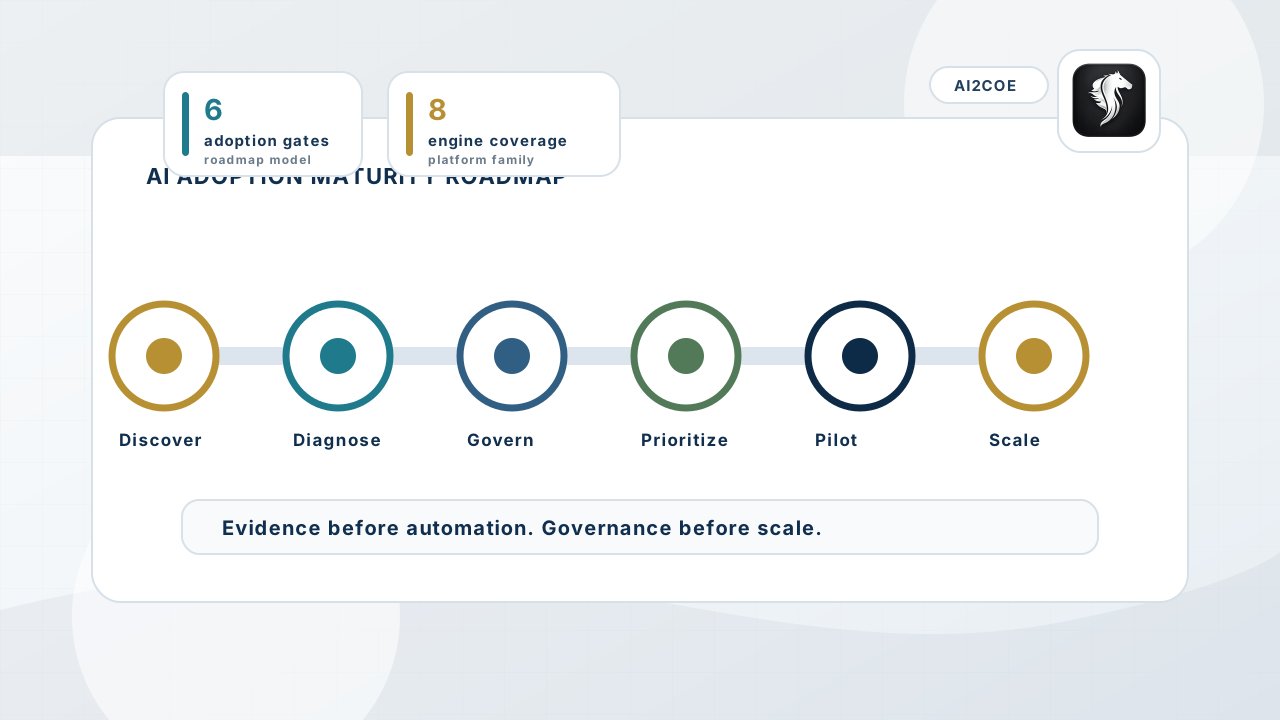
How this diagnostic works for an ICP.
| Business problem | Emergency procurement, stocked-but-purchased events, repeated buys, supplier alias risk, and price variance. |
|---|---|
| Buyer owner | CPO, Procurement Director, CFO, and Supply Chain leaders |
| Trigger event | Emergency buying spikes, repeated purchases, supplier overlap, price variance, or stocked-but-purchased exceptions. |
| Input data required | Po Number, Description |
| Optional fields | Material Id, Supplier, Unit Price, Quantity, Order Date, Order Type, Emergency Flag, Stock On Hand, Site, Currency |
| Upload workflow | Upload -> Validate -> Analyze -> Evidence -> Score -> Report -> Action -> Repeat |
| Column mapping | Industrial IQ profiles source-fit, suggests field matches, asks the user to normalize unmapped required fields, then recalculates mapping readiness before the engine runs. |
| Evidence generated | Source-backed evidence rows, reason codes, confidence tiers, review status, assumptions, limitations, and action-owner context. |
| Score output | Procurement leakage score |
| Report output | ProcureMind AI Procurement Leakage Report |
| Confidence tiers | High-confidence findings can move to review; weak or unsafe matches stay in human-review queues. |
| Recurring use case | Monthly or quarterly re-uploads create score history, action progress, benchmark comparison, and renewal value reporting. |
Minimum viable upload and best upload.
| Engine | Required Data File | Required Fields | Optional Fields | Output Generated | Minimum Viable Upload | Best Upload |
|---|---|---|---|---|---|---|
| ProcureMind AI | Purchase order CSV | Po Number, Description | Material Id, Supplier, Unit Price, Quantity, Order Date, Order Type | Procurement leakage score, evidence, report, actions, score history | Po Number, Description | Required fields plus site, value, date, owner, asset, supplier, and criticality context where available. |
What this engine analyzes.
- Emergency-buy, stocked-but-purchased, repeated-purchase, supplier-alias, price-variance, and vendor-overlap detection.
- PO-to-stock evidence for buy vs transfer review.
- Commercial control gaps where supplier or price fields are missing.
How the engine matures after the first run.
- Supplier consolidation opportunities, buyer/category evidence view, contract-leakage signals, and emergency premium model.
- Vendor overlap graph connecting item family, supplier alias, price variance, and purchase recurrence.
- Procurement leakage score with action tracker items by buyer owner.
- Buy vs transfer vs review recommendation engine with human approval controls.
- Avoided-spend ledger and supplier consolidation QBR report.
- Procurement benchmark pack by category, site, emergency rate, and supplier fragmentation.
How to read the output.
ProcureMind AI Procurement Leakage Report includes Procurement leakage score, evidence records, confidence tiers, assumptions, limitations, action tracker items, score history, and no-write-back governance language.
How this connects to AI2COE Industrial IQ
Procurement Leakage Intelligence is not treated as an isolated content topic. Industrial IQ connects it to uploaded data, engine evidence, confidence tiers, executive reports, actions, score history, and governance review.
ProcureMind AI Documentation buyer enablement checklist.
| Problem solved | Turns an operational data question into source-backed diagnostic evidence. |
|---|---|
| Who cares | CFO, COO, CIO, procurement, maintenance, reliability, ERP, governance, and board stakeholders where relevant. |
| Data needed | CSV exports with stable IDs, descriptions, quantities, values, dates, site, asset, supplier, and owner context where available. |
| Output delivered | Scores, evidence table, confidence tiers, executive report, action tracker items, score history, and governance status. |
| Value quantified | Working capital, carrying cost, emergency premium, dead stock, stockout risk, readiness gaps, or governance risk depending on diagnostic intent. |
| Decision supported | Whether to act, review, normalize data, escalate findings, fund remediation, or repeat the diagnostic cadence. |
| Report shared internally | Executive, CFO, procurement, inventory, readiness, governance, or renewal value report. |
| Recurring value | Baseline score -> re-upload -> score movement -> action closure -> benchmark comparison -> renewal value report. |
| Assumptions and limitations | Benchmarks and estimates remain planning context until customer-specific uploaded data is analyzed and reviewed. |
| Trust controls | No ERP write-back, evidence traceability, confidence tiers, human review, false-positive control, audit trail, and data-retention boundaries. |