Skip to main content
Works from CSV or workbook exports produced from SAP, IBM Maximo, Oracle ERP, Hexagon EAM, Infor, and other ERP, EAM, or CMMS systems. No direct integration or write-back is required —
Review data requirements →
AI2COE | AI to Centre of Excellence
Industrial AI Centre of Excellence Framework for asset-intensive enterprises.
AI2COE helps asset-intensive enterprises establish an Industrial AI Centre of Excellence through diagnostic evidence, governance, eight Industrial IQ engines, 18 industry blueprints, and bounded Agentic AI readiness.
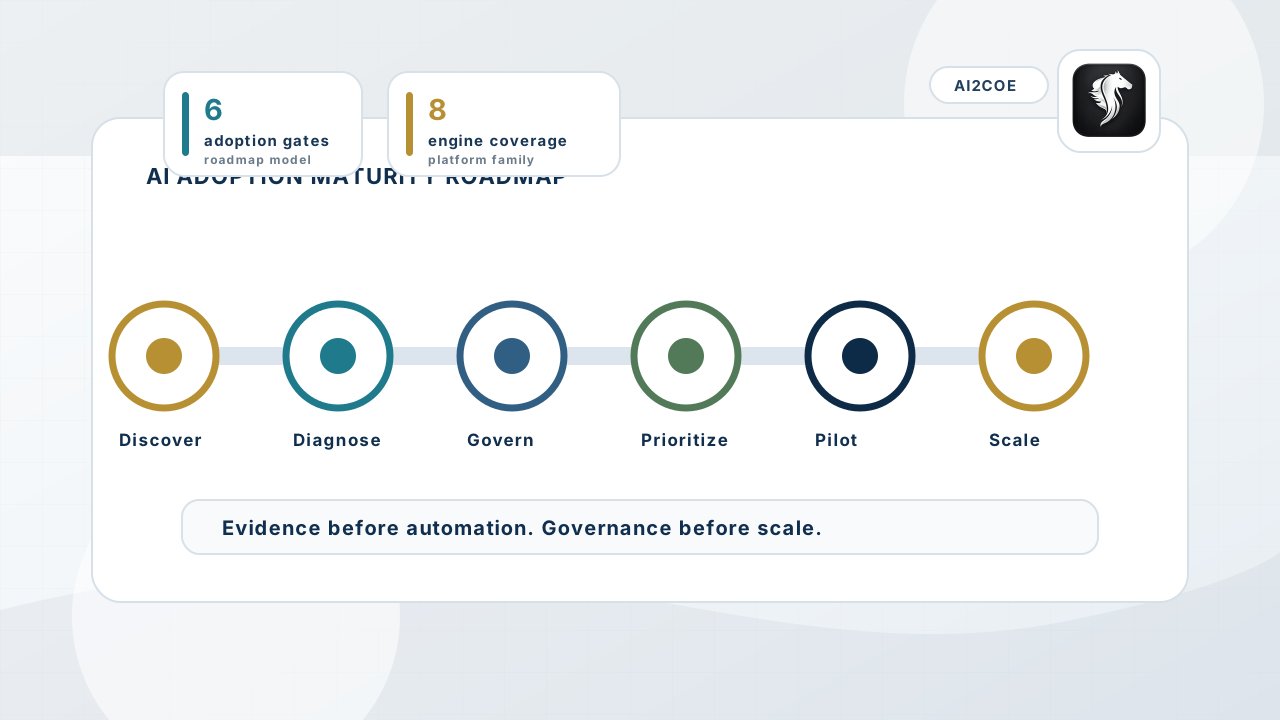
AI2COE frames AI adoption as a sequence of diagnostics, governance, prioritization, and controlled operating improvement.
Direct answer
What is an Industrial AI Centre of Excellence?
An Industrial AI Centre of Excellence is the governed operating model that connects operational data readiness, evidence classification, human review, pilot control, and scale decisions for asset-intensive enterprises.
AI2COE uses the British spelling Centre in its master-brand promise and recognises Center as the common US search variant. Both refer here to a governed Industrial AI CoE operating model, not a new department that replaces the customer's internal teams.
The AI2COE model has three layers: a six-stage lifecycle, twelve operating pillars, and four permanent CoE functions: govern, enable, optimise, and scale.
Canonical statement
AI2COE helps asset-intensive enterprises move from disconnected AI initiatives to a governed Industrial AI capability. Industrial IQ is the evidence and decision-intelligence platform that makes the operating model inspectable.
Not outsourcedAI2COE helps build the customer's governed capability; it does not replace accountable internal ownership.
Not generic AIThe framework is built around industrial source systems, MRO data, ERP readiness, trust controls, and bounded agency.
From AI initiatives to enterprise capability
Build an Industrial AI Centre of Excellence on evidence.
AI programs do not scale through disconnected pilots. They need a governed operating model that connects readiness, evidence, ownership, trust controls, and scale decisions. AI2COE brings that foundation through Industrial IQ, eight diagnostic AI engines, 18 industry blueprints, and evidence-first Agentic AI readiness.
01
DiagnoseStart with exported operational evidence and source-fit review.
02
QuantifySeparate observed, derived, estimated, and hypothesis-level value signals.
03
PrioritizeRank decisions by evidence strength, owner urgency, and operating risk.
04
GovernKeep no-write-back, source handling, confidence tiers, and human review visible.
05
PilotRun bounded diagnostics before broad AI or agentic commitments.
06
ScaleUse score history, action tracking, and governance evidence to expand safely.
GovernSet decision rights, evidence rules, risk limits, and human-review controls.EnableProvide reusable templates, field guidance, sample reports, and diagnostic paths.OptimiseUse evidence, score history, action tracking, and owner feedback to improve the operating model.ScaleExpand only where confidence, value, governance, and operating ownership are sufficient.
Operating hierarchy: AI2COE is the AI Centre of Excellence brand. Industrial IQ is the evidence and decision-intelligence platform. The eight engines provide the diagnostic lenses.
Three-layer framework
Six stages, twelve pillars, four permanent functions.
The six stages explain how the CoE moves from diagnosis to scale. The twelve pillars define what must be governed. The four functions keep the operating model alive after the first pilot decision.
Use case, data, tools, identity, authority, evaluation
ReadyMind AI + GovernanceMind AI
Keep authority at read-only review until gates pass
CoE service catalogue
Make the Centre of Excellence operational, not just advisory.
CoE service
AI2COE capability
Strategy and mandate review
Industrial AI Centre of Excellence Framework
Use-case intake
CoE Workbench and readiness diagnostic
Portfolio prioritisation
ReadyMind AI and FinanceMind AI
Industrial data readiness
Eight Industrial IQ diagnostic engines
Context-readiness review
PartsCleanse AI, AssetMind AI, and ReliabilityMind AI
Governance and decision-right design
GovernanceMind AI
Agentic AI readiness
Industrial Agentic AI Readiness Command Center
Evaluation planning
Evidence Library assets and assessment methodology
Pilot acceptance review
Industrial IQ report pack and action tracker
Value qualification
FinanceMind AI and assumption-bound planning models
Reusable-pattern publication
Evidence Library and Research Center
Monitoring and lifecycle review
Score History and Action Tracker
Trust and procurement support
Trust Center, DPA, SLA, data retention, and no ERP write-back
AI CoE Toolkit roadmap
Methodology assets for moving from AI interest to governed Industrial AI capability.
This is the public methodology library for future CoE operating assets. It supports buyer committees preparing an Industrial AI Centre of Excellence without implying that every standalone template or editable download has already been released.
Score the current operating model before the next AI commitment.
This interactive diagnostic is a v1 planning methodology. It is not a benchmark, certification, audit, or customer-proof claim. Use it to identify which operating pillars need evidence, ownership, reusable assets, assurance, or governance before scale.
Result: Select scores and calculate the readiness band.
Industry operating view
Priority sector preview: the same CoE discipline is applied differently by operating context.
This page keeps the framework focused. The full 18-industry operating vocabulary lives in the industry hub, where each sector can own its own source systems, buyer triggers, and diagnostic path.
Industry
Operating reality
Stage 01 evidence entry point
Oil & Gas
Long-lived assets, acquisitions, brownfield systems, and safety-critical operations create data quality debt that persists for decades.
Start with the strongest evidence path: catalog, inventory, reliability, asset, and finance diagnostics for shutdown and critical-spares readiness.
Manufacturing
Plants accumulate local item creation practices, CMMS migrations, and supplier variants that fragment enterprise visibility.
Sequence catalog, inventory, procurement, reliability, and finance diagnostics by plant-level operating risk.
Mining
Remote sites, mobile fleets, fixed plant, contractors, and regional warehouses create fragmented spares visibility.
Prioritize inventory, asset, reliability, catalog, and finance evidence before broader maintenance automation.
Utilities
Generation, grid, water, and critical infrastructure operators carry distributed spares across long-lived assets.
Use asset, reliability, inventory, governance, and finance diagnostics to prove critical-spares and outage-readiness priorities.
Data Centers
Data Centers operations depend on distributed physical assets, spare-parts readiness, and maintenance data that must be trusted before AI automation can scale.
Start with the engine pack that fits Data Centers: catalog, inventory, procurement, finance, asset, reliability, readiness, or governance evidence based on operating pressure.
Questions about the Industrial AI Centre of Excellence framework.
What is an Industrial AI Centre of Excellence?
An Industrial AI Centre of Excellence is the governed operating model that connects operational data readiness, evidence classification, human review, pilot control, and scale decisions for asset-intensive enterprises.
Is this the same as a generic enterprise AI CoE?
No. The AI2COE framework is specific to asset-intensive operations, ERP and EAM exports, MRO data quality, inventory, procurement, asset, reliability, governance, and bounded Agentic AI readiness.
Why should industrial AI adoption start with a diagnostic?
Industrial AI decisions require evidence about source data, operating risk, ownership, limitations, and confidence. A diagnostic-first approach helps leaders decide what to pilot, govern, remediate, or defer before broad spend.
Is the CoE readiness diagnostic a benchmark?
No. It is a v1 planning methodology for discussion and owner alignment. Benchmark reporting would require observed or approved data, review controls, and publication boundaries.
How does Industrial IQ support the CoE?
Industrial IQ supplies the evidence layer: eight diagnostic AI engines, source-backed findings, confidence tiers, executive reports, action tracking, score history, and no ERP write-back boundaries.
How does this connect to Agentic AI?
Bounded Agentic AI should only proceed after source data, authority limits, tool access, human review, evaluation controls, and escalation paths are clear.
What does the CoE diagnostic produce?
The diagnostic should produce a decision pack: maturity level, evidence confidence, twelve-pillar heatmap, blockers, RACI direction, use-case backlog, governance gaps, relevant Industrial IQ engines, Agentic AI dependency, and a 90-day evidence backlog.
Which industries does the framework support?
The framework is applied across 18 asset-intensive markets, including critical infrastructure, regulated operations, production networks, facilities, fleets, logistics, and regulated manufacturing contexts.