Works from CSV or workbook exports produced from SAP, IBM Maximo, Oracle ERP, Hexagon EAM, Infor, and other ERP, EAM, or CMMS systems. No direct integration or write-back is required — Review data requirements →
Cross-engine diagnostic entry path

Industrial IQ Snapshot

Industrial IQ Snapshot helps buyers select the right AI2COE diagnostic engine, preview source-fit requirements, inspect sample proof, and decide whether to proceed to uploaded-data diagnostics without ERP write-back.

8Engines
18Industry guides
0ERP write-back
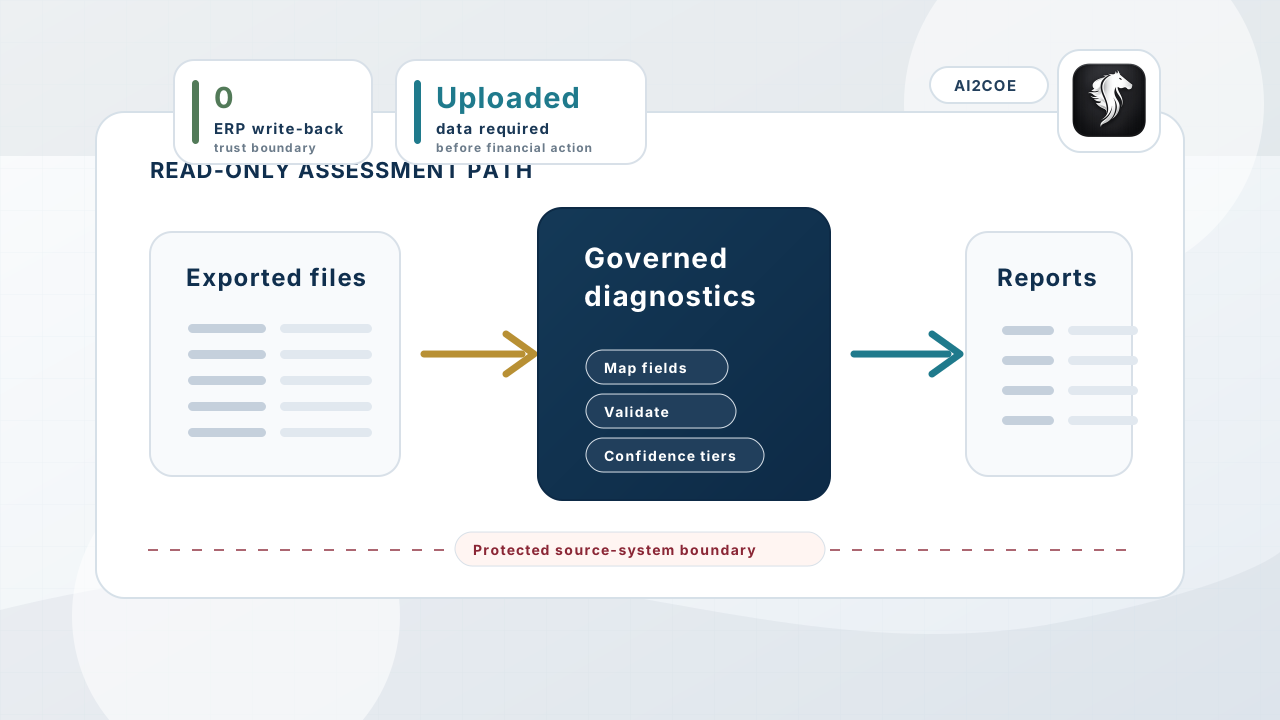
Safe AI assessment architecture showing CSV upload, read-only analysis, reporting output, and no ERP write-back boundary.
The snapshot uses exported operational data to produce review-ready evidence without writing back to operational systems.
Industrial IQ Snapshot

Snapshot-to-diagnostic conversion path and buyer decision gate.

The Industrial IQ Snapshot is the low-friction entry path for AI2COE. It helps buyers identify the right diagnostic engine, preview source-fit requirements, inspect sample evidence, and decide whether uploaded-data diagnostics are justified before larger remediation, ERP, AI, or consulting commitments.

UploadCSV export or sample dataset
Source FitRequired fields and data quality
AI MatchColumn aliases and confidence
NormalizeCanonical field preparation
DiagnoseEngine logic and evidence
ReportScore, actions, assumptions
RepeatScore history and renewal value
Buyer decision gate

How a Snapshot becomes a diagnostic.

1. Operating questionThe buyer names the problem: catalog quality, inventory risk, procurement leakage, working capital, asset-to-part readiness, maintenance readiness, AI readiness, or governance control.
2. Source-fit checkIndustrial IQ confirms which ERP, EAM, CMMS, inventory, procurement, asset, work-order, or governance exports are available before upload.
3. Engine routingThe Snapshot routes the buyer to the most relevant Industrial IQ engine instead of forcing every problem into a catalog-only workflow.
4. Sample proofThe buyer can inspect sample reports and assumptions before private operational data is shared.
5. Diagnostic gateIf the business question and data are strong enough, the buyer can move from Snapshot to a paid diagnostic or recurring intelligence path.
Engine routing

Choose the operating problem first, then the engine.

Snapshot engine path

PartsCleanse AI

MRO catalog deduplication, field quality, UOM consistency, and duplicate capital exposure.

Open documentation
Snapshot engine path

InventoryMind AI

Dead stock, slow-moving stock, excess, stockout risk, and duplicated stock exposure.

Open documentation
Snapshot engine path

ProcureMind AI

Emergency procurement, stocked-but-purchased events, repeated buys, supplier alias risk, and price variance.

Open documentation
Snapshot engine path

FinanceMind AI

Duplicate capital exposure, carrying cost, emergency premium, and recoverable value scenarios.

Open documentation
Snapshot engine path

AssetMind AI

Asset-to-part linkage, critical spare coverage, obsolete asset spares, and plant risk heatmaps.

Open documentation
Snapshot engine path

ReliabilityMind AI

Work-order spare availability, false stockout risk, repeat demand, and shutdown readiness.

Open documentation
Snapshot engine path

ReadyMind AI

ERP data quality, governance readiness, operational readiness, and first-use-case recommendation.

Open documentation
Snapshot engine path

GovernanceMind AI

Evidence traceability, review-level assignment, owner approval, auditability, and no-write-back governance.

Open documentation
Trust boundary

Snapshot review is diagnostic-first and no-write-back.

Industrial IQ Snapshot does not change ERP, EAM, CMMS, inventory, procurement, asset, or maintenance systems. It clarifies data readiness, sample-proof expectations, report outputs, and next action before any customer-specific findings are treated as operational evidence.

Primary CTARun Free Industrial IQ Snapshot.
Proof assetView Industrial IQ sample reports.
Commercial pathExplore pricing or request a diagnostic discussion.
Buyer Enablement Validation

Industrial IQ Snapshot buyer enablement checklist.

Problem solvedTurns an operational data question into source-backed diagnostic evidence.
Who caresCFO, COO, CIO, procurement, maintenance, reliability, ERP, governance, and board stakeholders where relevant.
Data neededCSV exports with stable IDs, descriptions, quantities, values, dates, site, asset, supplier, and owner context where available.
Output deliveredScores, evidence table, confidence tiers, executive report, action tracker items, score history, and governance status.
Value quantifiedWorking capital, carrying cost, emergency premium, dead stock, stockout risk, readiness gaps, or governance risk depending on diagnostic intent.
Decision supportedWhether to act, review, normalize data, escalate findings, fund remediation, or repeat the diagnostic cadence.
Report shared internallyExecutive, CFO, procurement, inventory, readiness, governance, or renewal value report.
Recurring valueBaseline score -> re-upload -> score movement -> action closure -> benchmark comparison -> renewal value report.
Assumptions and limitationsBenchmarks and estimates remain planning context until customer-specific uploaded data is analyzed and reviewed.
Trust controlsNo ERP write-back, evidence traceability, confidence tiers, human review, false-positive control, audit trail, and data-retention boundaries.
Decision framework

What this page helps leaders decide.

Definition

Industrial IQ Snapshot is the cross-engine entry path that helps a buyer select the right diagnostic before committing to a paid engagement or recurring intelligence path.

Commercial relevance

The Snapshot reduces buying risk by confirming the operating question, source-data readiness, likely diagnostic path, and proof asset before private data or budget is committed.

Operational symptoms

A buyer knows the issue is material but is unsure whether the first run should focus on catalog, inventory, procurement, finance, asset, reliability, readiness, or governance evidence.

Required input files

A representative sample of available exports, data dictionaries, system ownership notes, and business questions from the buying committee.

Diagnostic method

The Snapshot uses source-fit review and engine routing logic to determine the best first diagnostic path.

Evidence model

Recommended engine, required-file checklist, sample-report path, assumptions to validate, and decision gate for diagnostic scope.

Buyer-role interpretation

Executives use it to decide whether a diagnostic is worth funding; data owners use it to prepare exports; governance teams use it to approve boundaries.

Traditional approach vs Industrial IQ

Traditional discovery often starts with sales qualification. Industrial IQ Snapshot starts with data fit, evidence expectations, and buyer decision requirements.

Trust boundary

The Snapshot is an evaluation path and does not treat benchmark assumptions or sample outputs as customer-specific proof.

Recommended next step

Run an Industrial IQ Snapshot when the buyer needs routing clarity, view sample reports when the buyer needs proof format, request a diagnostic discussion when scope and data availability are known, or explore pricing when the buying path is ready for commercial review.
Related Industrial IQ pages

Industrial IQ platform · Industrial IQ Snapshot · Sample reports · Documentation · Trust Center

Enterprise review lens

Use this page to decide the next evidence step.

Industrial IQ pages are designed to move enterprise buyers from operating pain to source-backed diagnostic evidence, not to force an immediate platform commitment.

Best-fit reader

Finance, operations, procurement, maintenance, reliability, ERP/data, security, and executive sponsors.

Evidence to prepare

Relevant ERP, EAM, CMMS, inventory, procurement, asset, work-order, or readiness exports where available.

Output to expect

A diagnostic route, sample proof format, report evidence, confidence tier, owner review path, or commercial next step.

Trust boundary

Read-only diagnostics, no ERP write-back, source-file purge after report generation, and human review before action.