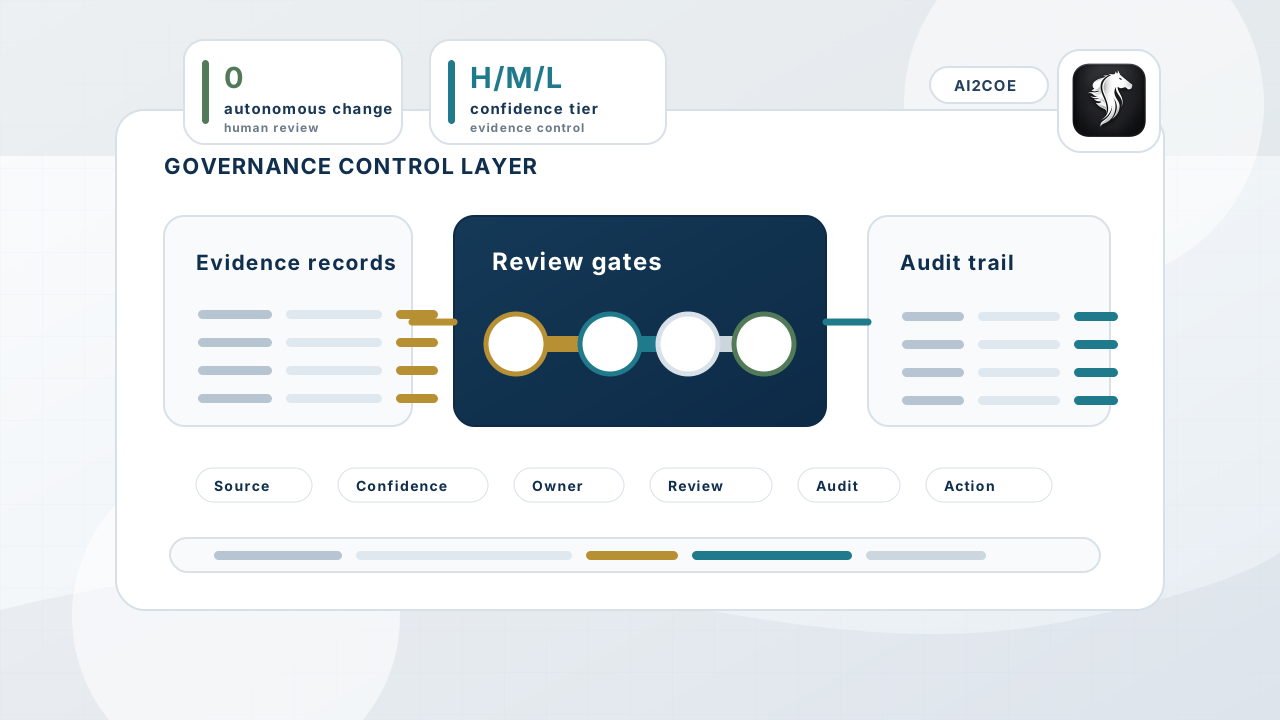
Audit Trail protects executive decisions.
The platform is built for controlled decision-making: report ownership, run metadata, admin activity, review status, and exported evidence are handled as governance artifacts.
| Control | How Industrial IQ handles it |
|---|---|
| Run metadata | Diagnostic runs retain timestamp, user, report ownership, and summary metrics. |
| Admin logs | Protected admin workflows capture access and change history. |
| Export governance | Reports and evidence packs are tied to the diagnostic run context. |
Use this trust control to align the buying committee before the diagnostic starts. Industrial IQ is designed to provide evidence, confidence tiers, executive reports, score history, and accountable actions while preserving source-system boundaries and reviewer control.
Confirms Industrial IQ begins with exported operational data and does not create an uncontrolled change path into SAP, Maximo, Oracle, EAM, CMMS, procurement, or inventory systems.
Validates the difference between source-file purge after report generation and governance metadata that may be retained for ownership, score history, quota usage, feedback, and audit controls.
Keeps findings in a human-review workflow so maintenance, procurement, finance, and reliability owners can accept, reject, defer, or request more evidence before action.
Security, ERP, operations, procurement, and finance teams use this review sequence to agree on the diagnostic boundary before data is uploaded. It turns the trust control into a practical buyer checklist, so the team knows what evidence is being evaluated, who owns the decision, and what Industrial IQ will not do on its own.
That discipline matters because industrial data findings can affect master-data cleanup, spares availability, procurement behavior, working capital, audit posture, and ERP migration planning. The safest path is to inspect exported operational data first, then route confidence-tiered findings through human review before any remediation work starts.
The platform is built for controlled decision-making: report ownership, run metadata, admin activity, review status, and exported evidence are handled as governance artifacts.
No. Industrial IQ sits above exported operational data and produces evidence, scores, reports, actions, score history, and governance without replacing or writing back to source systems.
Use this trust control to align governance expectations, then run the relevant Industrial IQ diagnostic engine or Industrial IQ Snapshot.
Trust review gives security, procurement, legal, IT, and governance reviewers clear language before a diagnostic starts.
CISO, CIO, procurement, legal, risk, security, data governance, and enterprise architecture teams.
Hosting, access, data handling, retention, source-file purge, no ERP write-back, human review, DPA, SLA, and buyer-security review language.
A buyer-security review path that clarifies what Industrial IQ does, what it does not do, and what can be reviewed during procurement.
Read-only diagnostics, no ERP write-back, source-file purge after report generation, and human review before action.
Grounded in approved AI2COE content only. No unsupported claims.