1 search intentsConsolidated into one canonical page
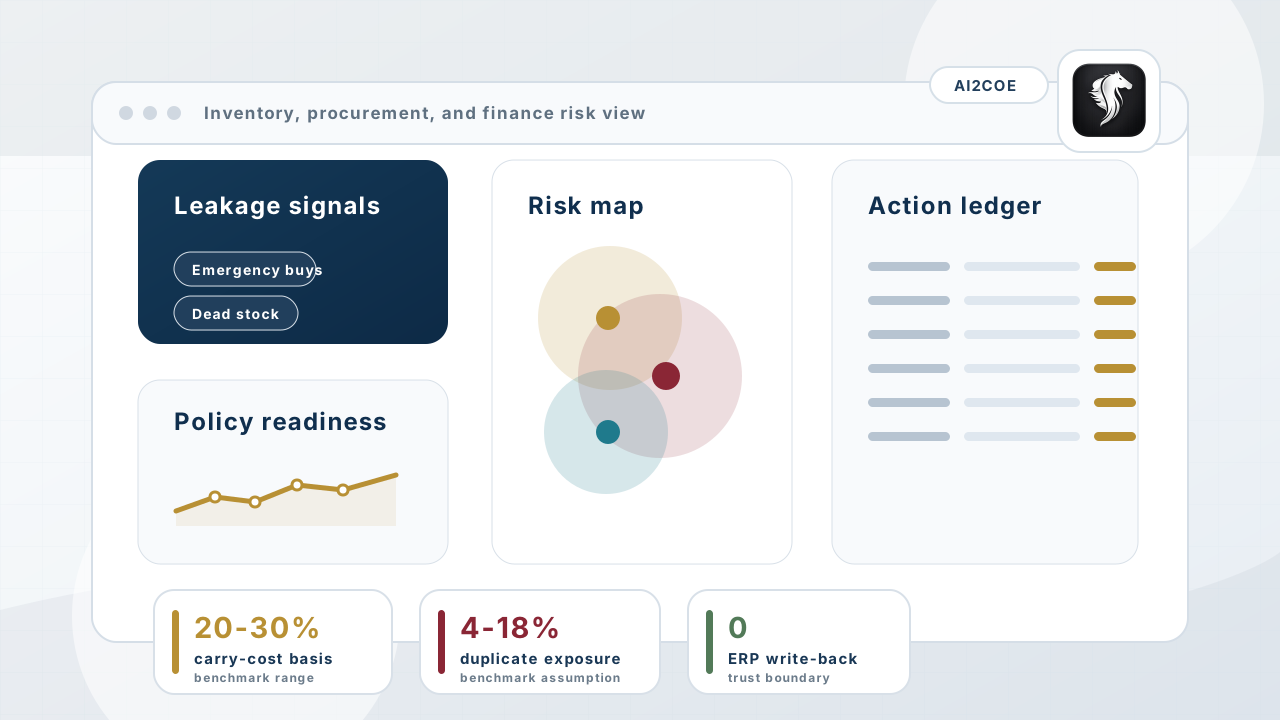
ProcureMind AI connects emergency buys, repeated purchases, supplier fragmentation, and stocked-but-purchased evidence.
Executive takeaway
Diagnostic engine guide
Supplier Fragmentation Analysis: Use this guide to connect the operating problem, required upload fields, diagnostic evidence, review logic, and buyer decision path for the relevant Industrial IQ engine. Supplier Fragmentation Analysis: Industrial IQ diagnostic context for uploaded-data evidence, ROI interpretation, governance controls, and the next buyer.
Best next stepOpen the sample report or run the matching engine with uploaded operational data.
Buyer Experience Map
Supplier Fragmentation Analysis should lead to a diagnostic, not another reading session.
The page now gives buyers the same four-step experience: understand the problem, see the data required, inspect the report output, and choose the safest next diagnostic path.
1ProblemGuide to supplier fragmentation analysis across MRO catalogs, purchase orders, supplier aliases, and procurement leakage.
2DataCSV or workbook exports from ERP, EAM, CMMS, inventory, procurement, asset, or work-order systems.
3ProofEvidence table, confidence tier, score, report output, and governance boundary.
4ActionRun Industrial IQ Snapshot or the mapped engine-specific diagnostic.
Primary CTARun Industrial IQ Snapshot
Trust boundaryNo ERP write-back, no autonomous master-data changes, and human-reviewable findings.
Next assetSample report, methodology, documentation, or required fields by engine.
Supplier Fragmentation Analysis should answer the buyer's first five questions without a sales call.
Enterprise buyers do not evaluate Industrial IQ as one person. Finance, operations, procurement, maintenance, ERP, security, and board sponsors each need a different proof path. This console gives every ICP a fast route to the right engine, data requirement, output, and trust control.
Find my role. Pick my engine. See the data. Trust the output. Act safely.
Buyer identityChoose the role that owns the decision so the page presents value, risk, proof, and evaluation concerns in the right language.
Industry contextMatch the diagnostic pack to sector-specific operating reality instead of forcing every buyer through a generic product story.
Data requiredShow minimum viable upload, best upload, sample datasets, field mapping, and what happens when fields are missing.
Output proofExpose sample reports, evidence tables, review levels, score interpretation, action tracker, and score history before private upload.
Trust boundaryKeep no ERP write-back, owner review, review levels, audit evidence, and sample-versus-uploaded-data labeling visible near the CTA.
Executive takeaway
Supplier Fragmentation Analysis: the executive view.
Supplier Fragmentation Analysis is an industrial decision problem, not only a data-cleanup label. Supplier fragmentation analysis shows where equivalent parts, supplier aliases, or repeated purchases weaken procurement leverage. Industrial IQ approaches it by mapping exported operational data, validating fields, running the relevant diagnostic engine, producing source-backed evidence, applying confidence tiers, and turning findings into executive reports and review actions. The recommended next step is to run an Industrial IQ Snapshot, inspect sample reports, and replace assumptions with uploaded-data evidence.
Trust boundary
Industrial IQ is a diagnostic and decision-support layer. It labels sample scenarios, separates assumptions from uploaded-data evidence, requires human review for action, and does not perform uncontrolled remediation or ERP write-back.
Definition
What this topic means.
Supplier fragmentation analysis evaluates whether similar items are being bought from too many suppliers, under inconsistent naming, or without clear preferred-source discipline.
Problem definition
Where the issue appears.
Fragmentation is hard to diagnose when catalog records and supplier names are inconsistent.
Commercial importance
Why leadership should care.
Commercial impact includes price variance, lost volume leverage, emergency premium, and review complexity.
Diagnostic method
How Industrial IQ approaches it.
ProcureMind AI identifies supplier overlap and repeated-buy patterns; PartsCleanse AI can support by grouping duplicate item families.
Findings should be reviewed against contracts, service levels, OEM requirements, and operational constraints.
Buyer interpretation
How the buyer committee should read this diagnostic.
Role
Interpretation
CFO
Review working-capital exposure, carrying cost, write-off risk, and the difference between benchmark assumptions and uploaded-data evidence.
COO
Review readiness, continuity risk, emergency-work pressure, and whether site-level operating teams trust the data enough to act.
CIO / ERP leader
Review data readiness, field availability, export quality, governance ownership, auditability, and whether the diagnostic can run without ERP write-back.
Broad cleanup, manual spreadsheet review, consulting assessment, ERP workflow design, or MDM implementation may begin before leaders know which findings are material.
Industrial IQ approach
Run a bounded diagnostic first, review source-backed evidence and confidence tiers, then decide whether remediation, governance, platform work, or recurring intelligence is justified.
Supplier Fragmentation Analysis -- what leaders need to know.
Definition
Definition
Supplier fragmentation analysis evaluates whether similar items are being bought from too many suppliers, under inconsistent naming, or without clear preferred-source discipline.
Problem definition
Problem definition
Fragmentation is hard to diagnose when catalog records and supplier names are inconsistent.
Why it matters commercially
Commercial impact includes price variance, lost volume leverage, emergency premium, and review complexity.
AI2COE decision model
Procurement-leakage decision model.
Question
Where are duplicate buying, emergency purchases, stocked-but-purchased events, supplier overlap, or price variance visible?
Baseline
Use purchase history, supplier aliases, item references, stock status, and contract context to separate leakage from normal buying.
Evidence
Run ProcureMind AI to identify leakage evidence; use InventoryMind AI and PartsCleanse AI as supporting context when stock or catalog disorder explains the buy.
Governance
Route findings to procurement owners before vendor consolidation, contract change, or policy enforcement.
Executive brief
The concise answer this page gives enterprise buyers.
Supplier fragmentation analysis shows where equivalent parts, supplier aliases, or repeated purchases weaken procurement leverage.
What it solvesGuide to supplier fragmentation analysis across MRO catalogs, purchase orders, supplier aliases, and procurement leakage.
Who should careCFOs, procurement heads, maintenance leaders, CIOs, and master-data owners who need evidence before committing budget.
Why nowERP migrations, inventory-reduction programs, AI initiatives, and procurement cleanups expose catalog debt that was previously hidden.
What happens nextRun the diagnostic, review duplicate-family evidence, route findings to owners, and only then approve remediation action.
FAQ
Buyer-ready questions.
What is supplier fragmentation analysis?
Supplier fragmentation analysis evaluates whether similar items are being bought from too many suppliers, under inconsistent naming, or without clear preferred-source discipline.
What data does Industrial IQ need?
Industrial IQ starts with exported operational data such as item master, inventory, procurement, asset, work-order, finance, or governance files. The exact fields depend on the engine selected.
Does Industrial IQ write back to ERP, EAM, or CMMS?
No. Industrial IQ produces evidence, confidence tiers, scores, reports, and review actions. It does not autonomously change SAP, Maximo, Oracle, EAM, CMMS, inventory, procurement, or maintenance systems.
How should leaders use the result?
Use the output to decide what should be reviewed, funded, governed, or escalated. Uploaded-data diagnostics replace planning assumptions with source-backed evidence.
✦ Website-grounded answers
AI2COE AI CopilotMRO catalog intelligence · website-trained
Grounded in approved AI2COE content only. No unsupported claims.
Source-groundedNo private reportsNo admin dataNo private operational data in chat
Do not paste private operational data into chat. Use the governed diagnostic upload path; source files are purged after report generation.
Ask a question. I answer only from approved AI2COE website content, cite the source pages, and route you to the right diagnostic, ROI model, industry brief, or contact path.
Ask a question
AI2COE AI
Free: Industrial IQ Sample Diagnostic Pack
PartsCleanse AI sample report
InventoryMind AI sample output
ProcureMind AI sample output
FinanceMind AI sample scenario
ReadyMind and GovernanceMind review samples
Before you leave
See how AI2COE Industrial IQ turns exported operational data into evidence, scores, reports, and review actions across catalog, inventory, procurement, finance, readiness, and governance diagnostics — without ERP write-back.
Sample-data disclaimer: sample outputs use demonstration data only and do not represent customer-specific claims.
We use cookies to measure site performance and deliver live chat support. Necessary cookies (session security, CSRF) run without consent. Privacy policy.
Ready to run an Industrial IQ Snapshot?Choose an engine -- Upload operational data -- Evidence without ERP write-back