Compatible with SAP  ·  IBM Maximo  ·  Oracle ERP  ·  Hexagon EAM  ·  Infor  ·  Any CMMS — Run an Industrial IQ diagnostic →
Assessment Checklist

A leadership checklist for MRO catalog health.

A healthy MRO catalog is not just complete. It is searchable, finance-readable, procurement-actionable, maintenance-safe, and ready for ERP or AI programs.

Buyer Experience Map

MRO Catalog Health Assessment Checklist should lead to a diagnostic, not another reading session.

The page now gives buyers the same four-step experience: understand the problem, see the data required, inspect the report output, and choose the safest next diagnostic path.

1ProblemAssess MRO catalog health across duplicate records, description quality, manufacturer fields, UOM consistency, cost readiness, site context, and governance controls.
2DataCSV or workbook exports from ERP, EAM, CMMS, inventory, procurement, asset, or work-order systems.
3ProofEvidence table, confidence tier, score, report output, and governance boundary.
4ActionRun Industrial IQ Snapshot or the mapped engine-specific diagnostic.
Primary CTARun Industrial IQ Snapshot
Trust boundaryNo ERP write-back, no autonomous master-data changes, and human-reviewable findings.
Next assetSample report, methodology, documentation, or required fields by engine.
ICP Experience Console

MRO Catalog Health Assessment Checklist should answer the buyer's first five questions without a sales call.

Enterprise buyers do not evaluate Industrial IQ as one person. Finance, operations, procurement, maintenance, ERP, security, and board sponsors each need a different proof path. This console gives every ICP a fast route to the right engine, data requirement, output, and trust control.

Force Team UX model

Find my role. Pick my engine. See the data. Trust the output. Act safely.

Buyer identityChoose the role that owns the decision so the page presents value, risk, proof, and objection handling in the right language.
Industry contextMatch the diagnostic pack to sector-specific operating reality instead of forcing every buyer through a generic product story.
Data requiredShow minimum viable upload, best upload, sample datasets, field mapping, and what happens when fields are missing.
Output proofExpose sample reports, evidence tables, confidence tiers, score interpretation, action tracker, and score history before private upload.
Trust boundaryKeep no ERP write-back, human review, confidence tiers, audit evidence, and sample-versus-uploaded-data labeling visible near the CTA.
Executive answer

MRO Catalog Health Assessment Checklist -- what leaders need to know.

Data checks

Data checks

Review item number uniqueness, description length, manufacturer completeness, manufacturer part number capture, UOM consistency, unit cost availability, quantity on hand, site or storeroom context, and currency fields.

Business checks

Business checks

Measure duplicate-family exposure, stock fragmentation, emergency-buy categories, obsolete inventory, supplier aliases, and high-value records that need specialist review.

Governance checks

Governance checks

Confirm material creation controls, duplicate-prevention workflow, owner review process, remediation sign-off, and post-cleanup monitoring.

AI2COE decision model

From search query to governed diagnostic.

Question

Is the catalog problem material enough to justify action?

Benchmark

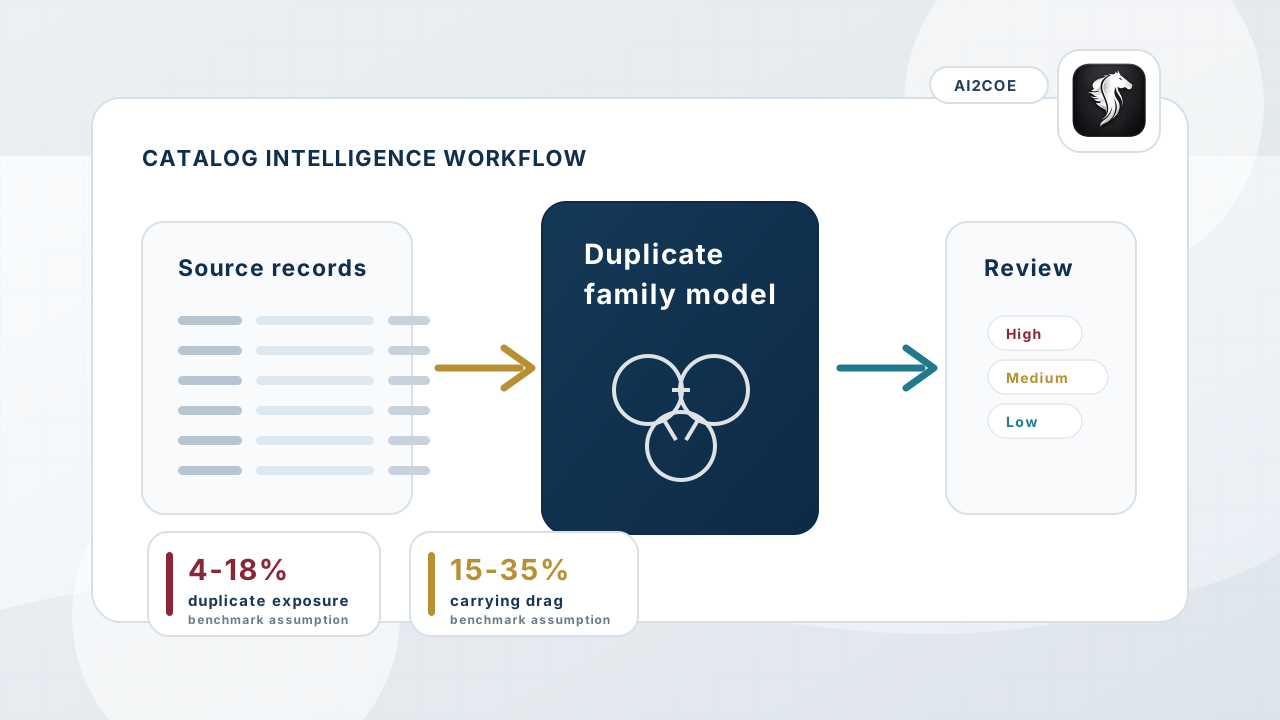
Use the scorecard to estimate duplicate exposure and carrying-cost drag.

Evidence

Run PartsCleanse AI to identify actual duplicate families and confidence tiers.

Governance

Route findings to owners before any ERP record is retired or consolidated.

Answer-ready brief

The concise answer this page gives enterprise buyers.

A healthy MRO catalog is not just complete. It is searchable, finance-readable, procurement-actionable, maintenance-safe, and ready for ERP or AI programs.

What it solvesAssess MRO catalog health across duplicate records, description quality, manufacturer fields, UOM consistency, cost readiness, site context, and governance controls.
Who should careCFOs, procurement heads, maintenance leaders, CIOs, and master-data owners who need evidence before committing budget.
Why nowERP migrations, inventory-reduction programs, AI initiatives, and procurement cleanups expose catalog debt that was previously hidden.
What happens nextRun the diagnostic, review duplicate-family evidence, route findings to owners, and only then approve remediation action.
FAQ

Buyer-ready questions.

What makes an MRO catalog unhealthy?

Duplicate records, short descriptions, missing manufacturer data, inconsistent UOMs, missing cost, site ambiguity, and weak governance controls.

Can a checklist replace a diagnostic?

No. A checklist helps prepare the data; the diagnostic tests actual duplicate-family exposure.

What is the first field to fix?

Description is essential, but manufacturer, MPN, UOM, cost, quantity, and site context significantly improve decision quality.

AI2COE Copilot