Works from CSV or workbook exports produced from SAP, IBM Maximo, Oracle ERP, Hexagon EAM, Infor, and other ERP, EAM, or CMMS systems. No direct integration or write-back is required — Review data requirements →
Authority Hub

AI governance for industrial operations must protect uptime and accountability.

AI governance for industrial operations controls evidence, ownership, auditability, model boundaries, data retention, and human review before automation scales.

Buyer contextDirect operating problem
Operational contextProblem, source system, industry setting, and recommended diagnostic path
Recommended next stepRun Evidence Governance Intelligence
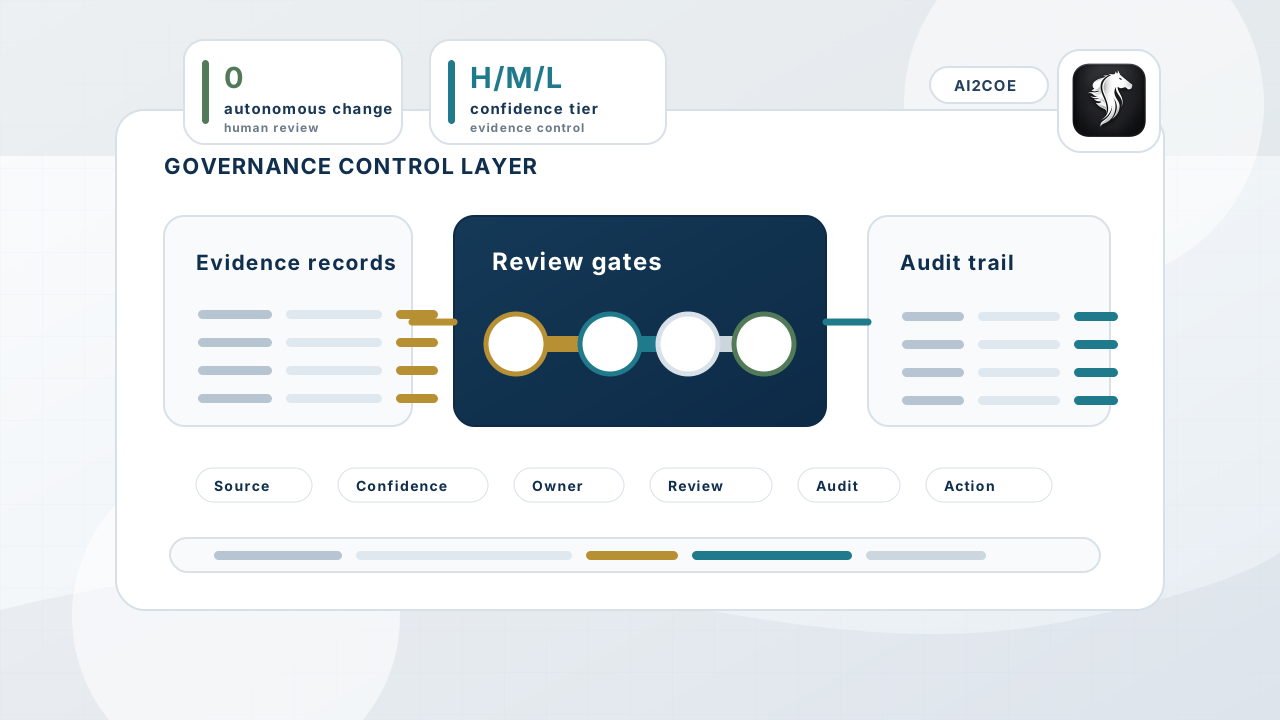
Executive AI governance layer showing risk controls, evidence records, approval checkpoints, and audit-ready decision support.
Industrial AI governance depends on evidence records, review ownership, confidence boundaries, and audit-ready decisions.
Evidence summary

Buyer evidence resource

Industrial AI Governance Readiness: Use this page to understand the operating question, exported-data evidence path, review boundary, and next Industrial IQ action. Review industrial AI governance readiness with source-backed evidence, confidence tiers, human review, audit trail, no ERP write-back, and data controls.

Run Free Industrial IQ Snapshot
Review ownerExecutive sponsors, operating leaders, finance reviewers, procurement teams, maintenance owners, ERP/data leaders, and governance reviewers who need evidence before approving action.
Input file contextOperational CSV exports, item master fields, inventory, procurement, asset, work-order, finance, readiness, or governance data depending on the page.
Diagnostic evidenceSource-backed evidence, scores, confidence tiers, report outputs, action tracking, score history, and governance context.
Recommended actionRun Free Industrial IQ Snapshot and select the diagnostic engine that matches the operating question.
Authority hub Reviewed 2026-06-20 Benchmark language is planning context until replaced by uploaded-data evidence.
Evidence summary

AI Governance for Industrial Operations

Industrial AI governance is the control system that keeps AI evidence traceable, reviewable, bounded, and safe for operations. AI2COE treats this as a decision-support issue: define the operating problem, map the ERP or CMMS data required, run a governed diagnostic, separate benchmark assumptions from uploaded-data evidence, and move only reviewed findings into action.

Reference point
What this helps you decide

AI Governance for Industrial Operations decision support

Industrial AI governance is the control system that keeps AI evidence traceable, reviewable, bounded, and safe for operations.

Who uses itCFOs, COOs, CIOs, procurement, maintenance, reliability, and ERP data-governance leaders evaluating industrial AI readiness.
Data neededMRO item master, ERP or CMMS catalog export, item descriptions, manufacturer or MPN, UOM, quantity, unit cost, site, and criticality where available.
Next actionUse this authority page to frame the problem, then run evidence governance intelligence to replace benchmark assumptions with uploaded-data evidence.
Direct answer

What it is.

Industrial AI governance is the control system that keeps AI evidence traceable, reviewable, bounded, and safe for operations.

Definition: It covers data handling, access control, model boundaries, audit logs, output disclaimers, approval workflow, human-in-the-loop review, and escalation paths.
Decision relationship map
EntityAI Governance for Industrial Operations
PlatformAI2COE Industrial IQ
Next actionRun Evidence Governance Intelligence
Business problem

Why buyers search for this.

Industrial decisions can affect uptime, safety, compliance, inventory, and procurement. AI outputs must not become uncontrolled instructions.

Why it matters

What leadership needs to know.

Enterprise buyers need confidence that diagnostics create evidence without forcing ERP edits, exposing private data, or bypassing accountable owners.

AI2COE approach

How we handle it.

AI2COE publishes clear boundaries: CSV-first, no ERP write-back, source purge after report generation, retained summary metrics, and confidence-tiered review.

GovernanceMind AI relationship

How the engine proves value.

GovernanceMind AI owns the evidence and review-control interpretation. PartsCleanse AI demonstrates the model on catalog evidence, but the governance standard applies across all Industrial IQ engines.

Research-grade operating model

Human-review and audit-trail decision model for industrial AI.

Industrial AI governance is credible only when evidence, confidence, ownership, and action status are visible. This model keeps Industrial IQ inside a diagnostic and decision-support boundary while still giving leaders a practical path from AI-assisted evidence to governed review.

Evidence recordEach AI-assisted finding should point to the source row, mapped field, diagnostic rule, confidence tier, and report section that supports it.
Human-review gateOperational owners approve, reject, defer, or escalate findings before any remediation, workflow change, or ERP action is considered.
Audit trailReview status, owner assignment, report export, and action history create a decision trail for CISO, CIO, audit, and governance teams.
No-write-back boundaryIndustrial IQ supports evidence review and action tracking; it does not perform uncontrolled system changes or autonomous ERP remediation.
Related industries
Regulated and asset-intensive operations
Related ERP / EAM systems
ERPEAMCMMSMDMData Governance
Industrial IQ platform bridge

How this connects to AI2COE Industrial IQ

AI Governance for Industrial Operations is not treated as an isolated content topic. Industrial IQ connects it to uploaded data, engine evidence, confidence tiers, executive reports, actions, score history, and governance review.

PartsCleanse AIcreates catalog evidence and duplicate-family findings.
InventoryMind AIextends catalog signals into inventory risk, dead stock, excess stock, and stockout exposure.
ProcureMind AIconnects supplier and purchase signals to emergency buying, repeat purchases, and leakage.
FinanceMind AItranslates operating findings into working-capital exposure, carrying cost, and ROI scenarios.
AssetMind AIconnects parts to asset relevance, equipment coverage, and plant-register context.
ReliabilityMind AIconnects spare availability to maintenance readiness, false-stockout risk, and shutdown planning.
ReadyMind AIevaluates ERP, data, governance, and AI readiness gaps before transformation spend.
GovernanceMind AImanages confidence, evidence traceability, human review, and auditability.
FAQ

Questions enterprise buyers should resolve.

Why is no ERP write-back important?

It prevents a diagnostic from becoming an uncontrolled operational change. Findings remain evidence for owner review.

What data is retained?

AI2COE states that uploaded source catalogs are purged after report generation; summary metrics, Open Findings, report ownership, quota usage, feedback, and audit metadata may be retained.

Can AI2COE support procurement review?

Yes. Report outputs are designed for finance, procurement, operations, CIO, and governance review.

What should governance teams verify?

Data source, reviewer owner, confidence tier, exception notes, retention policy, and remediation approval path.

Editorial governance

Reviewed for enterprise decision support.

This page is maintained as an answer-first authority page for enterprise buyers evaluating industrial MRO intelligence.

Content typeAuthority hub
Reviewed2026-06-20
Claim policyBenchmarks are labelled; uploaded-data evidence is separated from assumptions.
Buyer intent

What decision this page helps the buyer make.

Decision question

How should industrial AI findings stay traceable, human-reviewed, confidence-tiered, and audit-ready?

Best-fit reader

CISO, CIO, legal, procurement, board, and governance reviewers validating control posture before adoption.

Related decision topics
AI governance assessmentno ERP write-backhuman-reviewed evidenceaudit trail
Useful next reads
Buyer journey

Choose the next action by buyer readiness.

Choose the next action based on where the buying committee is now: proof review, data readiness, pilot scoping, or security validation.

Open evaluation guide

Trust boundary: No ERP write-back. Source files purged after report generation. Human review before action. Sample reports use demonstration data until replaced by uploaded-data diagnostics.

Decision framework

What this page helps leaders decide.

Definition

AI governance for industrial operations is the control model that links AI-assisted findings to source evidence, confidence tiers, human review, audit trail, and action ownership.

Commercial relevance

Governance discipline is required before AI can support decisions that affect safety, maintenance, procurement, finance, compliance, or ERP remediation.

Operational symptoms

Risk appears as unreviewed AI output, missing source records, no confidence tier, unclear decision owner, weak audit trail, and pressure to automate before evidence is trusted.

Required input files

Source records, diagnostic findings, review status, user actions, report exports, confidence tiers, decision logs, and governance policy references.

Diagnostic method

GovernanceMind AI and Industrial IQ evaluate evidence traceability, review workflow, no-write-back boundaries, and owner accountability.

Evidence model

Governance output includes readiness score, evidence table, review queue, audit events, and executive governance report.

Buyer-role interpretation

CISOs, CIOs, governance leaders, board members, and operating owners use the result to decide whether AI-assisted action is controlled enough to proceed.

Traditional approach vs Industrial IQ

Traditional governance policies can stay abstract. Industrial IQ ties governance to diagnostic evidence and visible review status.

Trust boundary

Industrial IQ supports decision review; it does not authorize autonomous remediation or replace internal controls.

Recommended next step

Run an Industrial IQ Snapshot when the buyer needs routing clarity, view sample reports when the buyer needs proof format, request a diagnostic discussion when scope and data availability are known, or explore pricing when the buying path is ready for commercial review.

Related Industrial IQ pages

Industrial IQ platform · Industrial IQ Snapshot · Sample reports · Documentation · Trust Center

Enterprise context

What is AI governance readiness for industrial operations?

AI governance readiness for industrial operations is the ability to connect AI-assisted findings to source evidence, confidence tiers, human review, audit trail, data-retention boundaries, and accountable action owners before decisions affect uptime, procurement, maintenance, finance, or ERP data.

Business outcome

Governance, legal, CIO, CISO, and operating owners can approve where AI-assisted diagnostics are safe to use.

Financial impact

Investment decisions are tied to traceable evidence rather than unowned model output.

Operational impact

Operational AI readiness improves when findings have source records, confidence boundaries, and review owners.

Risk control

No ERP write-back, source-file purge after report generation, and human review before action remain explicit.

Related operating terms

Relevant systems and source data

Connected decision paths

GovernanceMind AI · ReadyMind AI · security and data handling brief · data retention controls