Works from CSV or workbook exports produced from SAP, IBM Maximo, Oracle ERP, Hexagon EAM, Infor, and other ERP, EAM, or CMMS systems. No direct integration or write-back is required — Review data requirements →
Working Capital

Spare-parts inventory optimization starts with trusted item-master evidence.

Min-max tuning, service-level targets, and replenishment policies are weak when duplicate item records split demand history. PartsCleanse AI creates the evidence foundation before optimization policy is changed.

CFO-readyCapital exposure signal
Procurement-readyLeakage and supplier fragmentation
Ops-readyAvailability and false-stockout context
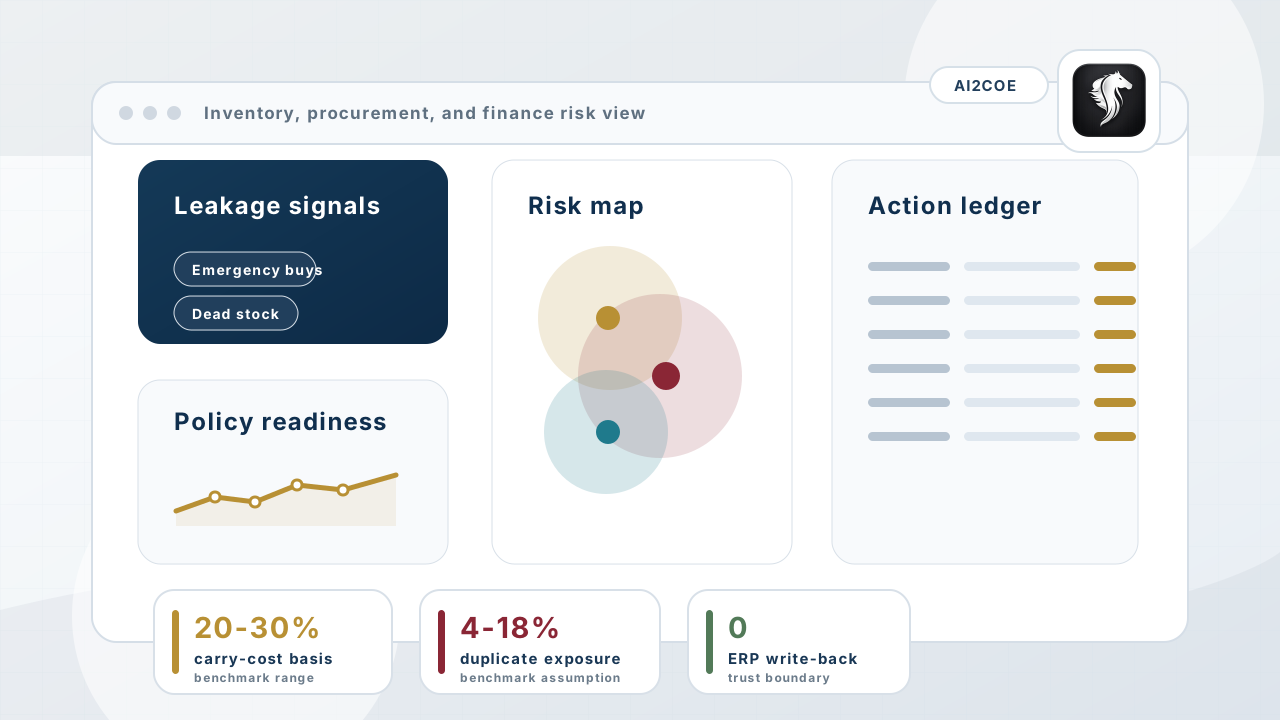
MRO procurement value leakage dashboard showing duplicate parts, stock imbalance, obsolescence risk, and emergency buying signals.
InventoryMind AI and FinanceMind AI examine dead stock, excess, stockout risk, carrying cost, and policy evidence before optimization.
Evidence summary

Diagnostic evidence path

Spare Parts Inventory Optimization Diagnostic: This engine path connects the operating problem, exported source data, diagnostic logic, evidence output, review boundary, and next action for Industrial IQ buyers. Assess spare parts optimization, obsolete inventory, critical spares, stockout risk, dead stock, and working-capital exposure before policy changes.

Run This Engine
Review ownerThe operating, finance, procurement, maintenance, data, and governance leaders accountable for this diagnostic decision.
Input file contextTypical exported operational files, helpful optional fields, sample data, and mapped CSV or workbook evidence.
Diagnostic evidenceSource-backed findings, confidence tiers, score interpretation, report preview, review actions, and recurring-use path.
Recommended actionInspect the sample report, then run the matching engine with bounded exported operational data.
Buyer Experience Map

Spare Parts Inventory Optimization: move from context to diagnostic evidence.

Start with the operating problem, confirm the source data needed, inspect the expected report output, and choose the safest next diagnostic path.

1ProblemOptimize spare-parts inventory by first detecting duplicate MRO records, fragmented demand history, excess stock, carrying-cost drag, and recoverable working capital.
2DataCSV or workbook exports from ERP, EAM, CMMS, inventory, procurement, asset, or work-order systems.
3ProofEvidence table, confidence tier, score, report output, and governance boundary.
4ActionRun Free Industrial IQ Snapshot or the mapped engine-specific diagnostic.
Primary CTARun Free Industrial IQ Snapshot
Trust boundaryNo ERP write-back, no autonomous master-data changes, and human-reviewable findings.
Next assetSample report, methodology, documentation, or required fields by engine.
Your Role. Your Engine. Your Evidence.

Spare Parts Inventory Optimization should answer the buyer's first five questions without a sales call.

Enterprise buyers do not evaluate Industrial IQ as one person. Finance, operations, procurement, maintenance, ERP, security, and board sponsors each need a different proof path. This console gives every ICP a fast route to the right engine, data requirement, output, and trust control.

Enterprise Decision Model

Find my role. Pick my engine. See the data. Trust the output. Act safely.

Buyer identityChoose the role that owns the decision so the page presents value, risk, proof, and evaluation concerns in the right language.
Industry contextMatch the diagnostic pack to sector-specific operating reality instead of forcing every buyer through a generic product story.
Source data clarityShow minimum viable upload, best upload, sample datasets, field mapping, and what happens when fields are missing.
Output proofExpose sample reports, evidence tables, review levels, score interpretation, action tracker, and score history before private upload.
Trust boundaryKeep no ERP write-back, owner review, review levels, audit evidence, and sample-versus-uploaded-data labeling visible near the CTA.
What leaders need to know

Spare Parts Inventory Optimization -- what leaders need to know.

Why optimization fails without cleansing

Why optimization fails without cleansing

Duplicate item records distort consumption, reorder points, stock levels, and vendor history. Policy optimization then operates on incomplete signals.

What to run first

What to run first

A duplicate-family diagnostic shows where working capital is trapped and which records require review before policy changes.

How the result is used

How the result is used

Finance sees exposure; procurement sees fragmentation; operations sees availability risk; CIOs see data-governance backlog.

AI2COE decision model

Inventory-risk decision model.

Question

Are dead, slow, excess, duplicated, or stockout-risk signals distorting inventory policy?

Baseline

Use movement, value, criticality, site, min/max, and stock-position evidence before changing stocking rules.

Evidence

Run InventoryMind AI to classify inventory risk; use PartsCleanse AI only when duplicate item families distort demand, value, or false-stockout signals.

Governance

Route policy exceptions to inventory, finance, and maintenance owners before min/max, reorder, or transfer action.

Executive brief

Executive answer for the buying committee.

Min-max tuning, service-level targets, and replenishment policies are weak when duplicate item records split demand history. PartsCleanse AI creates the evidence foundation before optimization policy is changed.

What it solvesOptimize spare-parts inventory by first detecting duplicate MRO records, fragmented demand history, excess stock, carrying-cost drag, and recoverable working capital.
Who should careCFOs, procurement heads, maintenance leaders, CIOs, and master-data owners who need evidence before committing budget.
Why nowERP migrations, inventory-reduction programs, AI initiatives, and procurement cleanups expose catalog debt that was previously hidden.
What happens nextRun the diagnostic, review duplicate-family evidence, route findings to owners, and only then approve remediation action.
FAQ

Buyer-ready questions.

Is PartsCleanse AI an inventory optimizer?

It is the diagnostic evidence layer that should run before inventory optimization.

Does it calculate recoverable working capital?

Yes. Reports show exposure and recoverability assumptions based on available catalog fields.

Can it support multi-site catalogs?

Yes, when site, plant, warehouse, or storeroom fields are present.

Decision framework

What this page helps leaders decide.

Definition

Spare-parts inventory optimization is the disciplined review of stock, movement, criticality, duplicate families, procurement signals, and service risk before stocking-policy changes.

Commercial relevance

Inventory optimization affects working capital, carrying cost, stockout exposure, emergency buying, and maintenance readiness.

Operational symptoms

Dead stock, slow movement, excess stock, false stockouts, repeated emergency purchases, and duplicate item families that split demand or value.

Required input files

Item master, inventory balance, stock movement, unit cost, purchase history, supplier context, asset criticality, and duplicate-family evidence.

Diagnostic method

InventoryMind AI segments dead, slow, excess, and stockout-risk inventory while PartsCleanse AI supplies duplicate-family context and FinanceMind AI supports value interpretation.

Evidence model

Output includes inventory risk segments, value exposure, carrying-cost assumptions, criticality exceptions, confidence tiers, and recommended review actions.

Buyer-role interpretation

CFOs read capital exposure, COOs read service risk, maintenance teams read critical-spare exceptions, and procurement reads stocked-but-purchased patterns.

Traditional approach vs Industrial IQ

Traditional optimization often changes parameters from imperfect data. Industrial IQ diagnoses data and evidence quality before policy changes.

Trust boundary

Findings are review signals and do not instruct automatic disposal, reorder changes, or ERP updates.

Recommended next step

Run an Industrial IQ Snapshot when the buyer needs routing clarity, view sample reports when the buyer needs proof format, request a diagnostic discussion when scope and data availability are known, or explore pricing when the buying path is ready for commercial review.

Related Industrial IQ pages

Industrial IQ platform · Industrial IQ Snapshot · Sample reports · Documentation · Trust Center

Diagnostic playbook map

Show the diagnostic path behind this solution.

The diagnostic workflow converts operating pain into source data, evidence classification, confidence tier, report output, and buyer-owned next action.

Assess Industrial AI Readiness
Diagnostic evidence path

Choose the next step that matches your buying stage.

Industrial IQ is designed for evidence-first buyers. Review sample proof, run a bounded Snapshot, align the buyer committee, or request a founder-led diagnostic pilot when the operating problem is ready for review.

Read-only diagnostics · No ERP write-back · Source files purged after report generation · Human review before action
AI2COE Copilot