Evidence before action
Use public evidence assets before private upload.
These resources help buyers move from research to diagnostic readiness without unsupported claims or uncontrolled remediation.
Buyer utility
What this resource helps a committee decide.
Start with the decision
Clarify whether the goal is SAP or Maximo migration readiness, duplicate spare-parts exposure, procurement leakage, inventory trust, AI readiness, or governance control.
Prepare source exports
Item master, inventory, procurement, supplier, asset, BOM, work-order, and finance exports improve confidence. Missing fields should be visible as limitations, not hidden.
Separate candidates from facts
Duplicate-looking records, obsolete candidates, false-stockout signals, and leakage signals require owner review before remediation.
Define the cleanup boundary
Industrial IQ produces evidence and actions. ERP, EAM, CMMS, MDM, procurement, and maintenance owners decide what source-system remediation is approved.
Evidence boundary
Planning assets are not customer-specific proof.
Public calculators, sample reports, synthetic scenarios, and buyer guides help with evaluation. Customer-specific findings require uploaded source data, field mapping, confidence tiers, and human owner review before action.
Trust boundary: Industrial IQ diagnostics are read-only, produce reviewable evidence, and do not write back to ERP, EAM, CMMS, procurement, inventory, finance, or production systems.
Related assets
Continue the evidence path.
Related evidence asset
MRO data cleansing guide
Understand the core diagnostic path.
Related evidence assetMRO duplicate exposure diagnostic
Size duplicate exposure before cleanup.
Related evidence assetRequired fields by engine
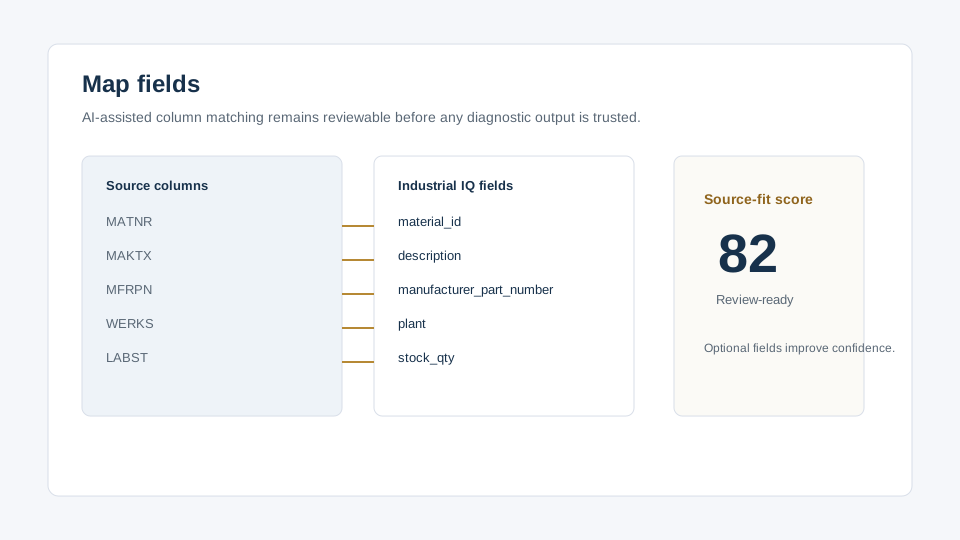
Map data fields before upload.
Related evidence assetCSV templates
Prepare starter files for diagnostic review.
Related evidence assetPartsCleanse sample report
Inspect the report style before sharing private data.
Related evidence assetNo ERP write-back
Review the system-safety boundary.
FAQ
Questions buyers should resolve before a pilot.
Should MRO data cleansing begin with ERP write-back?
No. Start with a read-only diagnostic, confidence tiers, and owner review. Source-system changes should happen only after approved remediation.
What fields should be prepared first?
Begin with material or item number, description, manufacturer, manufacturer part number, UOM, plant or site, quantity, unit cost, supplier, and movement context where available.
Does AI2COE cleanse records automatically?
No. Industrial IQ produces diagnostic evidence and review actions. Cleanup remains buyer-controlled.
Why run a diagnostic before cleansing?
It shows which records are material, which findings are high confidence, and where missing fields limit the cleanup case.
Resource guide
Use this page to prepare source files, proof review, and the next evidence step.
Resource review reduces friction: what data is needed, how reports look, how evidence is reviewed, and which route the buyer can take next.
Implementation leads, data owners, procurement reviewers, and product champions.
Required fields, CSV templates, user manuals, buyer guides, sample reports, diagnostic scenarios, and trust controls.
A prepared evaluation path that leads to sample proof, data templates, upload, or a scoped diagnostic discussion.
Read-only diagnostics, no ERP write-back, source-file purge after report generation, and human review before action.