Compatible with SAP  ·  IBM Maximo  ·  Oracle ERP  ·  Hexagon EAM  ·  Infor  ·  Any CMMS — Run an Industrial IQ diagnostic →
For Leaders | AI2COE

Five industrial leadership roles. One governed diagnostic. Answers for each.

PartsCleanse AI delivers different evidence to each decision-maker who governs MRO catalog quality. Select your role below.

CFO / FinanceCPO / ProcurementCOO / OperationsCIO / ERP OwnerMaintenance / Reliability
CFO / Finance

CFOs: here is the capital exposure figure — before the board meeting.

Industrial organizations carry between $16M and $38M in capital at risk inside a typical 50,000-SKU MRO catalog. That is a quantified diagnostic finding — not an estimate. PartsCleanse AI gives Finance the number, the duplicate-family evidence, and the board-ready brief to support a remediation funding decision.

Pain points this diagnostic resolves
Working capital trapped in duplicate inventoryExcess stock tied to fragmented item records inflates inventory valuation without delivering operational availability.
No defensible business case for catalog remediationInternal estimates of catalog quality are not auditable. A diagnostic finding with a confidence tier is.
SAP migration cost underestimated by FinancePost-migration duplicate cleanup costs 10-100x more than pre-migration rationalization.
Carrying cost drag is invisible on the P&LAnnual carrying cost on duplicate inventory runs 22-28% of stock value — rarely surfaced as a recoverable line item.
CPO / Procurement

Procurement leaders: trace where you are buying the same part twice.

Duplicate item records create invisible duplicate purchase pathways. A gasket with three descriptions in SAP becomes three procurement events and three inventory positions. PartsCleanse AI surfaces the duplicate families driving off-contract spend, supplier alias leakage, and sourcing fragmentation.

Pain points this diagnostic resolves
Supplier alias leakage is unquantifiedThe same supplier under different name formats creates split-order patterns that bypass volume agreements.
Off-contract spend traces back to item master disorderPlanners who cannot find the right record buy off-contract. The root cause is catalog fragmentation.
Item standardization projects stall without evidenceWithout a governed duplicate-family map, standardization workshops have no starting point.
Sourcing consolidation claims are challenged in reviewProcurement cannot defend consolidation recommendations without confidence-tiered duplicate evidence.
COO / Operations

Operations leaders: which sites are paying for catalog disorder in downtime?

Planner search friction, phantom stockouts, and cross-site inconsistency are the operational cost of a fragmented item master. PartsCleanse AI routes findings by site and operating unit so Operations can prioritize the cleanup that restores the most maintenance readiness.

Pain points this diagnostic resolves
Planners lose 20-40 minutes per work order on catalog searchFragmented descriptions create search ambiguity that slows every maintenance event.
Phantom stockouts from split inventory positionsThe same part in three records means stock counts look healthy when the available position is zero.
Cross-site standardization has no governed baselineMulti-site operators cannot rationalize storerooms without a catalog audit spanning all ERP instances.
Downtime risk from incorrect part consolidationManual deduplication without discriminator controls produces unsafe matches that risk equipment failure.
CIO / ERP Owner

CIOs: is your material master ready for S/4HANA — or will duplicates become migration blockers?

SAP ECC reaches end of mainstream support in 2027. S/4HANA enforces a stricter material master model. Duplicate and inconsistent records that coexist in ECC become migration blockers post-cutover. PartsCleanse AI rationalizes the material master before the migration programme begins — from a single CSV export, no integration required.

Pain points this diagnostic resolves
S/4HANA migration blocked by material master qualityDuplicate records cause data validation failures during RISE/S/4HANA migration requiring expensive post-cutover remediation.
No controlled baseline before ERP consolidationERP consolidation projects start without a governed record of what is in the current item master.
AI automation spend is premature on untrusted dataPredictive maintenance AI deployed on a fragmented catalog amplifies bad decisions rather than correcting them.
IT cannot engage without a no-integration starting pointPartsCleanse AI starts from a CSV export — no API project, no ERP access, no change management required.
Maintenance / Reliability

Maintenance leaders: are these duplicate flags safe to consolidate?

Generic fuzzy-match tools flag similar descriptions without evaluating whether consolidation is operationally safe. PartsCleanse AI applies 7-class industrial discriminator penalties — size, pressure class, material family, model number, functional subtype, commercial unit, and part category — before any match is confirmed.

Pain points this diagnostic resolves
False-positive consolidation creates safety riskIncorrect part merges in maintenance catalogs can route wrong components to critical equipment.
Technical owners lack a governed review queueWithout confidence tiers, every duplicate flag requires full specialist review — consuming maintenance engineering time.
Industry operating context is missing from generic toolsOil & Gas pressure ratings, pharmaceutical GMP requirements, and aviation AOG classifications require sector-aware matching logic.
No audit trail for consolidation decisionsMaintenance organizations need to show why a consolidation was approved — the confidence tier and discriminator log provide that trail.
One upload. Five stakeholders. Immediate evidence.

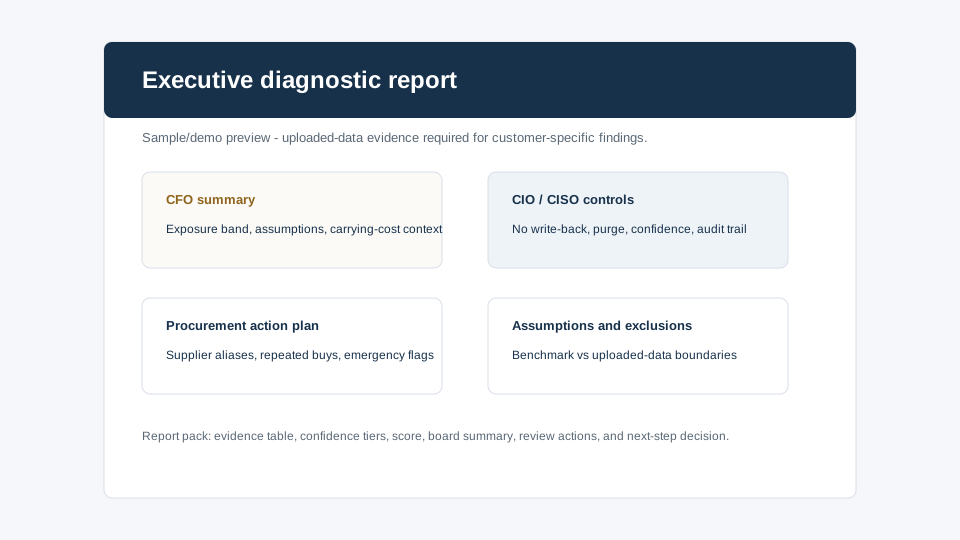
Start the diagnostic — all five role reports are generated from a single CSV upload.

AI2COE Copilot