False Stockout Risk Diagnostic: move from context to diagnostic evidence.
Start with the operating problem, confirm the source data needed, inspect the expected report output, and choose the safest next diagnostic path.
False stockout risk exists when planners see shortage in one record while usable or related stock may exist under another SKU, site, or naming convention.
Start with the operating problem, confirm the source data needed, inspect the expected report output, and choose the safest next diagnostic path.
Enterprise buyers do not evaluate Industrial IQ as one person. Finance, operations, procurement, maintenance, ERP, security, and board sponsors each need a different proof path. This console gives every ICP a fast route to the right engine, data requirement, output, and trust control.
False Stockout Risk Diagnostic is an industrial decision problem, not only a data-cleanup label. False stockout risk exists when planners see shortage in one record while usable or related stock may exist under another SKU, site, or naming convention. Industrial IQ approaches it by mapping exported operational data, validating fields, running the relevant diagnostic engine, producing source-backed evidence, applying confidence tiers, and turning findings into executive reports and review actions. The recommended next step is to run an Industrial IQ Snapshot, inspect sample reports, and replace assumptions with uploaded-data evidence.
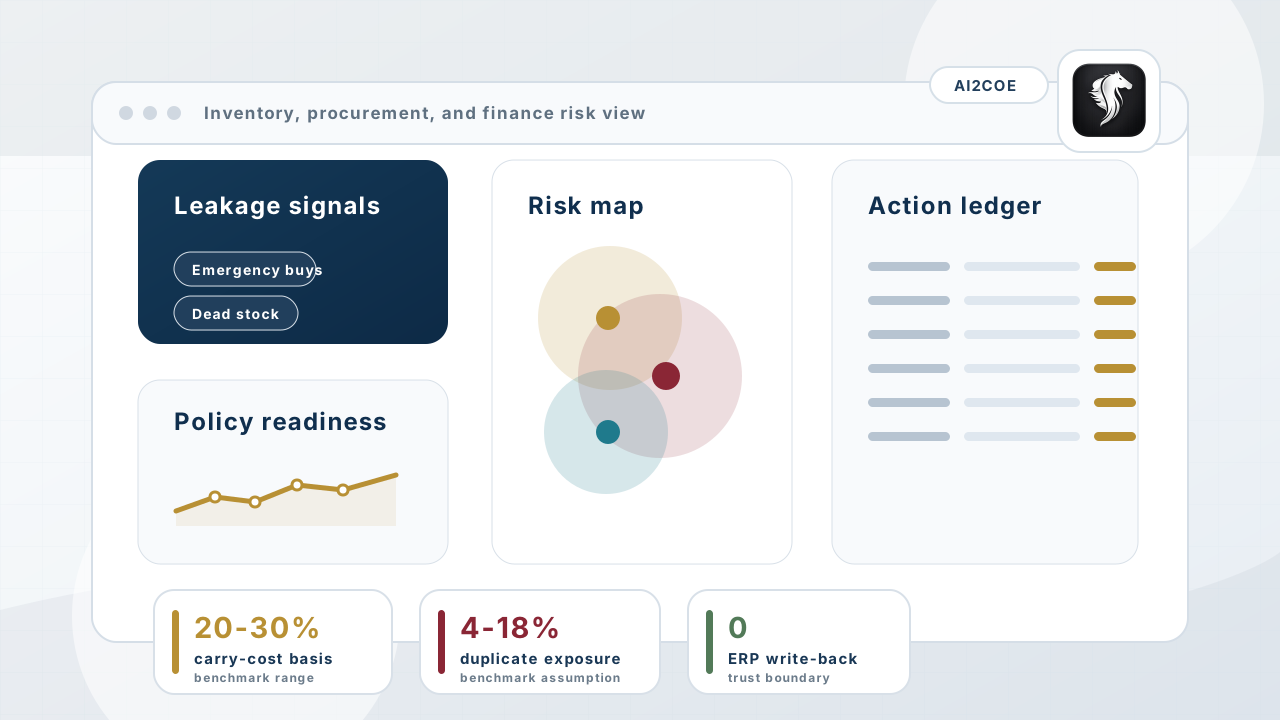
Industrial IQ is a diagnostic and decision-support layer. It labels sample scenarios, separates assumptions from uploaded-data evidence, requires human review for action, and does not perform uncontrolled remediation or ERP write-back.
A false stockout risk diagnostic compares item master, inventory, work-order, asset, and procurement data to detect availability signals that systems may hide.
The problem shows up as urgent buys, delayed work orders, planner workarounds, local stock hoarding, and downtime risk despite inventory on hand.
The commercial value is lower emergency procurement, stronger maintenance execution, and better critical-spare confidence.
ReliabilityMind AI and InventoryMind AI connect work-order demand, inventory availability, duplicate families, and asset context.
False-stockout candidates, source records, confidence tier, work-order impact, procurement signal, and owner action.
The diagnostic identifies risk signals. Maintenance owners confirm interchangeability before any action.
| Role | Interpretation |
|---|---|
| CFO | Review working-capital exposure, carrying cost, write-off risk, and the difference between benchmark assumptions and uploaded-data evidence. |
| COO | Review readiness, continuity risk, emergency-work pressure, and whether site-level operating teams trust the data enough to act. |
| CIO / ERP leader | Review data readiness, field availability, export quality, governance ownership, auditability, and whether the diagnostic can run without ERP write-back. |
| Procurement | Review supplier fragmentation, emergency-buying patterns, stocked-but-purchased signals, price variance, and owner-ready leakage evidence. |
| Maintenance / Reliability | Review false-stockout risk, critical-spare coverage, work-order readiness, asset-to-part gaps, and specialist review queues. |
| Approach | Decision implication |
|---|---|
| Traditional approach | Broad cleanup, manual spreadsheet review, consulting assessment, ERP workflow design, or MDM implementation may begin before leaders know which findings are material. |
| Industrial IQ approach | Run a bounded diagnostic first, review source-backed evidence and confidence tiers, then decide whether remediation, governance, platform work, or recurring intelligence is justified. |
Continue the evaluation with this related platform, documentation, methodology, research, report, or trust resource.
Related Industrial IQ pageContinue the evaluation with this related platform, documentation, methodology, research, report, or trust resource.
A false stockout risk diagnostic compares item master, inventory, work-order, asset, and procurement data to detect availability signals that systems may hide.
The problem shows up as urgent buys, delayed work orders, planner workarounds, local stock hoarding, and downtime risk despite inventory on hand.
The commercial value is lower emergency procurement, stronger maintenance execution, and better critical-spare confidence.
False stockout risk exists when planners see shortage in one record while usable or related stock may exist under another SKU, site, or naming convention.
A false stockout risk diagnostic compares item master, inventory, work-order, asset, and procurement data to detect availability signals that systems may hide.
Industrial IQ starts with exported operational data such as item master, inventory, procurement, asset, work-order, finance, or governance files. The exact fields depend on the engine selected.
No. Industrial IQ produces evidence, confidence tiers, scores, reports, and review actions. It does not autonomously change SAP, Maximo, Oracle, EAM, CMMS, inventory, procurement, or maintenance systems.
Use the output to decide what should be reviewed, funded, governed, or escalated. Uploaded-data diagnostics replace planning assumptions with source-backed evidence.
The procurement leakage analysis page remains the parent commercial path; this route explains the narrower buying pattern, source exports, evidence output, and review boundary.
ProcureMind AI remains the product engine for PO-line evidence, supplier fragmentation, emergency-buying signals, false-stockout procurement, and leakage review.
Useful source exports include purchase history, supplier records, item master, inventory balances, contract context, lead-time fields, price, currency, plant/site, and emergency-buy indicators.
Outputs include procurement exception candidates, supplier overlap, stocked-but-purchased signals, leakage evidence, confidence tiers, and owner-review actions.
Procurement findings are evidence for review. They do not authorize autonomous sourcing, buying, supplier changes, or ERP/P2P write-back.
The solution page carries the broader buyer journey. This route keeps the narrower procurement-intelligence, false-stockout, or regional role clear.
No. They are reviewable diagnostic findings that require accountable owner review before any procurement or supplier action.
Industrial IQ is designed for evidence-first buyers. Review sample proof, run a bounded Snapshot, align the buyer committee, or request a founder-led diagnostic pilot when the operating problem is ready for review.
See what the report looks like before sharing internal data.
Have a data export Run Free Industrial IQ SnapshotStart with an export-first diagnostic path and no ERP write-back.
Need committee alignment Download Buyer Evaluation GuideGive finance, operations, procurement, ERP, security, and maintenance the same evaluation frame.
Ready for review Request Founder-Led PilotAsk for a founder-led pilot review when the problem has an owner and source data is available.
Product evaluation separates the operating problem, required source files, diagnostic logic, evidence outputs, and review boundary so buyers understand what the engine does and what remains human-owned.
Product sponsor, process owner, ERP/data lead, and executive reviewer.
Source exports mapped to the engine, required fields, optional context, assumptions, exclusions, and confidence-tier evidence.
Engine-specific findings, score context, report sections, open findings, action-tracker items, and next review steps.
Read-only diagnostics, no ERP write-back, source-file purge after report generation, and human review before action.
Grounded in approved AI2COE content only. No unsupported claims.