Works from CSV or workbook exports produced from SAP, IBM Maximo, Oracle ERP, Hexagon EAM, Infor, and other ERP, EAM, or CMMS systems. No direct integration or write-back is required — Review data requirements →
Duplicate SKU Detection

Duplicate SKU detection that protects operations from unsafe consolidation.

Duplicate SKU detection in industrial operations is not a simple text-matching task. The same catalog can contain pump seals, valves, bearings, motors, gaskets, filters, and fasteners that look similar but are not interchangeable. PartsCleanse AI detects duplicate SKU families while preserving the engineering and commercial discriminators that matter.

7 controlsSize, pressure, material, model, UOM, subtype, category
Review-firstNo automatic ERP deletion
CFO-readyCapital exposure and recovery ranges
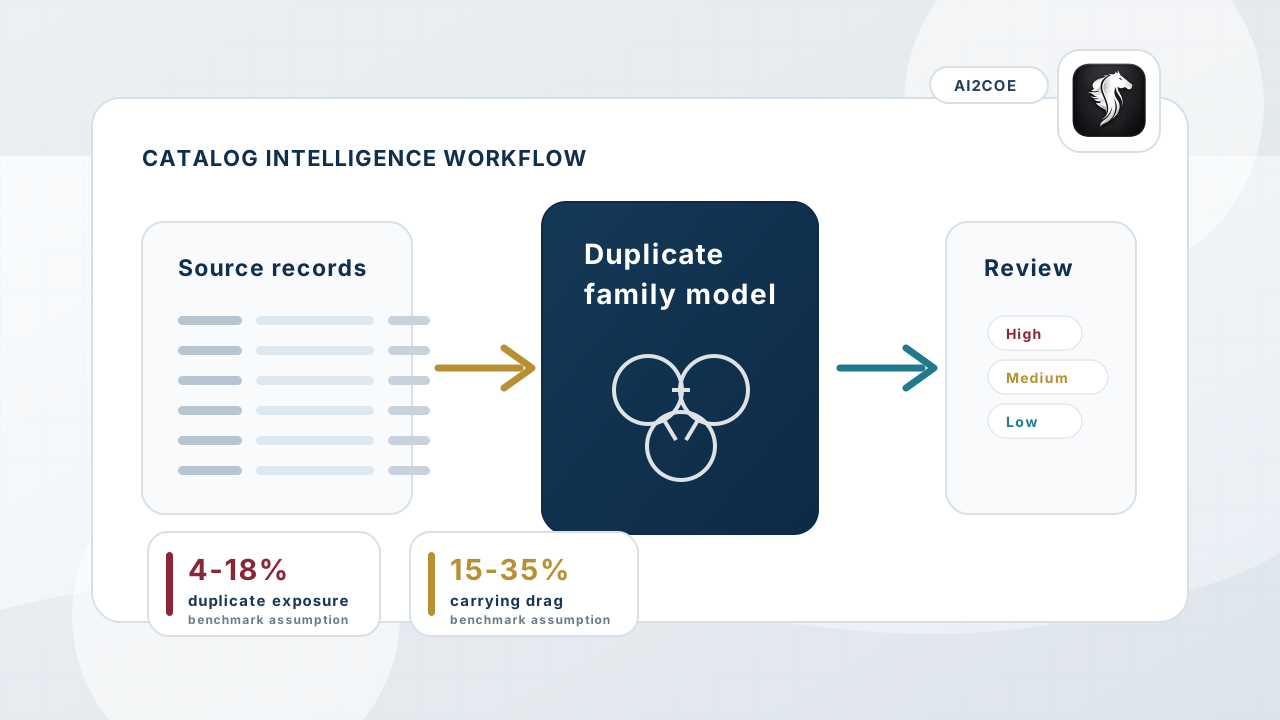
PartsCleanse AI catalog intelligence workflow showing duplicate detection, normalization, and MRO data quality improvement.
MRO catalog cleansing becomes safer when duplicate families and incomplete records are reviewed as source-backed evidence.
Evidence summary

Diagnostic evidence path

Duplicate SKU Detection for Industrial MRO: This engine path connects the operating problem, exported source data, diagnostic logic, evidence output, review boundary, and next action for Industrial IQ buyers. Duplicate SKU Detection: Industrial IQ diagnostic context for uploaded-data evidence, assumption-bound value interpretation, governance controls, and the next.

Run This Engine
Review ownerThe operating, finance, procurement, maintenance, data, and governance leaders accountable for this diagnostic decision.
Input file contextTypical exported operational files, helpful optional fields, sample data, and mapped CSV or workbook evidence.
Diagnostic evidenceSource-backed findings, confidence tiers, score interpretation, report preview, review actions, and recurring-use path.
Recommended actionInspect the sample report, then run the matching engine with bounded exported operational data.
Buyer Experience Map

Duplicate SKU Detection for Industrial MRO: move from context to diagnostic evidence.

Start with the operating problem, confirm the source data needed, inspect the expected report output, and choose the safest next diagnostic path.

1ProblemUse PartsCleanse AI for duplicate SKU detection across SAP, Maximo, Oracle, EAM, and CMMS exports with industrial false-positive controls and executive reporting.
2DataCSV or workbook exports from ERP, EAM, CMMS, inventory, procurement, asset, or work-order systems.
3ProofEvidence table, confidence tier, score, report output, and governance boundary.
4ActionRun Free Industrial IQ Snapshot or the mapped engine-specific diagnostic.
Primary CTARun Free Industrial IQ Snapshot
Trust boundaryNo ERP write-back, no autonomous master-data changes, and human-reviewable findings.
Next assetSample report, methodology, documentation, or required fields by engine.
Your Role. Your Engine. Your Evidence.

Duplicate SKU Detection for Industrial MRO should answer the buyer's first five questions without a sales call.

Enterprise buyers do not evaluate Industrial IQ as one person. Finance, operations, procurement, maintenance, ERP, security, and board sponsors each need a different proof path. This console gives every ICP a fast route to the right engine, data requirement, output, and trust control.

Enterprise Decision Model

Find my role. Pick my engine. See the data. Trust the output. Act safely.

Buyer identityChoose the role that owns the decision so the page presents value, risk, proof, and evaluation concerns in the right language.
Industry contextMatch the diagnostic pack to sector-specific operating reality instead of forcing every buyer through a generic product story.
Source data clarityShow minimum viable upload, best upload, sample datasets, field mapping, and what happens when fields are missing.
Output proofExpose sample reports, evidence tables, review levels, score interpretation, action tracker, and score history before private upload.
Trust boundaryKeep no ERP write-back, owner review, review levels, audit evidence, and sample-versus-uploaded-data labeling visible near the CTA.
What leaders need to know

Duplicate SKU Detection for Industrial MRO -- what leaders need to know.

The risk in generic duplicate SKU matching

The risk in generic duplicate SKU matching

Generic fuzzy matching can over-score records that share common words but differ by size, pressure class, material, model, or unit of measure. In MRO operations, that can turn a data-quality exercise into a maintenance risk.

What PartsCleanse AI adds

What PartsCleanse AI adds

The engine combines normalization, manufacturer aliases, TF-IDF weighted blocking, confidence tiers, and industrial discriminator penalties. The result is a review pack, not a blind merge list.

Why executives care

Why executives care

Duplicate SKUs split demand history, inflate inventory, distort reorder logic, and hide preferred supplier behavior. The report translates those patterns into finance, procurement, operations, and data-governance language.

AI2COE decision model

Catalog decision model.

Question

Is the catalog problem material enough to justify action?

Baseline

Use the scorecard to estimate duplicate exposure, unsafe-match controls, and carrying-cost drag.

Evidence

Run PartsCleanse AI to identify actual duplicate families, discriminator conflicts, and confidence tiers.

Governance

Route findings to owners before any ERP record is retired or consolidated.

Executive brief

Executive answer for the buying committee.

Duplicate SKU detection in industrial operations is not a simple text-matching task. The same catalog can contain pump seals, valves, bearings, motors, gaskets, filters, and fasteners that look similar but are not interchangeable. PartsCleanse AI detects duplicate SKU families while preserving the engineering and commercial discriminators that matter.

What it solvesUse PartsCleanse AI for duplicate SKU detection across SAP, Maximo, Oracle, EAM, and CMMS exports with industrial false-positive controls and executive reporting.
Who should careCFOs, procurement heads, maintenance leaders, CIOs, and master-data owners who need evidence before committing budget.
Why nowERP migrations, inventory-reduction programs, AI initiatives, and procurement cleanups expose catalog debt that was previously hidden.
What happens nextRun the diagnostic, review duplicate-family evidence, route findings to owners, and only then approve remediation action.
FAQ

Buyer-ready questions.

What is duplicate SKU detection?

It identifies records that likely describe the same physical item even when descriptions, manufacturer names, units, or part numbers vary across systems and sites.

Why is industrial duplicate SKU detection different?

Industrial parts can appear similar but differ in critical specifications. The diagnostic must preserve size, pressure, material, model, UOM, subtype, and category controls.

Can I use this before a master-data project?

Yes. The product is designed to quantify the duplicate-SKU opportunity before larger remediation, ERP governance, or consulting spend is approved.

Diagnostic playbook map

Show the diagnostic path behind this solution.

The diagnostic workflow converts operating pain into source data, evidence classification, confidence tier, report output, and buyer-owned next action.

Assess Industrial AI Readiness
Diagnostic evidence path

Choose the next step that matches your buying stage.

Industrial IQ is designed for evidence-first buyers. Review sample proof, run a bounded Snapshot, align the buyer committee, or request a founder-led diagnostic pilot when the operating problem is ready for review.

Read-only diagnostics · No ERP write-back · Source files purged after report generation · Human review before action
AI2COE Copilot