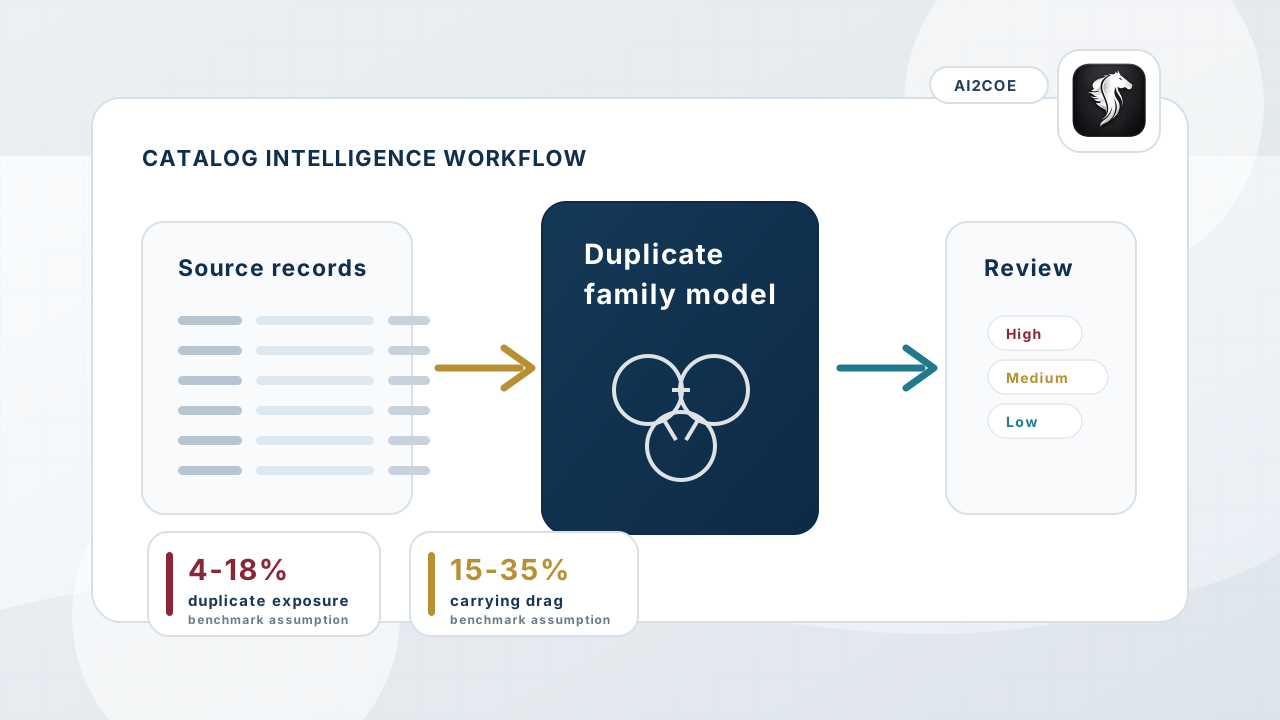
Before the upload, show the buying committee what the diagnostic proves.
This short brief frames PartsCleanse AI for CFO, procurement, operations, CIO, and master-data owners before they run the workbench.
Upload a CSV export from SAP, Maximo, Oracle, or any CMMS. Receive confidence-tiered duplicate families, a capital-at-risk figure, and five executive report artifacts for CFO, CIO, and Procurement review — in under 90 seconds. No ERP integration. No IT project.
This short brief frames PartsCleanse AI for CFO, procurement, operations, CIO, and master-data owners before they run the workbench.
PartsCleanse AI reports are structured for CFO, procurement, operations, CIO, and master-data owners. The output does not simply list duplicate rows; it explains value, confidence, operating risk, source purge posture, and review governance.
PartsCleanse AI is a 15-business-day, ERP-agnostic MRO catalog deduplication diagnostic. It identifies duplicate spare-parts records in SAP, IBM Maximo, Oracle, Hexagon EAM, or any CMMS catalog using confidence-tiered scoring with 7-class industrial discriminator penalties that prevent unsafe part consolidations. Engagements start at $8,000 from a single CSV export — no integration, no IT project, no subscription.
Unlike generic fuzzy-match tools, PartsCleanse AI applies critical discriminator penalties after text scoring — size, pressure class, material family, model number, functional subtype, commercial unit (pack vs each), and part category. A 2-inch gate valve and a 4-inch gate valve sharing similar descriptions will never be flagged as duplicates. This controls false-positive consolidation across all Tier 1/2/3 findings.
MRO catalog deduplication is the process of identifying spare-parts item records in an ERP or CMMS that describe the same physical component under different descriptions, codes, or supplier formats — then quantifying the financial exposure from duplicate stock before authorizing any consolidation. PartsCleanse AI automates this diagnostic in under 90 seconds from a CSV export, with no ERP integration required.
PartsCleanse AI is designed to change the internal conversation from "we think the catalog has duplicates" to "here are the duplicate families, here is the capital exposure, here is the confidence tier, and here is the governed review path."
That distinction matters. Industrial organizations do not need a prettier spreadsheet; they need a defensible evidence pack that maintenance, procurement, finance, and master-data owners can use together.
Findings open directly in the browser with KPI narrative, risk interpretation, and review guidance.
A structured workbook for analysts and data stewards to inspect duplicate families and confidence tiers.
A board-ready document with business narrative, KPI summary, governance language, and next actions.
A presentation-ready decision brief for finance, procurement, operations, and leadership review.
A governed review baseline, not an uncontrolled ERP overwrite.
Methodology, outputs, ERP coverage, or competitive differentiation — the Copilot pulls from the full knowledge base.
| Capability | Manual / Spreadsheet | Generic dedup tool | PartsCleanse AI |
|---|---|---|---|
| Processes 50,000 SKUs | Weeks to months | Minutes -- unvalidated | 42.9 seconds |
| Industrial discriminator controls (size, pressure, material, model) | ✗ None | ✗ Generic text only | ✓ 7 discriminator classes |
| Confidence-tiered output (Tier 1 / 2 / 3 review routing) | ✗ Binary yes/no | ✗ Single score | ✓ 3-tier governed review |
| SAP abbreviation handling (pre-normalization before scoring) | ✗ Requires manual prep | ✗ Misses SAP format | ✓ Adaptive input profiler |
| Capital-at-risk figure (in executive report language) | ✗ Manual calculation | ✗ Not produced | ✓ Per-run quantification |
| Board-ready deliverables (Browser, Excel, Word, PDF, CSV) | ✗ Self-formatted | ✗ Raw export only | ✓ 5 formats per run |
| ERP integration required | ✗ Often required | Sometimes | ✓ CSV only -- zero integration |
Engine 1 -- Input Profiler: Classifies the catalog as abbreviated (SAP), verbose, mixed, or clean before any scoring begins. Raw SAP abbreviations, post-migration description fragments, and multi-site data are handled before comparison -- not after.
Engine 2 -- Duplicate Detector: Runs TF-IDF weighted blocking, manufacturer alias normalization, 200-category part-type taxonomy, composite confidence scoring, and critical industrial discriminator penalties -- size, pressure rating, material family, model number, and pack-vs-each unit conflicts all prevent unsafe matches.
Register in two minutes. Upload your CSV. Receive a full duplicate-family report with capital-at-risk figures, confidence-tiered evidence, a board-ready Word summary, and a clean CSV baseline -- before your next management meeting.
PartsCleanse AI is calibrated for the catalog complexity of each sector. See your industry's tailored diagnostic pathway, use-case map, and AI adoption sequence.
PartsCleanse AI diagnostic engagements are priced at $8,000–$20,000 as a flat fee depending on catalog size. Includes engine processing, all five output artifacts, and delivery within 15 business days. No ERP integration or ongoing subscription required.
SAP ECC end-of-support is 2027. S/4HANA's stricter material master model turns duplicate records into migration blockers. PartsCleanse AI rationalizes the material master before migration begins — eliminating the most expensive category of post-cutover data cleanup.
PartsCleanse AI processes a 50,000-SKU catalog in 42.9 seconds. A 25,000-SKU Oil & Gas reference catalog produced 3,847 duplicate families, $4.2M capital at risk, in 38.7 seconds. Zero ERP connections required.
The engine applies discriminator penalties for size, pressure rating, material family, model number, and unit-of-measure conflicts. A 2-inch valve and a 4-inch valve sharing similar descriptions will never be flagged as duplicates. No automatic ERP overwrites occur.
PartsCleanse AI is an AI-powered MRO spare-parts catalog deduplication diagnostic. It processes CSV exports from SAP, Maximo, Oracle, or any CMMS to identify duplicate item families, quantify capital exposure, and produce five executive-grade report artifacts in under 90 seconds. No ERP integration or IT project is required to start.
PartsCleanse AI diagnostic engagements are priced at $8,000–$20,000 as a flat fee depending on catalog size. The price includes engine processing, all five output artifacts, and delivery within 15 business days. No ongoing subscription, ERP integration, or implementation program is required to initiate the engagement.
SAP ECC reaches end of mainstream support in 2027. S/4HANA enforces a stricter material master data model — duplicate and inconsistent records that coexist in ECC become migration blockers or data-integrity failures post-cutover. PartsCleanse AI rationalizes the material master before migration begins, eliminating the most costly category of data remediation: post-cutover cleanup.
No. PartsCleanse AI starts from a standard CSV catalog export from SAP, IBM Maximo, Oracle, Hexagon EAM, Infor, or any site-level CMMS. No API connection, no IT procurement cycle, and no onboarding program is required. Upload the file and receive results immediately.
The engine applies critical discriminator penalties after fuzzy text scoring. Size, pressure rating, material family, model number, functional subtype, and pack-vs-each unit conflicts reduce unsafe match confidence scores. A 2-inch valve and a 4-inch valve sharing similar descriptions will never be flagged as duplicates. Tier 2 and Tier 3 results form a specialist review backlog — no automatic ERP overwrites occur.
Each diagnostic produces five artifacts: an in-browser executive report, an Excel evidence workbook with confidence-tiered duplicate families, a Word executive summary for board presentation, a PDF executive report, and a clean CSV baseline for governed review. All five are available immediately after the engine run completes.
The engine processes a 50,000-SKU catalog in 42.9 seconds. Smaller catalogs run proportionally faster. Output artifacts are available immediately — no consultant turnaround time, no project delay.
PartsCleanse AI serves 18 asset-intensive industries including oil and gas, mining, manufacturing, utilities, food and beverage, pharmaceutical, aviation MRO, rail and transit, ports and marine terminals, data centers, and construction. Each industry page maps the diagnostic to that sector's specific ERP environment, compliance requirements, and cost model.
The strongest sponsor is usually the CFO, COO, Head of Procurement, CIO, Reliability Director, Maintenance Director, or Master Data Governance owner. The product is intentionally cross-functional: finance needs the capital exposure, procurement needs supplier and duplicate-item leakage, operations needs uptime context, and data governance needs a controlled review backlog.
Prepare a CSV export with item number, item description, UOM, quantity on hand, unit cost, site or plant, manufacturer, manufacturer part number, supplier, and any criticality or commodity fields available. The engine can run with partial data, but richer fields produce stronger CFO, procurement, operations, and governance interpretation.
Source catalog files are processed for the run and purged after report generation. AI2COE retains only summary metrics, report ownership, quota usage, feedback, and audit metadata for dashboards and product improvement. Session-only downloadable files are not intended to become permanent server-side storage.
The right next step depends on where you are. Use the pathway below to move from problem confirmation to procurement-ready engagement.
You suspect catalog duplication is eroding working capital but have not yet quantified it. Start here.
The problem is confirmed. You are now evaluating whether PartsCleanse AI fits your data posture and governance requirements.
Evaluation is complete. You are ready to scope an engagement, obtain procurement documentation, or request a formal quote.
Generic data cleansing tools, MDM platforms, and consulting services all address catalog quality. But they address it at a different cost, time, and governance posture than PartsCleanse AI. The table below captures the critical differences.
| Criterion | PartsCleanse AI | Generic fuzzy matcher | SAP MDG / Oracle MDM | MRO consulting firm |
|---|---|---|---|---|
| Industrial false-positive control | 7 discriminator classes | None -- text-only scoring | Rule-based, requires config | Manual analyst review |
| Time to first finding | Under 90 seconds | Hours -- no output format | Weeks to months -- platform setup | 4-16 weeks -- engagement timeline |
| Input requirement | Single CSV export | Varies -- often requires integration | Full ERP integration | Multiple data pulls + workshops |
| Executive output artifacts | 5 per run (browser, Excel, Word, PDF, CSV) | CSV or log only | ERP workflow -- no report | Slide deck -- varies by firm |
| SAP abbreviation handling | Adaptive normalization engine | Not supported | Partial -- via data standards config | Analyst judgment |
| No ERP write-back | Guaranteed -- diagnostic only | Not applicable | No -- MDG executes changes | Depends on scope |
| Cost to start | Free (30 runs) | Varies -- usually free but no output | High -- license + SI fees | $50K-$500K+ engagement cost |
PartsCleanse AI addresses the catalog layer. The modules below apply the same governed, no-integration-required diagnostic approach to maintenance history and procurement spend.
Work-order and CMMS history analyzed for bad actors, repeat failure patterns, downtime exposure, and maintenance strategy segmentation.
Explore the module → Controlled betaPO, supplier, and spend data analyzed for price variance, emergency-buy premiums, supplier fragmentation, and tail-spend governance.
Explore the module →Grounded in approved AI2COE content only. No unsupported claims.