CFO / Finance, COO / Operations, CIO / ERP, CPO / Procurement
Enterprise trust posture
Proof controls buyers expect before they upload operational data.
Source purge
Uploaded source files are purged after report generation; summary metrics and Open Findings remain.
No ERP write-back
The diagnostic creates evidence for review. It never changes, deletes, merges, or overwrites ERP records.
Local currency
Reports display money in the user's selected or country-derived currency, while USD remains the base audit calculation.
Audit trail
Report ownership, access, quota, and feedback events are retained for governed review.
Session downloads
Excel, Word, PDF, and CSV downloads are available only in the active generation session.
Open Findings
Browser findings remain available without retaining the original source catalog rows.
Regional decision cockpit
Brazil: buyer role, engine path, input files, output, and trust boundary.
Regional teams can review the decision path before the detailed operating context, evidence tables, and FAQs.
PartsCleanse AI, InventoryMind AI, ReliabilityMind AI
material master, manufacturer, manufacturer part number, UOM, plant/site
Brazil evidence records, confidence tiers, diagnostic score, executive report, review actions
Read-only diagnostics, no ERP write-back, source-file purge after report generation, and human review.
Request a regional diagnostic review or inspect sample reports before private upload.
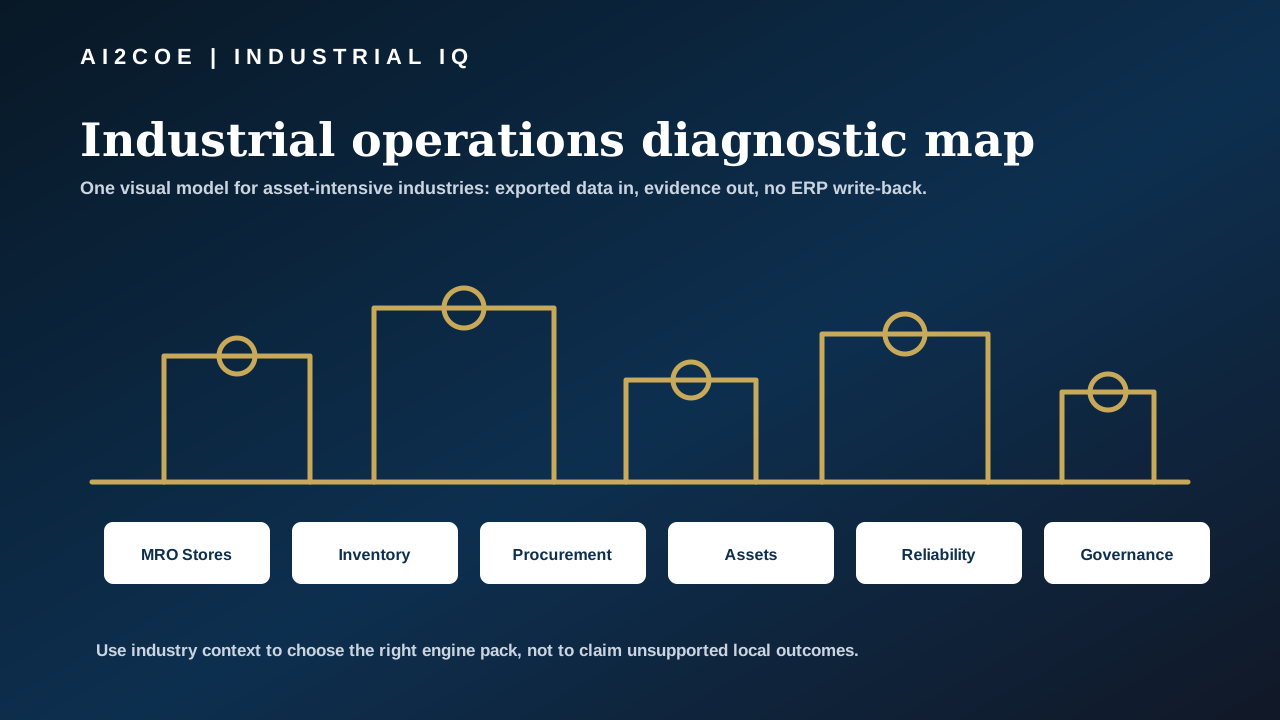
Role and industry fit map
Brazil: match buyer role, industry reality, and first diagnostic.
Qualified teams can self-route by role and sector before a sales conversation. AI2COE does not claim in-country presence, named customers, regional certifications, or assured financial outcomes.
Role path
CFO / Finance
Working-capital exposure from duplicate families, slow movement, excess stock, and high-value spares.
Role pathCOO / Operations
Remote-site continuity, shutdown readiness, maintenance delay, and false-stockout risk.
Role pathCIO / ERP
SAP, Maximo, Oracle, TOTVS-adjacent exports, and CMMS readiness before cleanup or AI adoption.
Role pathCPO / Procurement
Supplier fragmentation, emergency purchases, stocked-but-purchased events, and project buying variance.
Role pathMaintenance / Reliability
Critical-spare readiness, asset-to-part gaps, work-order delay exposure, and false-stockout risk.
Related industry paths
Industry entry point
Oil & Gas
Use this sector path for source data, recommended engines, evidence outputs, and a diagnostic next step tailored to the operating reality.
Industry entry pointMining
Use this sector path for source data, recommended engines, evidence outputs, and a diagnostic next step tailored to the operating reality.
Industry entry pointManufacturing
Use this sector path for source data, recommended engines, evidence outputs, and a diagnostic next step tailored to the operating reality.
Industry entry pointFood & Beverage
Use this sector path for source data, recommended engines, evidence outputs, and a diagnostic next step tailored to the operating reality.
Industry entry pointUtilities
Use this sector path for source data, recommended engines, evidence outputs, and a diagnostic next step tailored to the operating reality.
Industry entry pointTelecom Network Operators
Use this sector path for source data, recommended engines, evidence outputs, and a diagnostic next step tailored to the operating reality.
Country answer
What this Brazil page helps a buyer decide.
AI2COE's Brazil page helps industrial buyers decide whether exported operational data is ready for MRO data cleansing, inventory-risk review, procurement leakage analysis, ERP readiness, maintenance readiness, or industrial AI readiness. It maps Oil & Gas, Mining, Pulp and paper, Utilities to required data, Industrial IQ engines, report outputs, and trust boundaries without claiming country offices, customers, partners, certifications, or promised outcomes.
| Who it is for | CFO / Finance, COO / Operations, CIO / ERP, CPO / Procurement, Maintenance / Reliability |
|---|---|
| Data needed | material master, manufacturer, manufacturer part number, UOM, plant/site, storeroom, inventory quantity, stock value |
| What Industrial IQ produces | Brazil evidence records, confidence tiers, diagnostic score, executive report, review actions, action tracker items |
| Why it is safe | Read-only diagnostics, no ERP write-back, source-file purge after report generation, confidence tiers, and human review before action. |
Country capability contract
Brazil page scope: what AI2COE can evaluate, what buyers provide, and what is not claimed.
This contract keeps the country page useful for ICP visitors while protecting evidence safety. It explains the diagnostic scope for regional buyers without implying physical office presence, formal recognitions, named implementation references, or promised outcomes.
| Capability area | What AI2COE can evaluate | Inputs to prepare | Not claimed |
|---|---|---|---|
| Remote diagnostic fit | Evaluate Brazil industrial AI readiness from exported source files, buyer context, and review-owner inputs for Oil & Gas, Mining, Pulp and paper, Utilities, Ports and logistics. | Industry context, project trigger, source-system list, buyer role, target decision, and security constraints. | No local subsidiary, in-country certification, government approval, named implementation reference, partner status, or realized outcome is claimed on this page. |
| ERP/EAM/CMMS readiness | Assess whether system records can support AI, ERP modernization, MRO data quality, inventory, procurement, asset, or maintenance decisions. | SAP, IBM Maximo, Oracle, TOTVS-adjacent exports, Infor, Hexagon EAM | No source-system write-back, production transaction, migration approval, or implementation completion is implied. |
| MRO and material master readiness | Review item identity, manufacturer context, UOM, plant/site fields, lifecycle state, duplicate candidates, and critical-spare context. | material master, manufacturer, manufacturer part number, UOM, plant/site, storeroom, inventory quantity, stock value | Duplicate, obsolete, excess, or critical-spare outputs remain review candidates until the accountable owner accepts the evidence. |
| Inventory and procurement review | Connect stock, valuation, supplier, PO, receipt, invoice, lead-time, and emergency-buy signals to the right owner path. | Inventory, procurement, supplier, PO history, valuation, usage, work-order, and site context where available. | Exposure, leakage, savings, recovery, and risk are not presented as verified financial outcomes without approved evidence. |
| AI ERP and Agentic AI boundary | Use country context to scope AI ERP modules, governed agents, denied actions, and human approval requirements. | Use case, allowed tools, denied actions, authority level, access scope, evidence class, and review owner. | No autonomous source-system action is approved by a country page; transaction-changing authority requires separate controls. |
| Localisation review | Record language, currency, procurement, data-residency, and buyer-committee considerations that may affect evaluation. | Country, legal-entity, currency, language, site, operating unit, procurement, and data-handling context. | Localization guidance is an operating-context model, not legal, tax, regulatory, procurement, or compliance advice. |
Regional buying thesis
Brazil teams need diagnostic evidence before transformation spend.
AI2COE Industrial IQ helps Brazil asset-intensive teams diagnose MRO catalog quality, inventory exposure, procurement leakage, ERP readiness, and AI readiness from exported data.
Trust boundary: Read-only diagnostics. No ERP write-back. Source files are processed to generate the diagnostic report pack and then purged. Human review happens before operational action. Summary metrics, Open Findings, report ownership, quota usage, feedback, and audit metadata may be retained for governance.
Operating signals
Distributed operationsMulti-site and remote operations can accumulate duplicate material records across plants and warehouses.
Procurement leakageDuplicate item masters weaken supplier leverage, emergency-buy visibility, and inventory rationalization.
Executive evidenceAI2COE reports translate uploaded catalog findings into CFO, procurement, operations, and CIO language.
Operating context
Specific regional conditions that make diagnostics useful.
- Remote mines, plants, ports, utilities, refineries, and infrastructure networks can carry the same spare under different descriptions, suppliers, units, and storerooms.
- Mining, oil and gas, and pulp and paper teams need shutdown and long-lead-spare evidence before inventory rationalization or procurement policy changes.
- Ports, logistics, utilities, and manufacturing operations need asset-to-part and work-order context to separate real stockout risk from catalog disorder.
- Procurement leaders need supplier alias, emergency-buy, repeated-purchase, and price-variance signals tied to catalog and inventory evidence.
- ERP/data leaders need export-first diagnostics before material master cleanup, migration readiness work, or industrial AI adoption.
Buyer paths
Which buyer owns the next decision?
Quantify Brazil capital exposure
Working-capital exposure from duplicate families, slow movement, excess stock, and high-value spares.
Assess Brazil operating risk
Remote-site continuity, shutdown readiness, maintenance delay, and false-stockout risk.
Check Brazil data readiness
SAP, Maximo, Oracle, TOTVS-adjacent exports, and CMMS readiness before cleanup or AI adoption.
Detect Brazil procurement leakage
Supplier fragmentation, emergency purchases, stocked-but-purchased events, and project buying variance.
Improve spares readiness
Critical-spare readiness, asset-to-part gaps, work-order delay exposure, and false-stockout risk.
Relevant Industrial IQ engines
Top diagnostic engines for this market.
PartsCleanse AI
MRO catalog intelligence for duplicate, incomplete, obsolete, and high-risk material records across plants and warehouses.
InventoryMind AI
Inventory-risk review for dead stock, excess stock, slow movement, critical spare uncertainty, and false stockouts.
ReliabilityMind AI
Maintenance-readiness diagnostic for shutdown spare coverage, asset-to-part linkage, and work-order spare availability.
ProcureMind AI
Procurement leakage review across supplier aliases, emergency buys, repeated purchases, and stocked-but-purchased events.
Where to start
Which diagnostic should this market start with?
Start with the engine tied to the active board pressure: capital exposure, uptime risk, procurement leakage, ERP readiness, or AI readiness.
Supporting path
Add supporting engines only when the exported data shows the next decision requires a cross-functional view.
Data sources supported
Start from exported data, not system access.
Industrial IQ is intentionally designed for a low-risk first diagnostic. The buyer exports relevant data from ERP, EAM, CMMS, procurement, inventory, finance, asset, work-order, or spreadsheet systems.
Required data examples
Prepare only the fields relevant to the decision.
Evidence and report outputs
What the diagnostic produces.
Findings are designed for owner review: evidence records, diagnostic reason codes, confidence tiers, score summaries, reports, and action ownership.
Localized answer snippets
PortugueseDiagnostico MRO por CSV para quantificar exposicao de duplicatas antes da remediacao.
Regional evidence preview
What a buyer should expect to see in the report.
| Finding type | Data signal | Decision supported |
|---|---|---|
| Duplicate material records | Similar descriptions, manufacturer fields, part numbers, UOM, stock, and supplier references do not align. | Prioritize cleanup, inventory review, or procurement owner action. |
| Critical-spare readiness | Asset, BOM, inventory, usage, and work-order exports do not prove spare coverage cleanly. | Decide which equipment or sites need maintenance-readiness review. |
| Procurement leakage | PO history, supplier names, item references, and stock-on-hand context show avoidable buying patterns. | Route leakage findings to procurement and operations owners. |
Current tools vs diagnostic evidence
Industrial IQ comes before bigger platform or consulting spend.
Existing systems remain authoritative. Industrial IQ uses exports from those systems to show which records, sites, suppliers, assets, or workflows need review before cleanup, optimization, or AI adoption.
ERP report
Useful for transactions and balances; Industrial IQ adds diagnostic confidence, evidence, and owner action.
BI dashboard
Useful for monitoring; Industrial IQ tests cross-record risk before transformation spend.
Consulting assessment
Useful for advisory framing; Industrial IQ grounds the next step in exported operational data.
Regional diagnostic scenarios
Specific operating questions this market should be able to answer.
Material master cleanup
Which duplicate or incomplete MRO records should be reviewed before master-data remediation begins?
Critical spare readiness
Which assets, BOMs, inventory balances, and work-order histories fail to prove spare coverage?
Procurement leakage
Where do PO history, supplier aliases, item records, and stock balances show avoidable buying patterns?
AI readiness
Which operational data sets are strong enough to support the first governed industrial AI use case?
Proof assets
Use these pages to validate the methodology before upload.
Proof asset
Sample reports
Public report examples that show how findings are framed for leadership.
Proof assetSample board pack
A board-ready preview of diagnostic findings, score movement, and action ownership.
Proof assetMethodology provenance
How report values separate benchmark assumptions from uploaded-data evidence.
Proof assetData retention
Source-file purge, report ownership, audit metadata, and governance controls.
Proof assetSecurity overview
Portal controls, audit logging, and deployment readiness posture.
Related decision paths
Continue with commercial and trust pages.
Related decision page
Oil and gas diagnostics
Continue the buyer review with a directly related Industrial IQ page.
Related decision pageMining critical-spares readiness
Continue the buyer review with a directly related Industrial IQ page.
Related decision pageMRO data cleansing diagnostic
Continue the buyer review with a directly related Industrial IQ page.
Related decision pageProcurement leakage analysis
Continue the buyer review with a directly related Industrial IQ page.
Related decision pageData retention controls
Continue the buyer review with a directly related Industrial IQ page.
Regional FAQ
Questions regional buyers should resolve clearly.
Can Brazilian operators start from a CSV export?
Yes. PartsCleanse AI starts from CSV exports and does not require ERP integration.
Does AI2COE support BRL-style financial interpretation?
Country-driven currency logic supports local currency presentation and profile-level overrides for authenticated users.
What industries in Brazil are strongest fits?
Oil & Gas, mining, pulp and paper, utilities, ports, manufacturing, and industrial infrastructure are priority segments.
Is customer catalog data retained?
No. The uploaded source catalog is purged after report generation. The portal retains only governed summary metrics and Open Findings.
What should Brazil teams start with?
Start with the diagnostic tied to the active decision: MRO data cleansing, inventory exposure, procurement leakage, maintenance readiness, ERP readiness, or industrial AI readiness. The page maps those decisions to the most relevant Industrial IQ engines.
Which Brazil industries benefit most?
The strongest fit is asset-intensive operations with complex spares, sites, procurement, maintenance, and ERP/EAM/CMMS records. Priority sectors shown on this page are Oil & Gas, Mining, Pulp and paper, Utilities, Ports and logistics, Manufacturing.
What files are needed?
The first run usually starts from exported files such as material master, manufacturer, manufacturer part number, UOM, plant/site, storeroom, inventory quantity, stock value. Optional asset, BOM, work-order, supplier, and finance fields improve diagnostic confidence.
Regional operating path
Choose the next step that matches your buying stage.
Industrial IQ is designed for evidence-first buyers. Review sample proof, run a bounded Snapshot, align the buyer committee, or request a founder-led diagnostic pilot when the operating problem is ready for review.
Read-only diagnostics · No ERP write-back · Source files purged after report generation · Human review before action
Still evaluating
View Sample Reports
See what the report looks like before sharing internal data.
Have a data export Request Regional Diagnostic ReviewStart with an export-first diagnostic path and no ERP write-back.
Need committee alignment Download Buyer Evaluation GuideGive finance, operations, procurement, ERP, security, and maintenance the same evaluation frame.
Ready for review Request Founder-Led PilotAsk for a founder-led pilot review when the problem has an owner and source data is available.
Regional operating lens
Use this page to evaluate Global operating context without inventing local proof.
Regional evaluation stays locally useful while keeping claims evidence-safe: no invented offices, unverified customer presence, certifications, or dominance claims.
Regional executive sponsors, industrial operators, procurement teams, and ERP/data owners.
Local industry mix, operating systems, source exports, buyer roles, engine fit, data handling concerns, and trust review needs.
A region-specific diagnostic path that points to engines, sample reports, buyer review, and contact without changing the platform promise.
Read-only diagnostics, no ERP write-back, source-file purge after report generation, and human review before action.
