Works from CSV or workbook exports produced from SAP, IBM Maximo, Oracle ERP, Hexagon EAM, Infor, and other ERP, EAM, or CMMS systems. No direct integration or write-back is required — Review data requirements →
Mining + Hexagon EAM

Hexagon EAM MRO catalog diagnostics for Mining.

Catalog intelligence for mobile fleets, fixed plant, conveyors, crushers, and remote spares. This page translates Hexagon EAM duplicate-detection language into the operating reality of Mining buyers.

Heavy assets and remote operationsIndustry context
Hexagon EAMSystem context
CSV-firstNo integration required
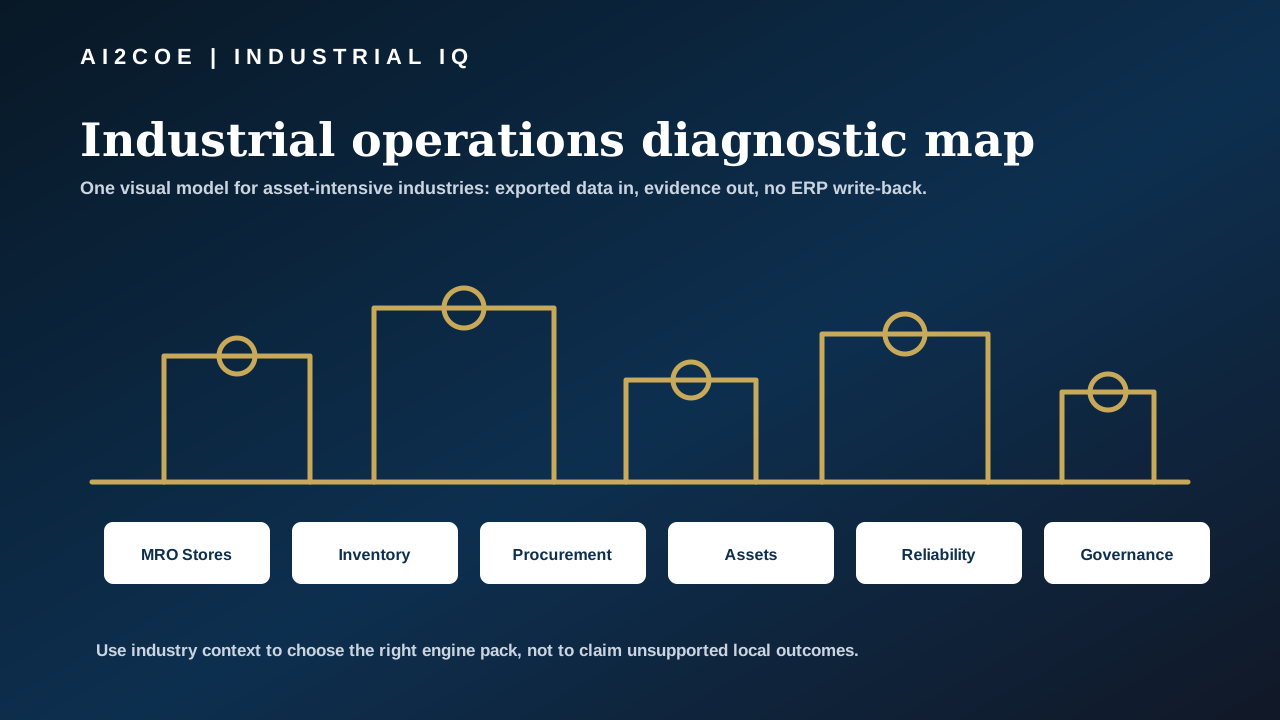
Industrial operations diagnostic map connecting stores, inventory, procurement, assets, reliability, and governance to Industrial IQ engines.
Industrial IQ routes each industry into the right evidence-first engine pack without claiming unsupported local outcomes.
Evidence summary

Industry evidence path

Mining + Hexagon EAM MRO Diagnostic: Industry operators use this path to connect operating pressure to the right Industrial IQ diagnostic, source files, report outputs, and governance controls. Hexagon EAM MRO duplicate catalog diagnostic for Mining: CSV-first upload, no ERP write-back, industry context, executive reports, and governed review evidence.

Run Industry Snapshot
Review ownerIndustry operators, plant leaders, site owners, finance, procurement, maintenance, and CIO teams
Input file contextIndustry-specific ERP, EAM, CMMS, inventory, procurement, asset, and work-order exports.
Diagnostic evidenceA recommended Industrial IQ engine pack with buyer-role interpretation, value levers, pilot path, and governance controls.
Recommended actionRun the industry-specific Industrial IQ Snapshot and review the engine pack sequence.
Industry operating reality

Mining buyers need system evidence, not generic data-quality language.

Mining operators carry high-value spares across mobile fleets, fixed plant, process equipment, remote warehouses, and contractor-managed maintenance records. Duplicate item masters hide stock, increase emergency buys, and weaken maintenance planning when a site cannot confidently identify what it already owns. PartsCleanse AI gives mining leadership an evidence-first view of duplicate families, capital exposure, commodity concentration, and site-level cleanup priorities.

Hexagon EAM fields

These fields strengthen duplicate detection, capital exposure, and review routing when present in the export.

PARTDESCRIPTIONUOMMANUFACTURERPART_NUMBERSTOREQTY_ON_HANDUNIT_COST
Use-case translation

How Industrial IQ fits Mining on Hexagon EAM.

01Duplicate spares across mine sites, mobile fleets, fixed plant, and warehouse catalogs.
02Capital-at-risk analysis for high-value components, bearings, belts, pumps, filters, and electrical spares.
03Site and commodity slicing for reliability, maintenance planning, and procurement teams.
04Controlled review backlog before SAP, Maximo, or CMMS material governance programs.
Buyer Committee Depth Model

Hexagon EAM MRO diagnostics for Mining: what the buying committee needs before acting.

Board answer for Mining.

Mining operators carry high-value spares across mobile fleets, fixed plant, process equipment, remote warehouses, and contractor-managed maintenance records. Duplicate item masters hide stock, increase emergency buys, and weaken maintenance planning when a site cannot confidently identify what it already owns. PartsCleanse AI gives mining leadership an evidence-first view of duplicate families, capital exposure, commodity concentration, and site-level cleanup priorities.

For Mining buyers, MRO catalog disorder is not a narrow master-data problem. It becomes a capital-allocation, uptime, procurement, ERP-readiness, and AI-governance question. The first decision is therefore not which platform to buy; it is whether the uploaded data proves a material exposure that leadership can defend.

Capital exposure lens: Mining leaders should use the Hexagon EAM export to test catalog health, duplicate-family exposure, cost coverage, plant/site risk, and review ownership before the ERP program expands. The diagnostic should convert this into local-currency exposure, confidence-adjusted value, and a prioritized human-review queue before any remediation program begins.

Evidence required before budget approval.

Source fieldsitem number, description, manufacturer, MPN, UOM, quantity, unit cost, plant/site, and ERP context where available
Diagnostic proofduplicate-family evidence, confidence tier, mapped-field completeness, local currency exposure, and owner-review route
Governance boundaryno ERP write-back, no autonomous retirement, source-file purge after report generation, retained Open Findings and audit metadata
Diagnostic evidenceboard-readable exposure signal, operational interpretation, prioritized review queue, and next-step recommendation
CFO Quantify working capital exposure, carrying-cost drag, and avoidable procurement leakage before approving remediation spend.
COO Understand whether duplicate records are creating false stockouts, planner friction, uptime risk, or shutdown readiness gaps.
CIO / ERP Lead Prove whether the ERP export is usable for AI and governance before committing to a larger data-transformation path.
Procurement Separate supplier fragmentation, repeated buying, and duplicate-stock exposure from normal category-management noise.
Maintenance Identify whether part-search uncertainty, duplicate descriptions, and alternate records are degrading service readiness.
No unsupported claim boundary

What AI2COE will and will not claim.

AI2COE can quantify uploaded-data signals, benchmark assumptions, confidence tiers, and review priorities. It does not present fixed financial outcomes, autonomous ERP changes, or final remediation value until the customer validates findings and acts through its own governance process.

FAQ

Buyer-ready questions.

How does AI2COE analyze Hexagon EAM operational data for Mining?

AI2COE starts with a CSV export, preserves Mining operating context, and routes the export to the relevant Industrial IQ engine before producing executive reports.

What is the strongest buying trigger for Mining?

Mining operations often carry material MRO inventory across remote sites. A duplicate or unfindable spare can trigger expedited freight, lost production risk, and excess safety stock simultaneously. The financial impact is not only an IT problem — it is a working-capital and operational-continuity issue that belongs on the balance-sheet review agenda before any ERP or CMMS governance program begins.

Does this require Hexagon EAM integration?

No. The first diagnostic is intentionally CSV-first and no-write-back.

Industry diagnostic map

Connect the industry context to the evidence path.

Industrial IQ connects site context, source exports, engine selection, and owner review before buyers move into detailed analysis.

View Sample Reports
Industry path

Choose the next step that matches your buying stage.

Industrial IQ is designed for evidence-first buyers. Review sample proof, run a bounded Snapshot, align the buyer committee, or request a founder-led diagnostic pilot when the operating problem is ready for review.

Read-only diagnostics · No ERP write-back · Source files purged after report generation · Human review before action
AI2COE Copilot