AI2COE AI ERP connects native module workflows, enterprise records, governed AI agents, approval context, and audit evidence. Industrial IQ provides diagnostic evidence where exported source-data review is needed — Get an AI ERP demo →
AI ERP

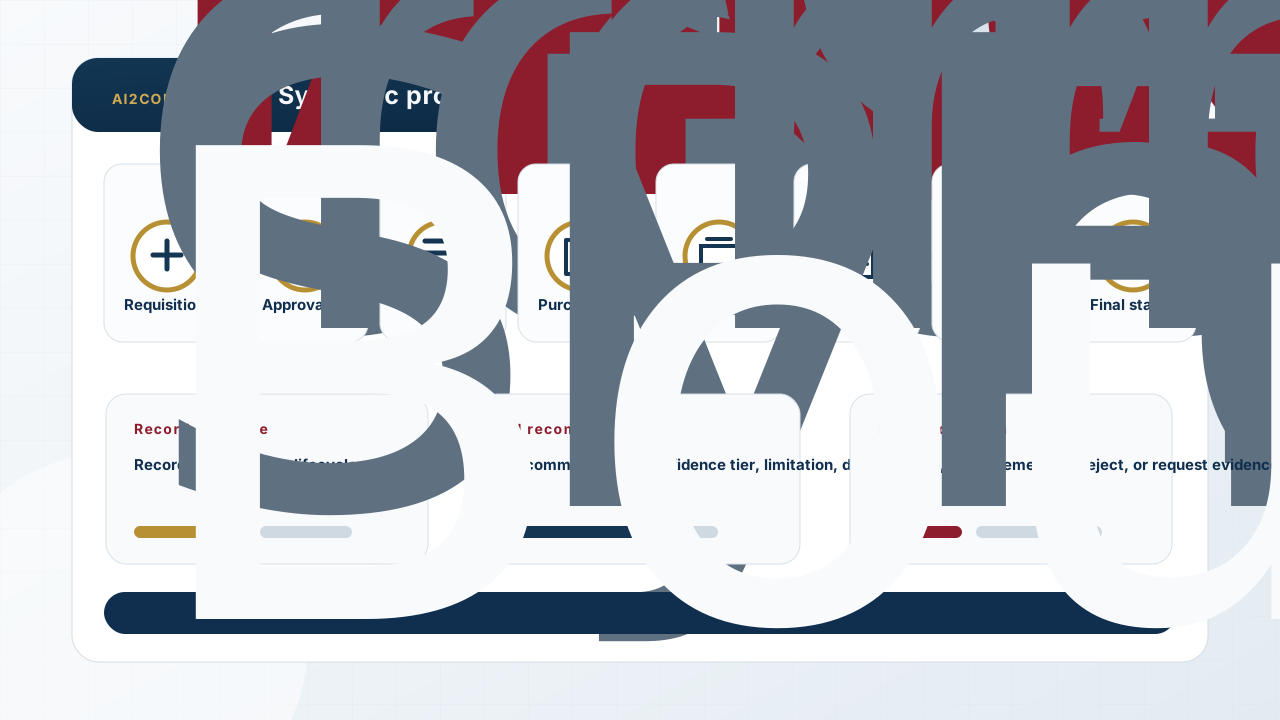
AI ERP product tour for synthetic procure-to-pay workflow review.

AI2COE AI ERP product tour shows a synthetic procure-to-pay workflow with source objects, governed recommendations, approvals, agent boundaries, audit evidence, and no-write-back controls.

SyntheticProcure-to-pay flow
ControlsHuman approvals
AuditEvidence trail
AI2COE AI ERP product tour visual showing source-to-pay records, approval states, AI recommendations, confidence, denied actions, human review, and audit trail.
The product tour makes the workflow tangible: synthetic records, approval state, AI recommendation, confidence, human review, and final audit metadata.
Short answer

AI2COE shows AI ERP through a synthetic workflow, not unsupported customer claims.

The AI2COE AI ERP product tour uses a synthetic procure-to-pay workflow to show how source records, evidence classes, confidence tiers, governed agent recommendations, denied actions, human approvals, and audit metadata fit together before production authority is considered.

Workflow shownProcure-to-pay with requisition, supplier, PO, receipt, invoice, inventory, approval, and audit context.
Agent boundaryRecommendations can be prepared for review; transaction execution requires approved authority.
Evidence boundarySynthetic tour, not benchmark data or customer outcome evidence.
Procure-to-pay walkthrough

What the AI ERP product tour demonstrates.

StageSynthetic recordFields, role, and statusAI recommendation and confidenceHuman action, audit, and result
Purchase requisition PR-2408-017 Need, site, material, requester, cost center, urgency; status: draft review. Recommend missing source records; confidence: Medium until supplier and stock context are present. Buyer submits to human approval queue; audit event: requisition-intake; result: review pending.
Approval routing APR-2408-017 Requester, threshold, budget owner, maintenance owner, procurement owner; status: approval review. Identify policy and ownership gaps; confidence: Derived from approval matrix. Owner approves, rejects, or requests evidence; audit event: approval-routed; result: owner assigned.
Purchase order draft PO-DRAFT-8841 Supplier, contract, price, lead time, material, work order; status: draft only. Compare supplier and contract context; confidence: Medium unless contract and stock records agree. PO release is denied in diagnostic mode; audit event: po-draft-reviewed; result: source-system action required.
Supplier confirmation SC-8841-A Promised date, quantity, price, supplier contact, delivery condition; status: confirmation review. Flag date, quantity, or price variance; confidence: Observed when confirmation record is present. Buyer reviews variance; audit event: supplier-confirmed; result: accept, defer, or escalate.
Goods receipt GR-55219 PO, material, quantity, bin, site, receiving date; status: received under review. Match receipt to PO and material identity; confidence: Observed for matching fields, Derived for identity-risk signals. Receiving owner reviews exceptions; audit event: goods-receipt-linked; result: receipt evidence attached.
Supplier invoice INV-77204 Supplier, invoice line, tax-adjacent fields, PO, receipt, terms; status: AP review. Prepare invoice-match summary and limitation note; confidence: Medium until AP owner reviews exceptions. Payment approval is denied in diagnostic mode; audit event: invoice-linked; result: match review pending.
Three-way match MATCH-8841 PO line, receipt line, invoice line, price, quantity, date; status: exception check. Classify exact match, partial match, or exception candidate; confidence: Observed where all source rows align. AP/procurement owner accepts or investigates; audit event: match-classified; result: exception queue or clear-to-review.
Exception handling EXC-8841-03 Emergency-buy signal, stocked-but-purchased flag, supplier alias, price variance; status: investigation. Recommend review path and exclusions; confidence: Estimated until source owners validate impact. Owner selects investigate, remediate, defer, or reject; audit event: exception-reviewed; result: action tracker item.
Payment approval boundary PAY-HOLD-8841 Invoice, match state, approval role, denied action, source-system owner; status: held outside AI2COE authority. Explain why payment cannot be approved from diagnostic evidence alone; confidence: High for boundary, not for payment decision. Finance acts only in system of record; audit event: payment-boundary-recorded; result: no AI2COE payment action.
Decision and audit record AUD-8841-FINAL Evidence class, confidence, limitation, owner, timestamp, final disposition; status: retained metadata. Summarize reviewed decision and next step; confidence follows approved owner action. Final result is approve, defer, remediate, reject, or request more evidence; audit event: decision-closed.
Evaluation steps

How enterprises review the tour.

Demo step

1. Choose the business process

Select finance, procurement, inventory, manufacturing, supply chain, maintenance, asset, material master, governance, quality, project, service, or agentic ERP.

Demo step

2. Identify source records

Name the ERP, EAM, CMMS, inventory, procurement, finance, work-order, asset, or service records needed for the decision.

Demo step

3. Review module evidence

Inspect source objects, missing fields, confidence tiers, limitations, and owner-review questions.

Demo step

4. See governed recommendations

Review advisory outputs without assuming source-system posting, approval, merge, release, or write-back authority.

Demo step

5. Decide the next step

Choose a controlled demo, source-fit diagnostic, readiness assessment, remediation first, or no-go decision.

AI ERP authority paths

Use the support page that matches the buyer question.

AI ERP path

Module coverage

All AI ERP module lenses and primary Industrial IQ support engines.

AI ERP path

Capability map

Workflow, source-object, owner, agent, evidence, and audit capabilities.

AI ERP path

Capability matrix

Native, integrated, diagnostic, governed-agent, and unsupported capabilities by module.

AI ERP path

Product demo

Demo path for module workflows, evidence outputs, and governed agents.

AI ERP path

Product tour

Synthetic procure-to-pay walkthrough with approvals, agent boundaries, and audit evidence.

AI ERP path

Procure-to-pay demo

Synthetic source-to-pay workflow from requisition through invoice match and audit trail.

AI ERP path

Product screens

Screen-state map for worklists, evidence panels, approval queues, audit trails, and report outputs.

AI ERP path

AI ERP pricing

Commercial-scope drivers for modules, users, source systems, integrations, countries, and agent authority.

AI ERP path

Module taxonomy

Classification of core ERP domains, adjacent capabilities, and unsupported-without-review areas.

AI ERP path

Implementation

Governed adoption path for module scoping, source-system review, pilot gates, and rollout.

AI ERP path

Integrations

Source export, read access, workflow handoff, and approved write-authority boundaries.

AI ERP path

AI ERP trust

No-write-back, human-review, source-file, agent-authority, and audit-control boundaries.

AI ERP path

Source systems

SAP, Oracle, Microsoft, Infor, IFS, Maximo, Epicor, Workday, EAM, and CMMS context.

AI ERP path

Industry use cases

AI ERP use-case routing across asset-intensive industry contexts.

FAQ

AI ERP evaluation questions.

Does AI2COE AI ERP cover all ERP modules?

AI2COE publishes a broad AI ERP module map across finance, procurement, inventory, manufacturing, supply chain, maintenance, asset management, material master, governance, quality, project, service, and agentic ERP. Each module remains bounded by source evidence, owner review, and approved authority.

Is AI2COE replacing SAP, Oracle, Microsoft, Infor, IFS, Maximo, Epicor, or Workday?

No. AI2COE AI ERP is an AI-native product layer and Industrial IQ is a diagnostic evidence layer around operational records. Incumbent ERP, EAM, CMMS, finance, procurement, and asset systems remain the systems of record unless a separate approved implementation changes that boundary.

Can AI2COE AI ERP write back to source systems?

Industrial IQ diagnostics are no-write-back. Transaction-changing AI ERP capability requires explicit source-system permission, product controls, security review, audit trail, and human approval.

How should an enterprise start evaluating AI ERP?

Start with a product demo or source-fit diagnostic that names the module, decision, records, owner, evidence class, confidence tier, limitation, and denied actions before any production authority is discussed.

Is this benchmark or customer outcome evidence?

No. These pages define product architecture, module coverage, source-system context, and diagnostic boundaries. Benchmark or customer outcome publication requires observed or approved data and separate review.